

The following is a list of vegetables you can plant in August in Sydney, a temperate zone. Just click on the link for the growing guide for each vegetable:
- Amaranth
- Artichokes in pots
- Beetroot
- Cabbage in seed trays
- Cape Gooseberry
- Capsicum in pots
- Chilli in pots
- Eggplant in seed trays
- Kohlrabi
- Leeks in seed trays
- Mustard Greens
- Onion
- Parsnip
- Peas
- Potato
- Radish
- Rocket
- Snow Peas
- Sunflower
- Tomato in pots
- Watermelon in pots
Plant of the Month – The delicate Clematis glycinoides – (headache plant)
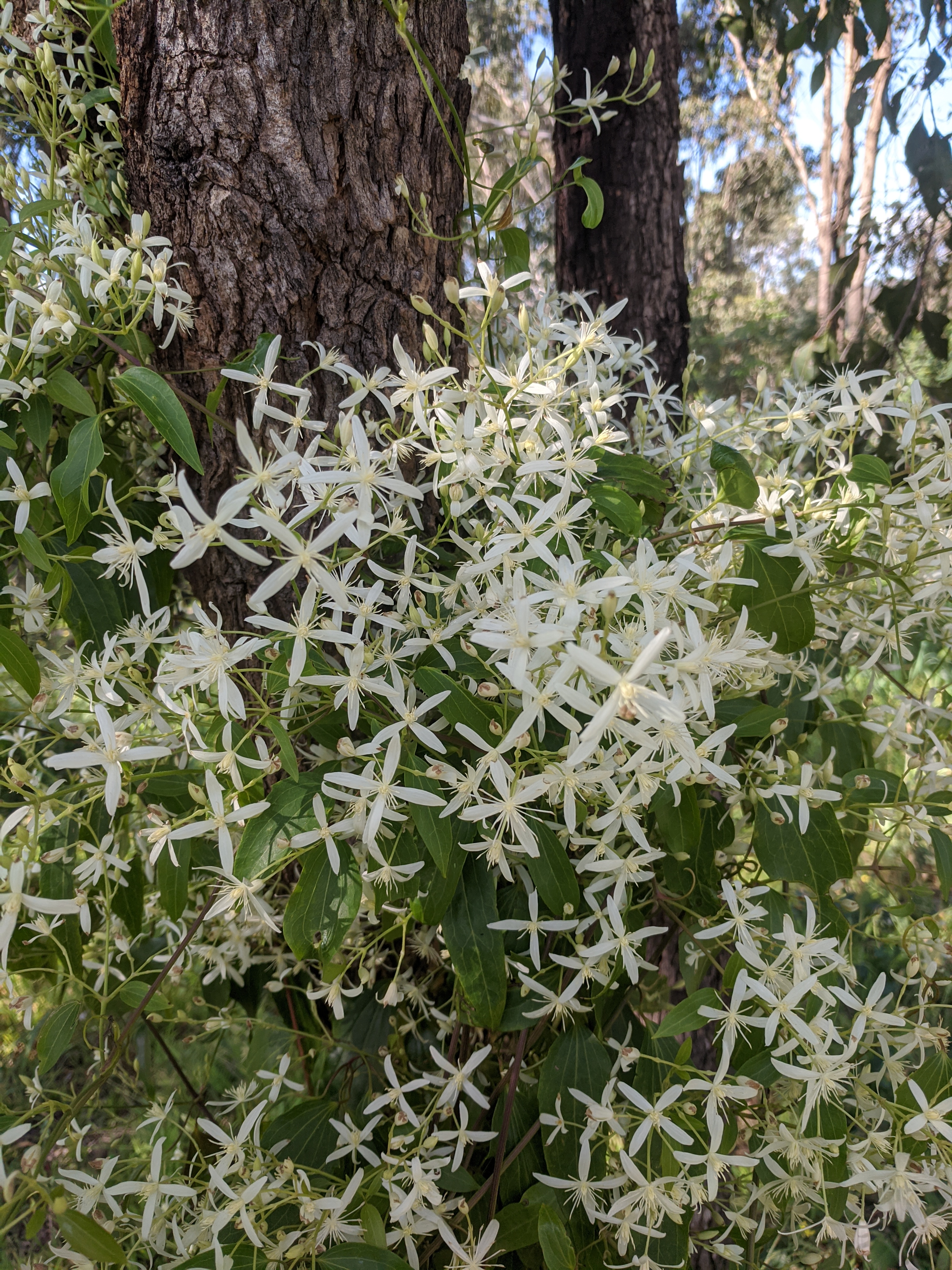
On a walk in bushland I came across this beautiful plant in full flower in August. Its flowers are stunningly beautiful with a delicate scent.
Clematis glycinoides is a woody stemmed climbing vine in the Ranunculaceae family with stems growing to 15m and forms dense ground and mid storey layers in a wide range of habitats, such as dry and wet sclerophyll woodlands, dry rainforest, and usually on heavier soils.
It grows in coastal areas of NSW, as well as the tablelands and the northern and central western slopes. It also grows on the Queensland coast to the far north and the eastern half of Victoria in the south. It is also found on Lord Howe Island.
It grows under grey myrtle, grey iron box, and manna gum species in open forests. The specimens I found were growing under iron bark trees in suburban bushland in NSW.

Interestingly, this plant is commonly known as the ‘headache plant’. This is because it is a supposed remedy for headaches. When its leaves are crushed, the the highly irritant ammonia like fumes are released and is inhaled, to relieve headaches.
This process was explained by herbalist Cheryll Williams:
The uncomfortable sensation of breathing in the ammonia-like fumes has been described as “the head ‘exploding’, the eyes ‘watering’ and intense irritation of the nasal passages” – such that the initial headache was quickly forgotten.
(Williams, Cheryll (2013), Medicinal Plants in Australia, vol. 4: An Antipodean Apothecary, Rosenberg Publishing, p. 110, ISBN 9781925078084)
Clematis glycinoides have separate male and female flowers which are sometimes on the same plant but often on separate plants (dioecious). In this case they were on separate plants.
Flowers have 4 sepals that look like petals and are 3 to 4 centimetres across that form a star or cross shape. They have no petals
The flowers of Clematis glycinoides are bright white or greenish-white and are in branched clusters. They cover the plants in profusion from late July to December with the greatest amount of flowers in September.
Below is an image of the female flowers that I found growing on a separate plant.

A close up of the female flower shows the different structure of the female flower with its whorl of staminodes, sterile stamens that do not produce pollen. See the image below.
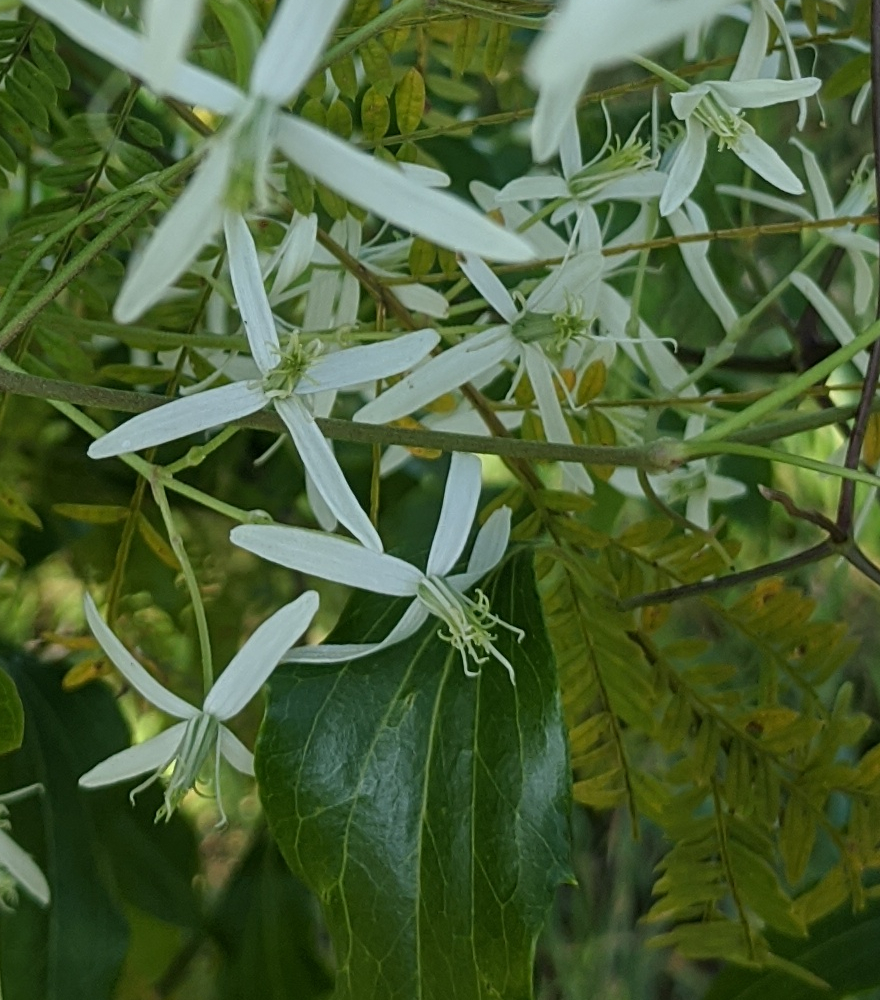
The more showy male flowers, on the image below, have many stamens that give them a star burst appearance.

Clematis glycinoides can have juvenile simple lanceolate (spear-shaped) to oblong leaves that are 1.5–12 cm long and 1–8 cm wide but the adult leaves are typically compound with three leaves as shown in the image below. They are 4-25 cm long and are shiny green.

The fruits of the Clematis glycinoides are achenes with a very thin coat and are gathered in fluffy heads as each achene has a plume-like attachment of hairs of several feathery ‘tails’ up to 6 centimetres (2.4 in) long.
You can see them at this link.
Propagation can be from seed or stem cuttings.
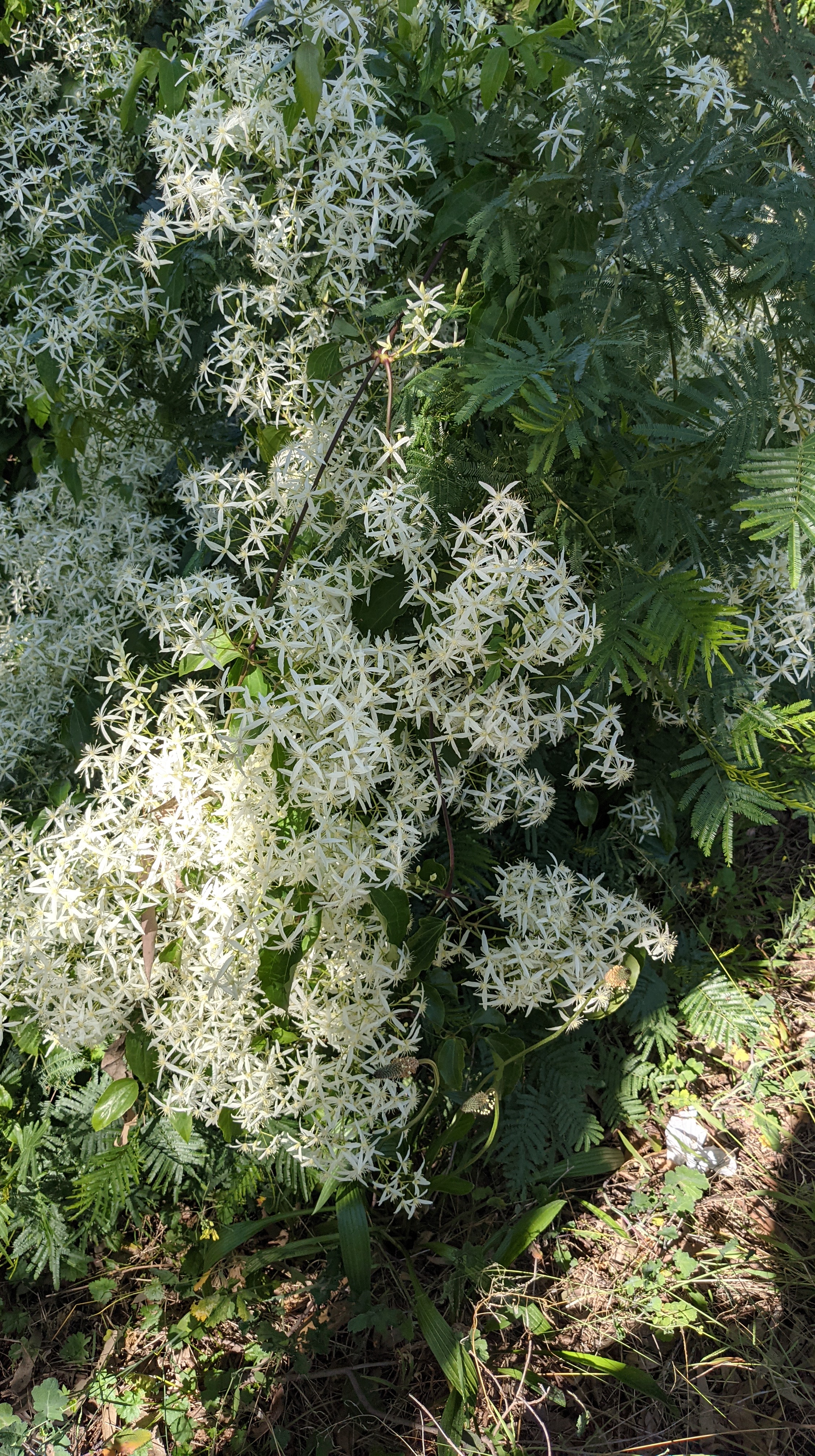
Below are more images. Click on all images on this post to get further close detail.



 The Grantham Gardener