
The following is a list of vegetables and herbs you can plant in November in Sydney, a temperate zone. Just click on the name for the growing guide for each vegetable or herb:
- Artichokes
- Asparagus crowns
- Basil seedlings
- Beans (bush and climbing)
- Beetroot
- Borage
- Broccoli
- Cabbage
- Cape Gooseberry
- Capsicum
- Carrot
- Celery
- Chives
- Coriander
- Cucumber
- Eggplant
- Jerusalem Artichoke
- Lemon Balm
- Lettuce
- Luffa
- Marrow
- Okra
- Parsley
- Peanut
- Pumpkin
- Radish
- Rocket
- Rockmelon (cantaloupe) seedlings
- Sage
- Silverbeet
- Spring Onions
- Sunflowers
- Sweet Corn
- Tarragon
- Tomato
- Turnip
- Watermelon
- Yacon
- Zucchini
Plant of the Month- Arthropodium cirratum-(rengarenga or the New Zealand Rock Lily )

The beautiful Arthropodium cirrata known as rengarenga by the Maori in its native New Zealand, also known as the New Zealand rock lily, is an evergreen, herbaceous perennial in the Asparagaceae family.
It occurs naturally north of Greymouth and Kaikoura near the sea and, as the name suggests, usually on rocks. As such the rengarenga is perfect for well drained sites as a border, on the patio in pots and planters and in rockeries.
The plant has a clumping habit, growing to 60 cm tall and 60 cm wide. It grows from rhizomes. Roots and buds and new leaf clusters arise from the creeping prostrate stems growing from the rhizome.
Leaves are 30-60 cm long and 3-10 cm wide.
The leaf is simple form and undivided. The narrow strap-shaped leaves are arranged singly along the stem, attached in a clasping manner and are slightly arching which gives an attractive appearance all year round.
The leaf margin is smooth and the surface hairless. Click on the image below to see further detail.

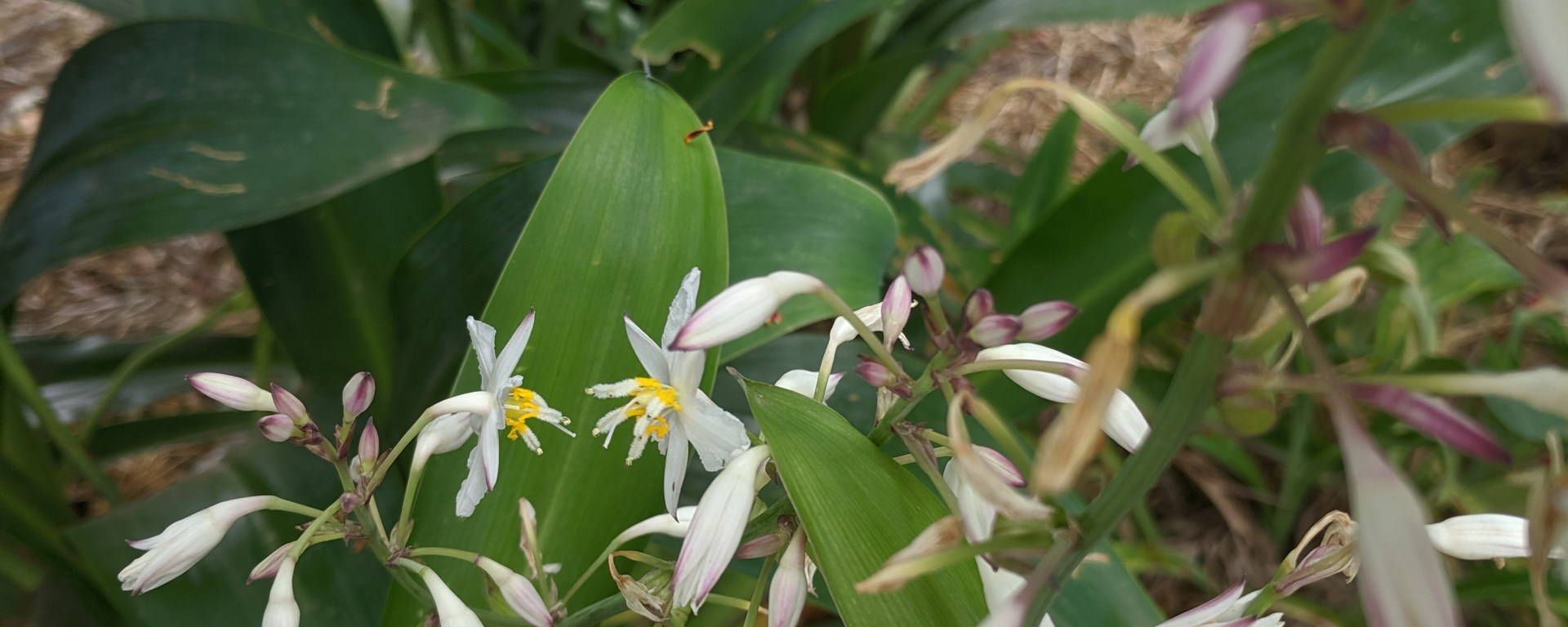
The flowers are borne on leafy bract inflorescences. Flowering peduncles (stem like structures) emerge from the centre of the plant’s long, bright green leaves. Loose panicles of delicate, pendant, star-shaped flowers, form and mature along the peduncle at the leafy bracts and are carried above the leaves .
The white flowers appear in late spring to early summer. Floral bracts open at nodes along the metre long flower stem. Lovely purple tinged buds open to reveal delicate white nodding flowers with prominent white and yellow fringed stamens that start out in a tricolour of purple, white and yellow.
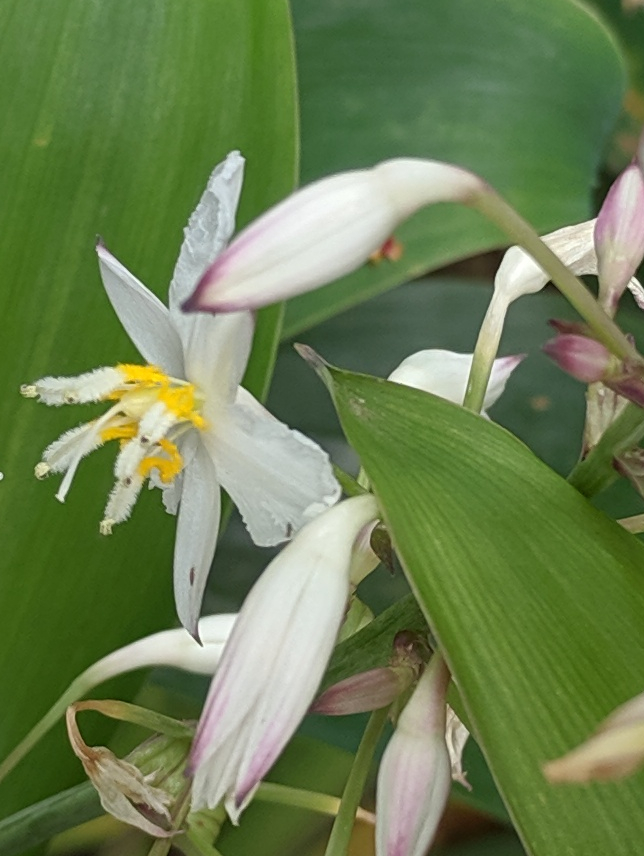

As the bud opens three sepals covering it open, then the three delicate petals open and reveal the ovary above the petals with its long style and the six filaments.
In the image above we can see the mature flowers, with their 3 white sepals (that covered the bud) and 3 delicate white, slightly frilled petals and 6 stamens. The upper portion of each stamen stalk (filament) is covered with fringed white hairs and bears two short curving tails with yellow hairs that are also fringed. These are the pollen bearing male structures of the flower.
The anthers at the end of the filaments start out as long and elongated and as the flower matures they curve tightly.
The flowers open along the panicle towards the top and the immature purple tinged buds can be seen as they are yet to develop while below some of the flowers have matured and are fully open.
When the flower is fertilized the plant forms seed capsules that hold hard, black seeds that can be used for propagation.

Cultivation:
Site:
The rengarenga lily prefers a site with bright filtered sun to dappled shade. In cooler climates the plant can even be grown in full sun. It does well as the understorey to trees as the plants are susceptible to frost. It is a great plant for those difficult shady corners.
The rengarenga will tolerate very dry, exposed sites (not subject to frosts) and a variety of soil types but perform best in a fertile, well drained soil. Rengarenga lilies do not like wet conditions and will suffer from root rot if planted in boggy soils.
If in doubt raise the garden beds to provide good drainage.
Planting:
Prepare the site by digging it over well to a depth of 30 cm adding some aged compost and aged cow manure.
Dig the planting hole twice the width and and to the depth of the root ball of the plant.
Gently tease out the roots and position the plant, then backfill with soil, firming it down to eliminate any air pockets.
If planting en-masse, space the plants 50 cm apart to allow enough space for the plant to grow.
Water the new plants in well with a liquid seaweed solution and mulch around the plant keeping it away from the stem.
Check and water as required by your climatic conditions but avoiding flooding the soil and risking root rot.
The rengarenga lily provides good groundcover and as it is an perennial plant, it can thrive with minimal maintenance.
It will benefit from feeding twice per year, in early spring and autumn, with a complete plant food and liquid fertilizer to ensure healthy growth and strong root development.
As the clumps grow, the rengarenga lily can be divided to provide new plants for other areas of your garden. It can also be propagated by seeds that form after flowering
The beautiful rengarenga plant is attractive all year round, whether in leaf or in flower. The masses of white flowers with purple tinged buds against the bright green of the strappy leaves add interest to a border or a rockery through spring and summer. The thick clumps of arching leaves keep weeds at bay and make an attractive feature through the rest of the year.

Further Reading:
1. This site has some detailed pictures of the rengarenga lily rhizome, leaves, flowers and seeds:
https://www.nzpcn.org.nz/flora/species/arthropodium-cirratum/
2. This site has further details of how the Maori use the rengarenga lily as a food source and for medicinal, spiritual and other cultural purposes:
 The Grantham Gardener