
The following is a list of vegetables that you can plant in May in Sydney, a temperate zone (just click on the link for the growing guide for each vegetable):
- Beans – broad beans
- Brussels sprouts seedlings
- Cabbage seedlings
- Carrot
- Cauliflower seedlings
- Garlic
- Kale seedlings
- Kohlrabi
- Leeks seedlings
- Lettuce
- Mizuna
- Mustard greens
- Onion
- Pak Choy
- Parsley
- Peas
- Radish
- Rocket
- Shallots
- Silverbeet
- Snow Peas
- Spinach
- Strawberry
- Turnip
Plant of the Month – Orbea Variegata – ( Starfish or Carrion Cactus)

Having grown this lovely succulent for many years in pots, I have been lucky enough to see it in flower around this time of year on a number of occasions. It never fails to impress and amaze. I thought I would share with you some of the beauty of the captivating Orbea variegata, the Starfish cactus.
Orbea variegata was originally named Stapelia variegata by Linnaeus in 1753. It was transferred to the genus, Orbea, in 1812 by Haworth but despite this, it is still often known under its original name.
The Orbea variegata or starfish cactus plant, belongs to the large family of stem succulents, Apocynaceae. It is also known as the carrion plant because it gives off the odour of rotting meat thereby attracting flies who act as pollinators as they lay their eggs on the flowers. The smell is not however, as strong as that of some other species in the family.
It is native to the coastal belt of the Western Cape, South Africa. Orbea variegata grows on well drained rocky areas with gentle slopes, and sometimes in shelter under trees and bushes . It has been naturalised in many areas of Australia that have a semi-arid climate and sandy well drained soils and with a mean annual rainfall of 275 to 512 mm and mean maximum temperatures range from 30°C in January to 20°C in July. Orbea variegata needs partial shade from surrounding vegetation during summer and good drainage
The stems of the Orbea variegata can be up to 25 cm long, but because they sprawl across the ground, the plant is about 10 cm in height. When grown in pots the long stems drape down over the edges of the pot.
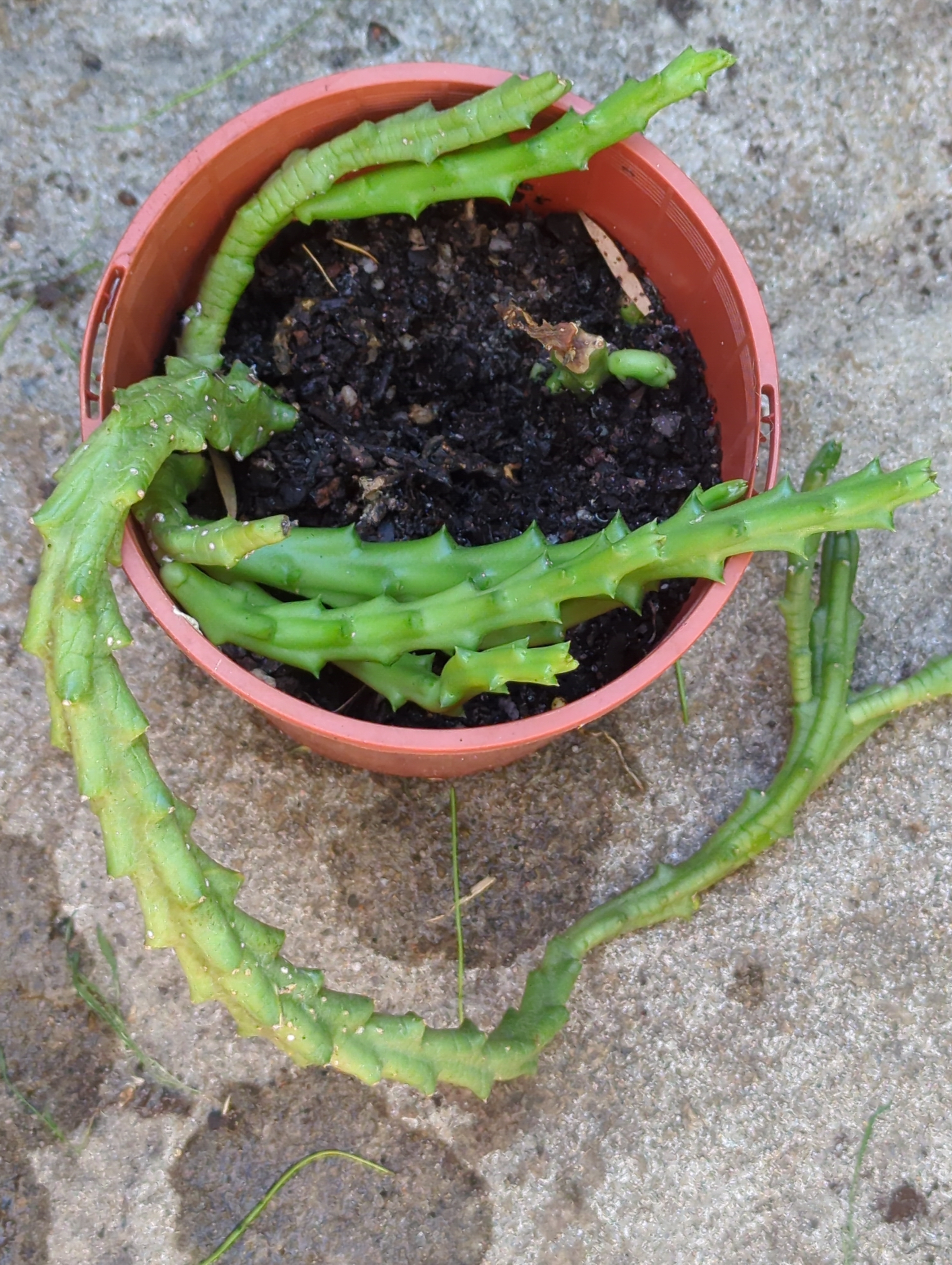
Stems are soft, smooth and green and may turn purple in sunshine. They are four sided and about 1-1.5 cm in diameter. The ridges between the sides have a series spine-like projections, or tubercles giving it a cactus like appearance

New stems mostly sprout at the base of the plant, while older stems may branch by dividing at the tip as can be seen in the image below.


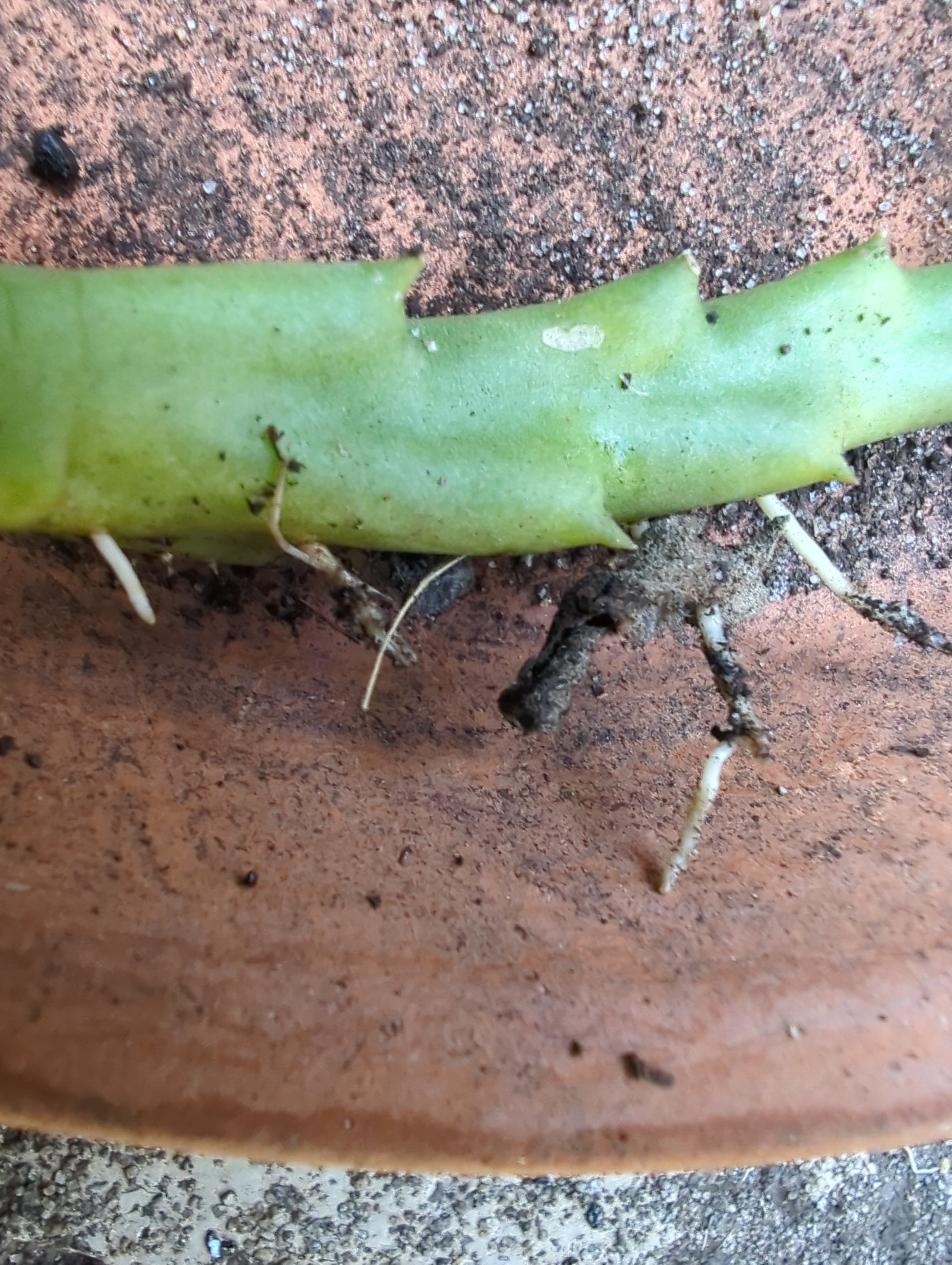
As the stems grow lying across the soil, the plant sends down roots which anchor it to the ground. See the roots emerging in the image below. In this way pieces of the stems can regenerate a plant if broken off.
It is an invasive species in southern Australia and the arid areas of Western Australia, of Western Australia, South Australia, New South Wales and Queensland. It has escaped cultivation and is naturalized in these areas where it is invading the chenopod shrublands and saltbush/bluebush vegetation communities.
So If you choose to grow Orbea variegata, take care to prevent stem pieces ending up as garden waste where it could end up in bushland and regenerate as a weed. Seed pods that develop should not be allowed to mature and disperse. If seeds are to be collected, enclose the long seed pods in bags.
As in all aspects of the gardening process, enjoying our plants comes with a responsibility to protect our vulnerable natural environment.
Orbea variegata flowers in late summer and autumn. The stunning star shaped flowers emerge near the base of a stem where they are held on a short stalk (peduncle) about 6cm long that arches outward. Up to three flowers can emerge from this point.
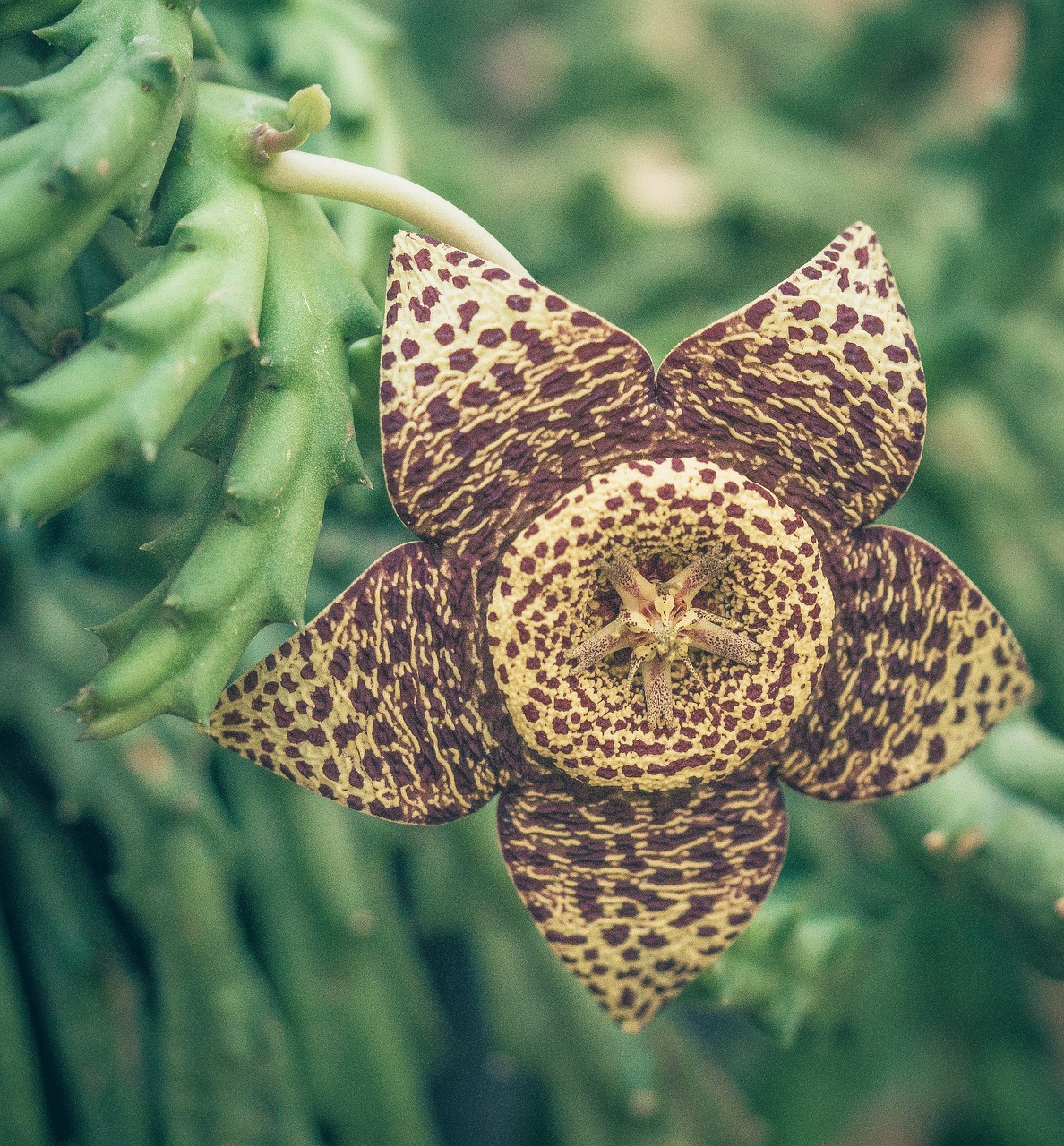
The Orbea variegata has a intricately decorated flower made up of layers of five-pointed stars.
Thee flowers are off-white or yellow flowers strongly speckled with maroon, up to 8 cm in diameter that may show regular or irregular banded markings.
They have five pointed or blunt lobes, 16-25 mm long, 12-21 mm wide at base and ovate
The large lobes surround a central thickened ring or annulus 18-23 mm in diameter This has finer maroon spots. It is shallowly bowl shaped with short bristles around the inner, reproductive part of the flower.

At the very centre is the star shaped carona 8 mm tall, 12-15 mm in diameter, raised above base of tube on a short cylindrical stalk 1 mm tall.
The 5 outer lobes are 4-6 mm long and 2 mm wide at base and oblong narrowing slightly towards 2-3 toothed apex They are a little thicker along centre than the sides. They are cream dotted with purple brown
The 5 inner lobes are 3-4 mm long, pressed to backs of anthers, ovate near base, then narrowing with club-like apex. The flattened dorsal horn is up to 3-4 mm long below the level of anthers, also cream dotted with purple-brown.

Click on the images of the flower above to view the amazing structure of the beautiful flower of the Orbea variegata in greater detail.
As it matures, Orbea variegata becomes a mat of many stems that can reach a diameter of 50 cm or more as seen in the image below. The buds and the flowers rest on the ground facing upward.
The image below shows the flowers and pentagonal shaped closed buds at various stages.

The seeds of the Orbea variegata are attached to a feathery stem that is carried on the wind. They are formed when the flowers are pollinated and develop into long horn-like seed pods that rise upwards. See the seed pods in the image below.

Cultivation and Care:
Soil:
Succulents prefer light, airy, well-drained succulent soil. Use a good quality Cactus and Succulent Potting Mix with perlite for extra drainage and that contains natural organic matter. Depending on the quality of the potting mix you can also amend it with extra perlite and a little sand. It should have a soil pH 7,5 to 8,5 (mildly alkaline).

Pot Selection:
Select a terracotta pot to allow the soil to dry out and prevent water-logging. It should be big enough to allow for some growth but not be too big, as crowding the plant encourages better flowering. It should be big enough to allow for some growth but not be too big, as crowding the plant encourages better flowering.
One way to achieve this is to put the plant in a small terracotta pot set into a wider bowl shaped pot. This is the best of both worlds and gives surface area for the plant’s prostrate habit to spill onto whilst restricting the shallow root system to encourage flowering. It also allows the flowers to lie flat on the soil surface as is their normal way of growing and can spill over the lip. Plant your Obea variegata and surround the plant with volcanic rock, pebbles or marble chips to prevent the surface of the soil drying out.
I have repotted some small stems that have developed roots.
Put a layer of pebbles in the bottom of the small pot to allow the water through efficiently. Then fill with Cactus and Succulent potting soil mixed with perlite and a little river sand
Fill a larger bowl pot with Cactus and Succulent potting soil and place a layer of pebbles over the top as a platform for the smaller pot that will hold the plant.

Plant a stem that has roots developed and place small pebbles around it.

I have placed a few small pieces with roots in the pot too.

By adding another pot and a few more succulents there is a micro-climate created by the plants growing together. The pot is located under the eaves, facing east and in location sheltered from drafts. The pebbles also radiate a little warmth to the plant and stop the soil from drying out. The benefit of growing the plants in individual small pots is that they can be removed indoors if required in extreme heat or cold winter days while the plant continues to grow into the pot undisturbed.
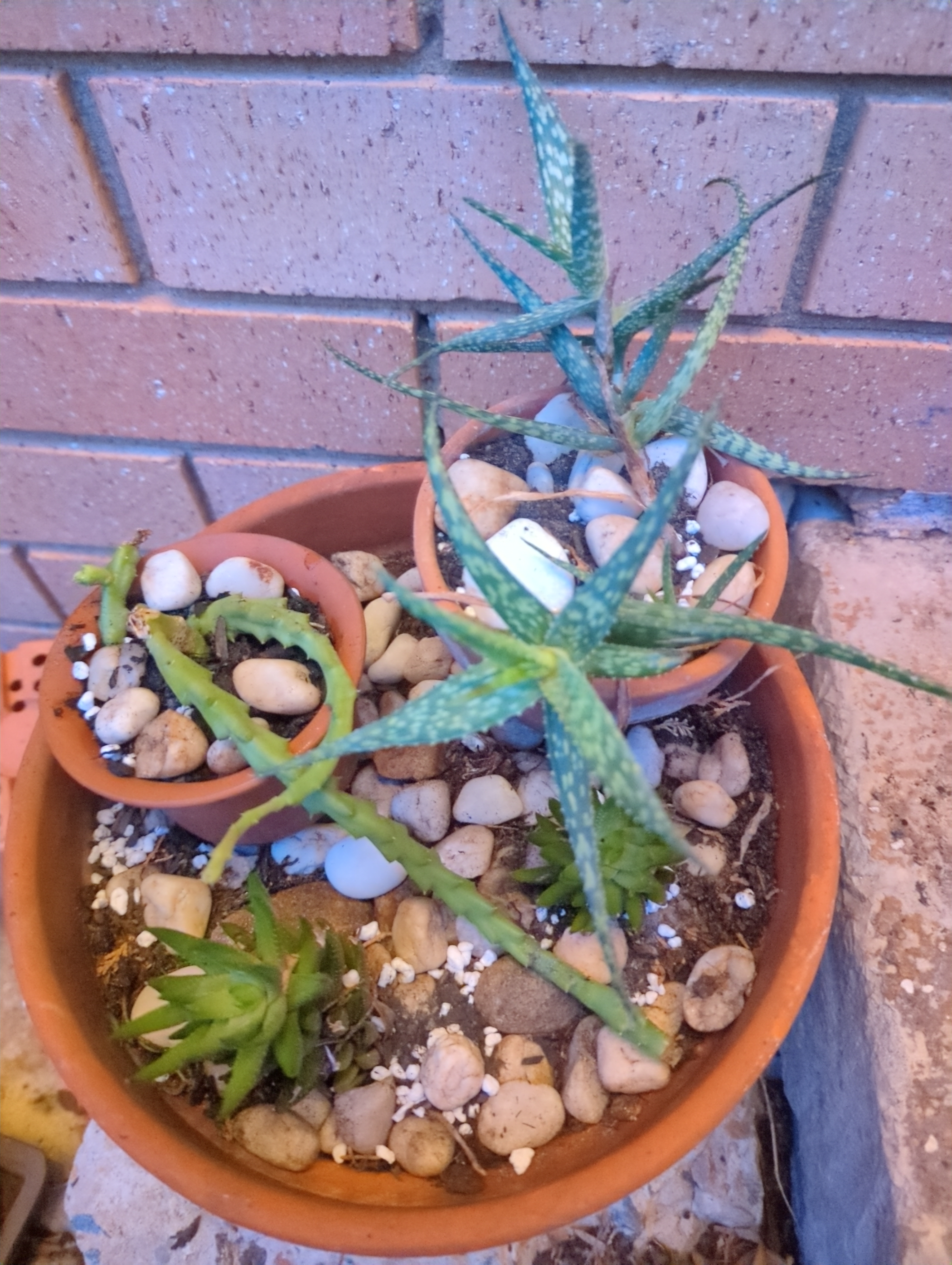
Do not use saucer under the pots to avoid the plant standing in water.
Site and Light:
Obea variegata needs bright, indirect sunlight with few hours of morning sun then protection from hot midday sun and afternoon shade.
My own plant is on a north facing covered verandah located against a warm wall and protected by other pot plants around it. This affords morning sun and protection from the heat of the day with shading in the afternoon. It always gets bright light at this location and so the conditions allowed flowers to form. Protection from the direct sun is important as it can be damaging to the stems and turns them red.
Temperature:
Obea variegata prefers a warm environment, with temperatures ranging between 21 to 29°C during the growing seasons of spring and summer. If grown outdoors the pot could be placed near a wall under eaves to benefit from radiant heat. It should be kept away from drafts .
Water: Wait for the soil to dry out completely between watering. When watering, soak the soil and then allow it to drain. Do not leave the plant sitting in water.
Opt to water sparingly at most times with very little during the winter. Drying out is preferred to water logging. Over the years growing this delightful succulent I have found it to be quite accepting of neglect and thriving on environmental moisture. If the plant has some cover from other plants It will happily survive during winter.
Repotting: Repot Orbea variegata every two to three years. In doing so, the soil is changed and gives the roots more space. It is also a a chance to address overcrowding by dividing the plant.
Feeding: These plants do not need fertilizer.
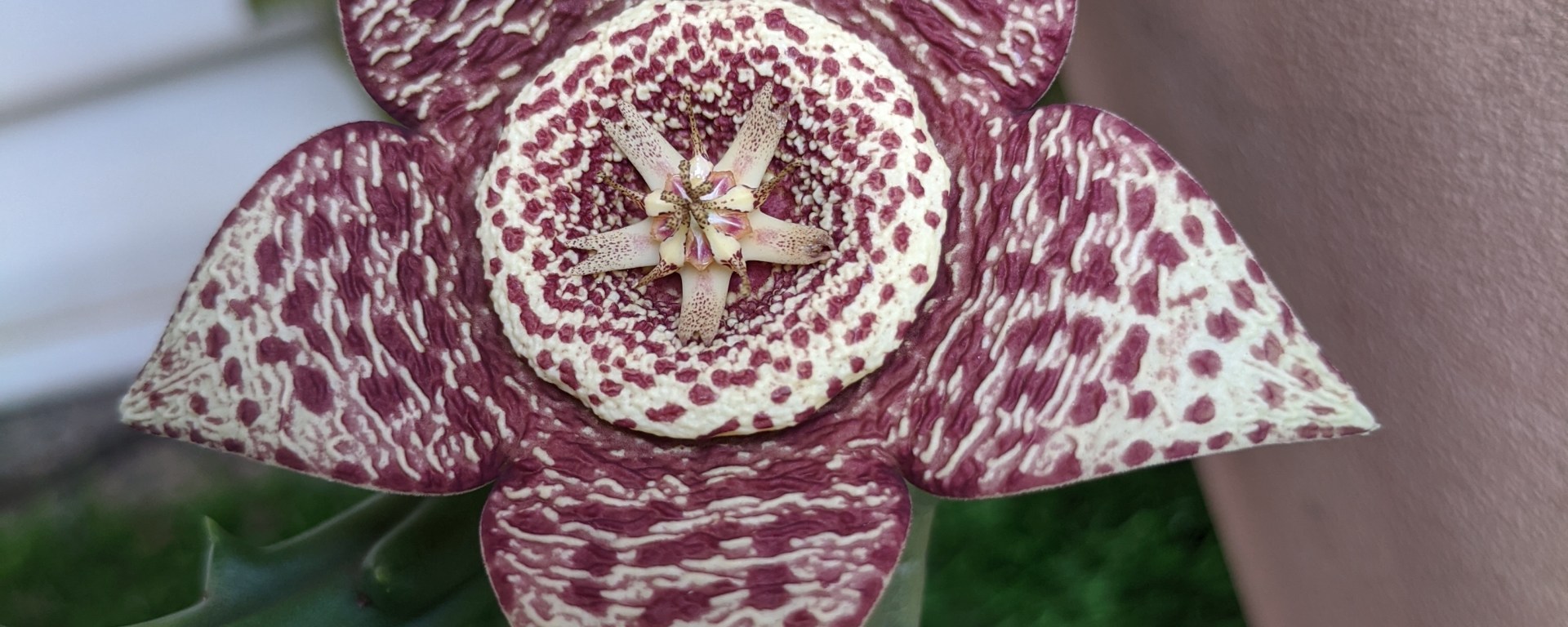
Orbea variegata is a low maintenance succulent that happily thrives and if the conditions of light and warmth are optimal, gives us a lovely surprise with its beautiful flower. The flower at the top of the post emerged in late April. Seed pods did not form. Remember to contain seeds and protect our fragile environment.

 The Grantham Gardener
