
The following is a list of vegetables you can plant in August in Sydney, a temperate zone. Just click on the link for the growing guide for each vegetable:
- Amaranth
- Artichokes in pots
- Beetroot
- Cabbage in seed trays
- Cape Gooseberry
- Capsicum in pots
- Chilli in pots
- Eggplant in seed trays
- Kohlrabi
- Leeks in seed trays
- Mustard Greens
- Onion
- Parsnip
- Peas
- Potato
- Radish
- Rocket
- Snow Peas
- Sunflower
- Tomato in pots
- Watermelon in pots
Plant of the Month – Crassula Ovata – (Jade plant)

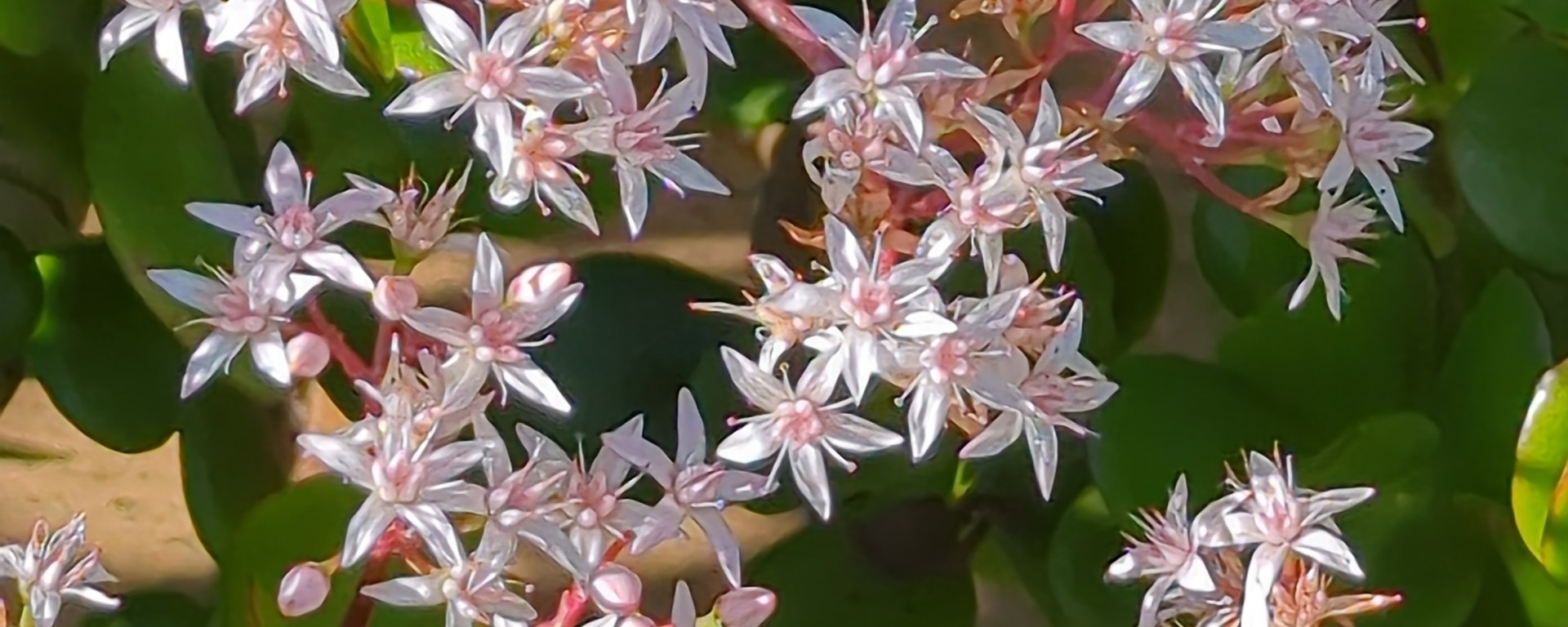
During the cloudy grey days of winter, the beautiful Crassula ovata, popularly known as the Jade or Lucky plant, sparkles with starry, pink tinged, white flowers borne in massed inflorescences that can cover the entire plant. they are so stunning that they cause you to stop and look at their delicate beauty.
(Click on any image on this post to see further detail.)
This beautiful, perennial succulent is a native of South Africa but has become a favourite across the world, grown in pots indoors or grown in tubs or in the ground outdoors in rockeries, retaining walls and gravel gardens.

Crassula ovata is an upright succulent shrub with rounded, thick-stemmed, strong branches. It can reach a height of up to 2.5 metres.
While its immature shoots are grey-green, the bark of older branches peels off in horizontal, brownish stripes. This makes them look woody. In fact they always remain fleshy at the core.

The leaves of the Crassula ovata are glossy, dark grey-green, oval and with a sharp edge that becomes a red margin when grown in full sun. They are are 3- 9 cm long and 1.8 – 4 cm wide and oval in shape and arranged in opposite pairs that are at right angles to each other along the branches. The fleshy leaves are borne on short stems that are 5 mm long.

When Crassula ovata matures, it produces small white or pink, star-like shaped flowers in winter. The shorter days, cold nights and lack of water for several weeks will induce flowering around the beginning of winter. To induce a potted plant to flower, gradually move it into a sunny or brightly lit position during summer and autumn.
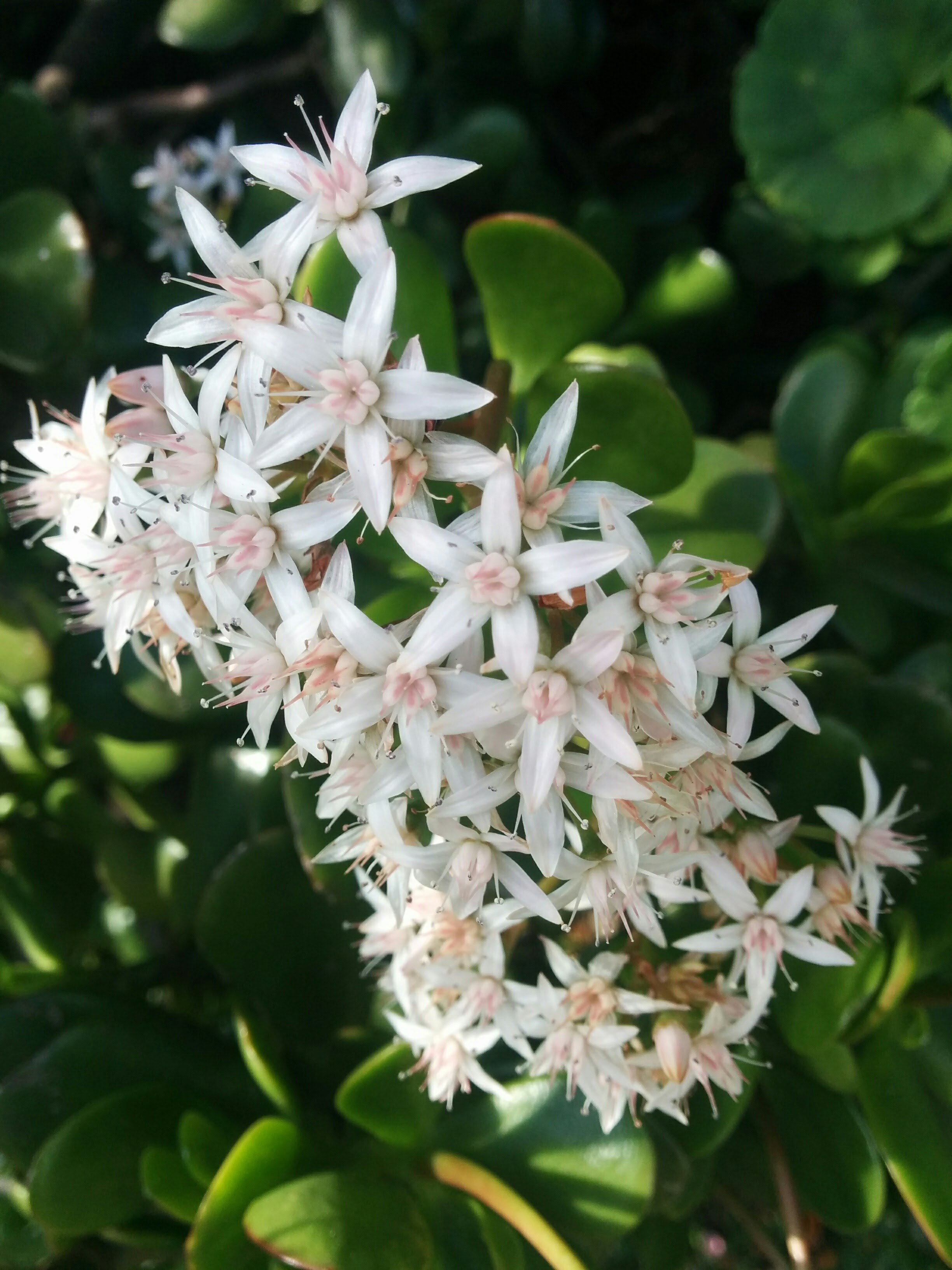
The terminal inflorescences are tight rounded clusters of flowers about 5 m in diameter.
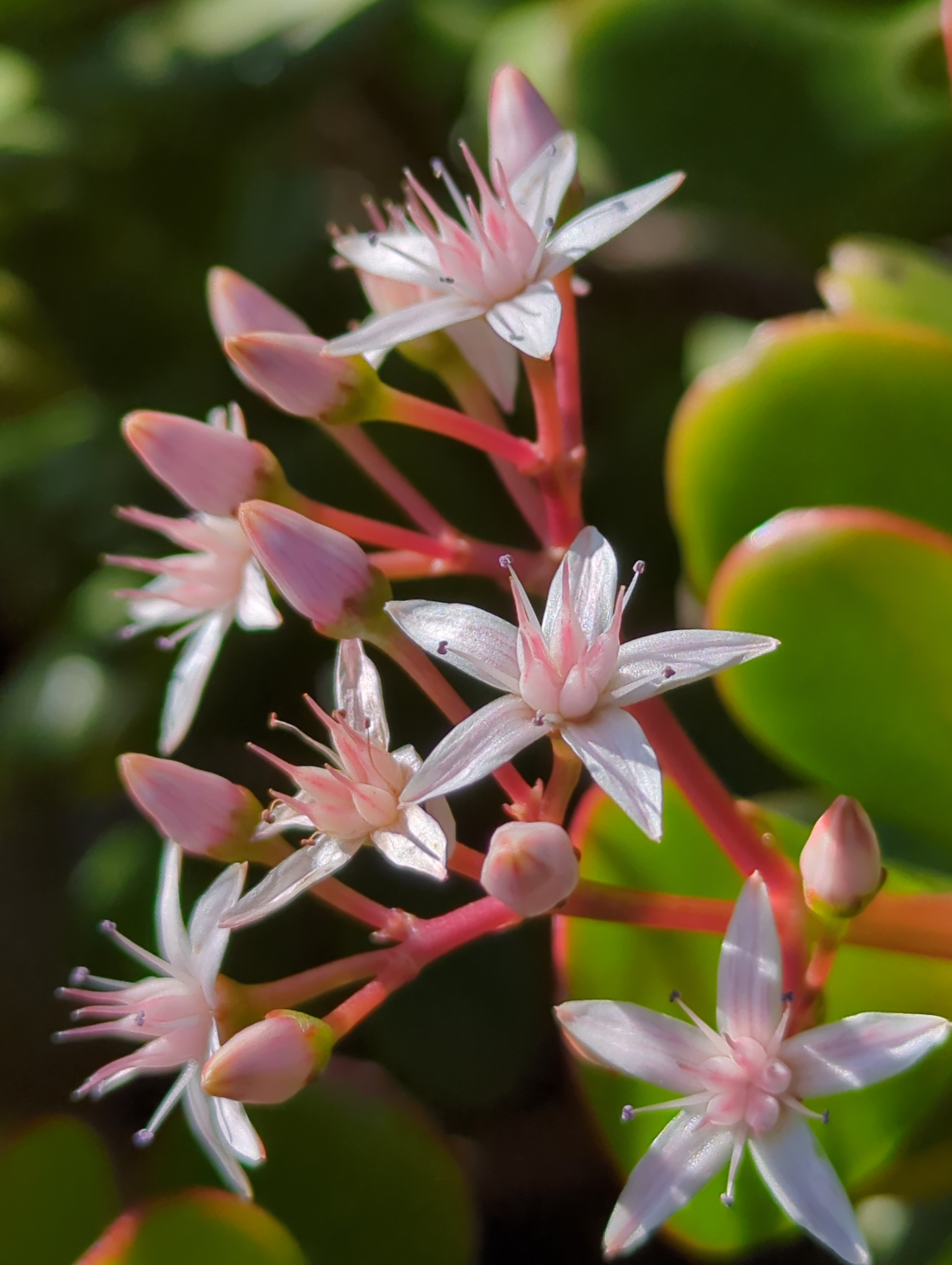
The inflorescence stem has a length of 1.5 to 1.8 cm and a diameter of 2 mm. The flower stalks are 5 mm long.

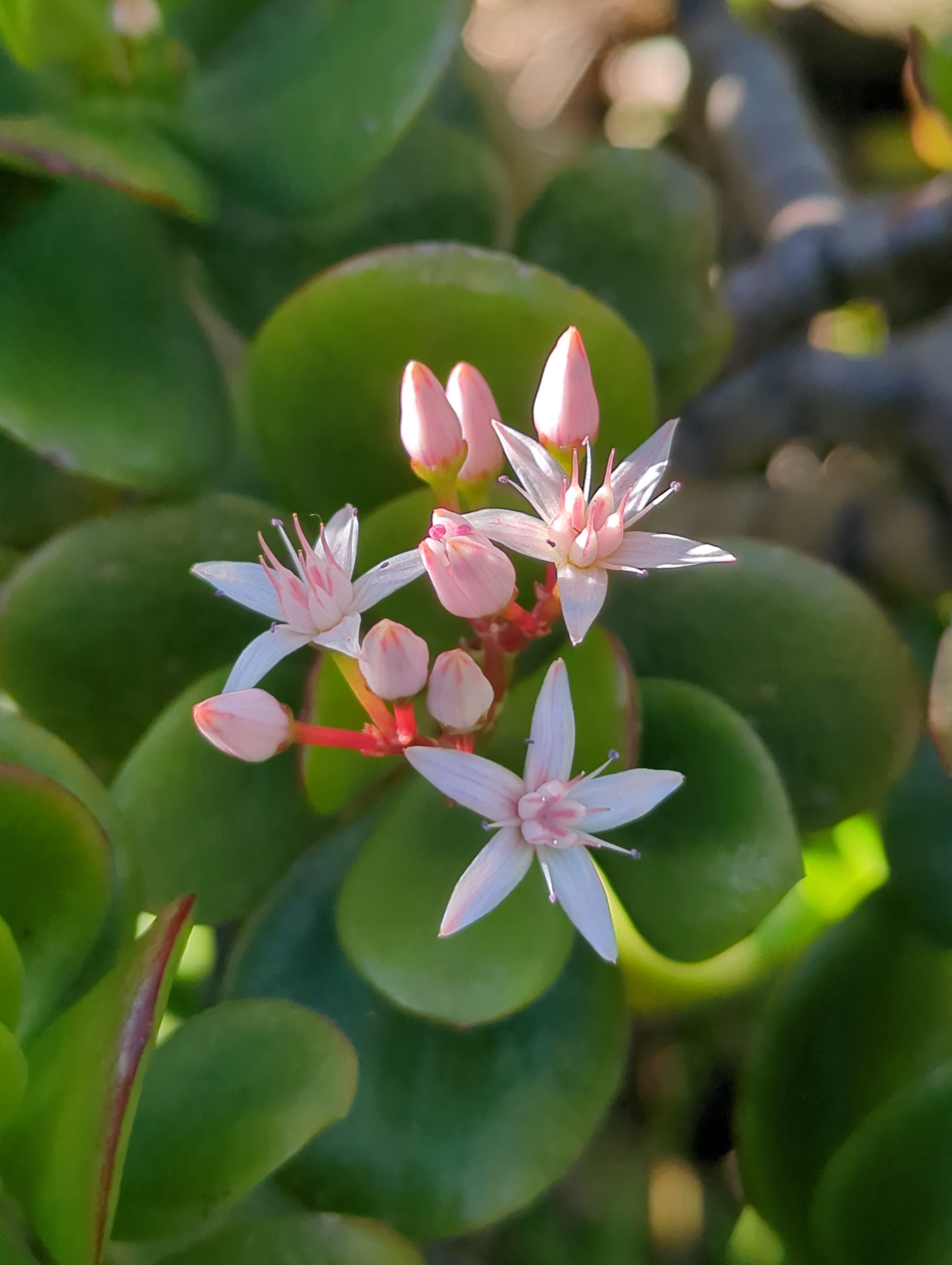
The flowers are sweetly scented and are hermaphroditic. They have five sepals, each about 2 mm long, are fused together at the base. The pink or white flower has a star-shaped corona of about 15 mm in diameter. Its lanceolate petals are 7 mm long and 2.5 mm wide. The five stamens are 5 mm long with their filaments and two lobed anthers.
The flowers attract bees, wasps, flies, beetles and butterflies.
The flowers develop into small capsules, which hold many fine dust-like seeds which are dispersed by the wind.
Cultivation:
Site:
Crassula ovata thrives in full sun or semi-shade, but will flower best in a sunny position and needs four to and needs six hours of direct sun or medium shade exposures with bright light per day.
If grown in the garden, select a site that will have morning sun and will be shaded in the hot hours of the afternoon. Placing the plant at the base of a tree will protect the plant from extreme heat.
Soil:
Crassula ovata is easy to grow in normal soil, but it must have good drainage.
If growing in pots, use a a quality Cactus and Succulent potting mix with some added Perlite to create a free draining medium.
Watering:
Crassula ovata requires little water in the summer and even less in the winter so water sparingly. It is susceptible to overwatering, especially during winter. Too much water can cause leaves to fall. However, a lack of water can also damage it. It should be grown in soil with good drainage or potting media, where the water can easily drain away. When grown in pots, it should never be allowed to stand in saucers of water but rather on pot risers to allow the water to drain away quickly.

Propagation:
Crassula ovata is very easy to propagate from a leaf or a cutting.
it is able to root from any piece of stem, even a single leaf and leaves that fall around the foot of the plant send down roots and grow into new plants.
In fact, entire parts of the plant can be easily reestablished in another part of the garden.
Take a stem or leaf cutting. Make sure to take the whole leaf including the base. Then set the cutting aside to dry for a day or more until the cut part has completely healed then pot into a free draining Cactus and Succulent potting mix with extra Perlite. Set the pot away from direct sunlight and allow to dry out between watering.
The cuttings will take from about 6-8 weeks to form new roots. The leaves will take longer.
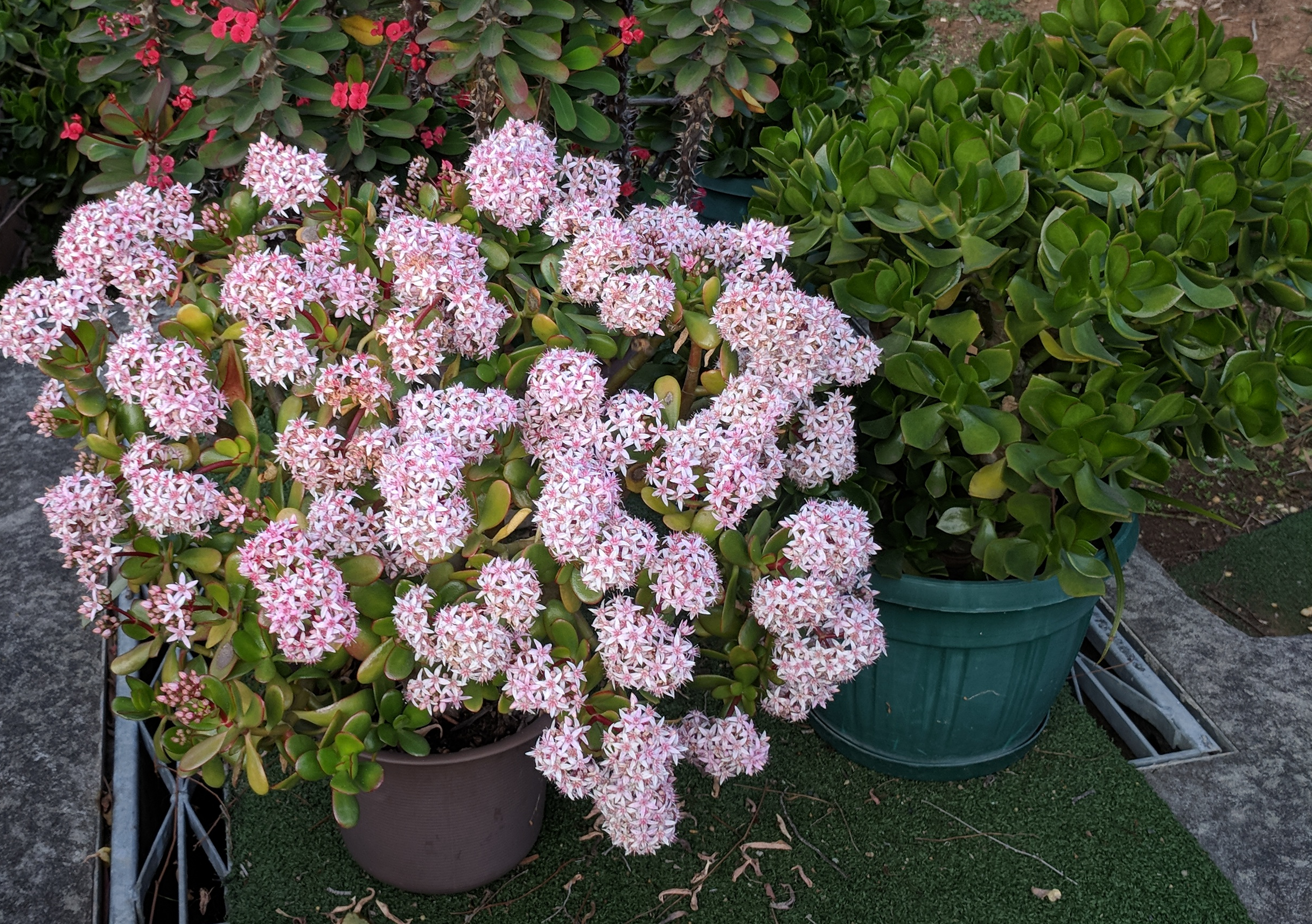
The beautiful, Crassula ovata is a wonderful structural plant that is so hardy and easy to care for in any situation. It is virtually indestructible and perfect for the water wise garden. The beauty of its leaves and the glorious flowers are so attractive all the year round.
In the ground, in pots or even as bonsai, Crassula ovata is the perfect plant for any home.
 The Grantham Gardener