

The following is a list of vegetables and herbs that you can plant in January in Sydney, a temperate zone. Just click on the name for the growing guide for each vegetable or herb:
- Amaranth
- Beans (dwarf and climbing)
- Beetroot
- Carrot
- Chives
- Cucumber
- Eggplant seedlings
- Kohlrabi
- Lettuce
- Marrow
- Mustard Greens
- Okra seedlings
- Parsley
- Radish
- Rosella
- Silverbeet
- Sunflower
- Sweet corn
- Turnip
- Zucchini
Plant of the Month – The graceful Hymenocallis – ( Spider lily)

For further detail just click on an image to enlarge.
The beautiful and fragrant Spider Lily belongs to the genus Hymenocallis that are perennial bulbous plants in the amaryllis family. They are native to the tropical and sub-tropical areas of Americas and have around 50 species. They thrive in moist, warm environments and have striking, delicate blooms with a delicate fragrance.
The name of the genus is derived from the Greek words ὑμήν (hymen), meaning “membrane”, and καλός (kalos), meaning “beautiful” and the flowers are truly beautiful!
The specimens I have, grown in pots on a north facing verandah, were given to me by Grantham gardener Deborah, and are Hymenocallis x festalis, commonly known as spider lily and also Peruvian daffodil due to the shape of the corolla cup.
It is a hybrid between Hymenocallis longipetala (as the pollen source) and Hymenocallis narcissiflora (as the female). Both species are native to Peru. It is a deciduous, perennial that looks like a spidery daffodil with extremely narrow perianth (petal-like) segments.
We have had the original bulbs for many years now and the plant has found its way to other pots of strappy plants that are in its environment. No doubt the seeds have spread naturally and I am quite pleased to find them when they surprise me by coming into flower.

The spider lily plants are clumping in habit, growing in dense clusters as off shoot bulbs develop over time. The plants take 2-5 years to mature but then will flower every year under the right environmental conditions. Each plant has a spread of 15-31 cm.
The bulb of the spider lily is pear-shaped with bright dry scales.and as they age, the bulb can reach a diameter of 12 cm. The larger the bulb the larger the flower produced..

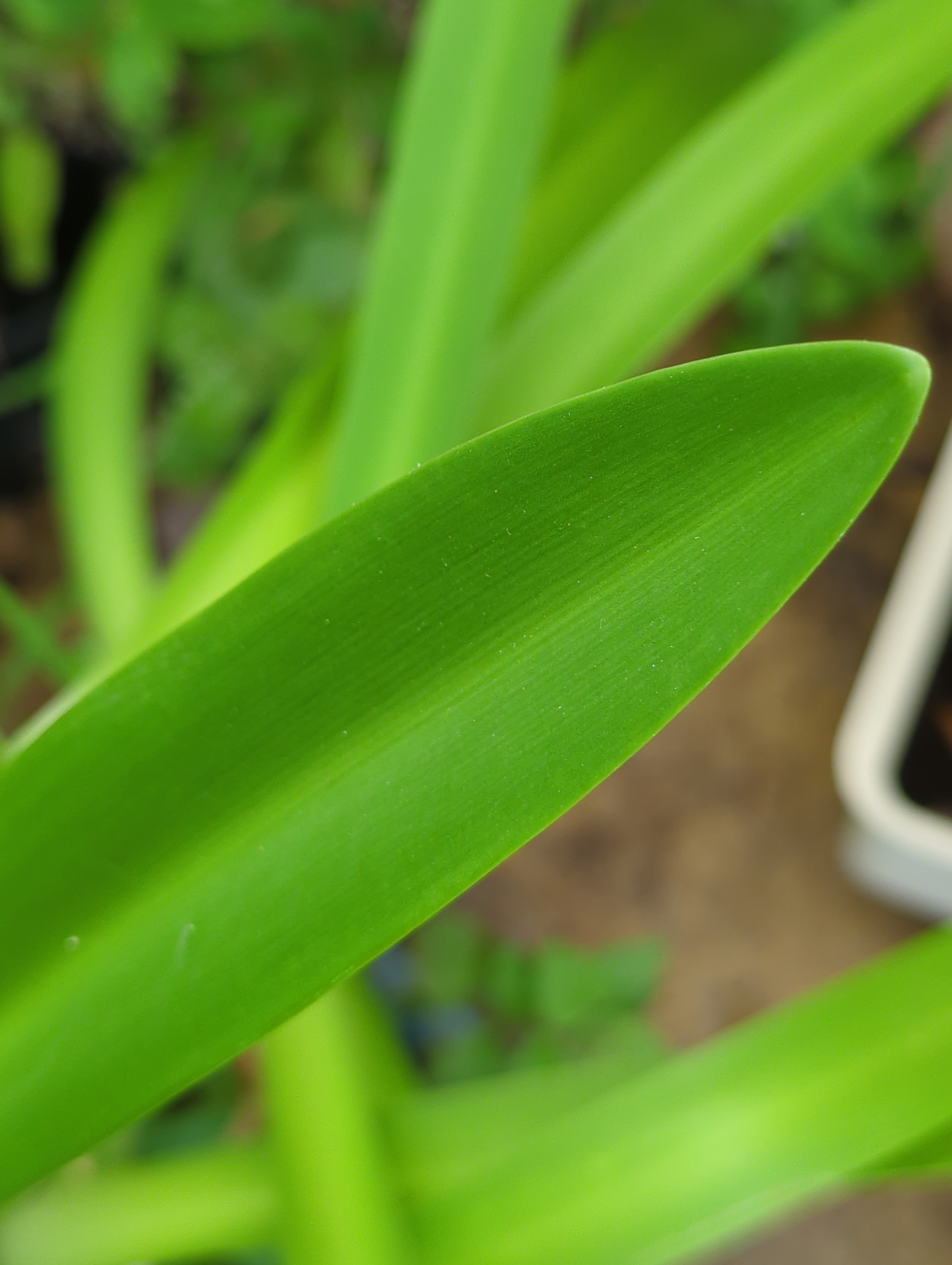
The foliage emerges first. The 3 cm wide linear leaves of the spider lily arise in ‘V’ shape from the onion-like bulbs in twos and are are erect or arching, bright green to bluish-green and strap shaped. They can grow from 45-65 cm in length. When the plant is not in flower the leaves are very attractive.
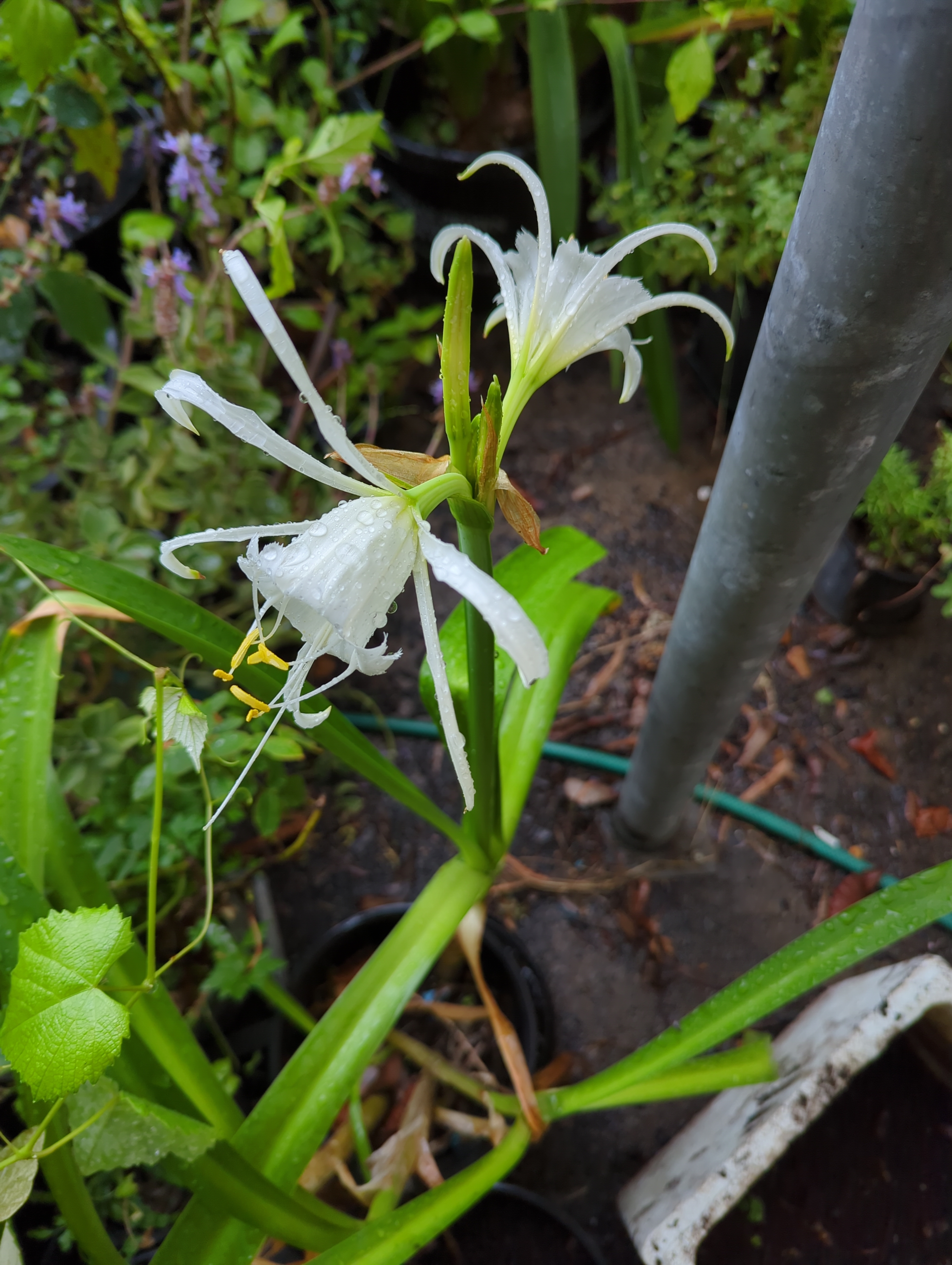
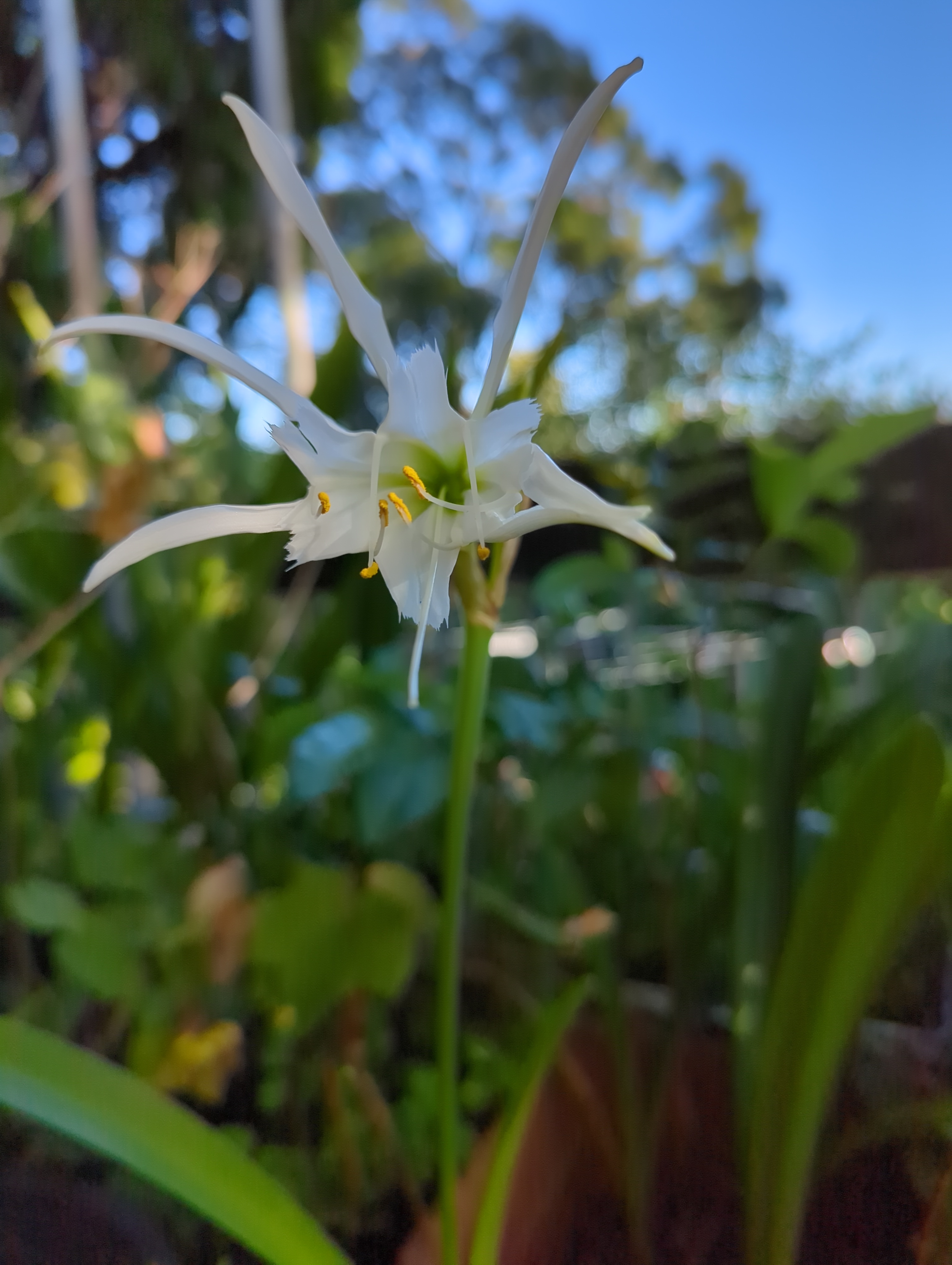
Each plant sends up a single, two-edged leafless stalk (scape) up to 60 cm tall, that is topped by an umbel of 2-5 fragrant, white, flowers up to 15 cm across. Each of these will open every 2-3 days

The elegant, showy flowers bloom mainly in the summer and are white and fragrant.
At the top of the scape and at the base of each flower is a green ovary with three chambers (locules), each containing one or more ovules (structures that become seeds).
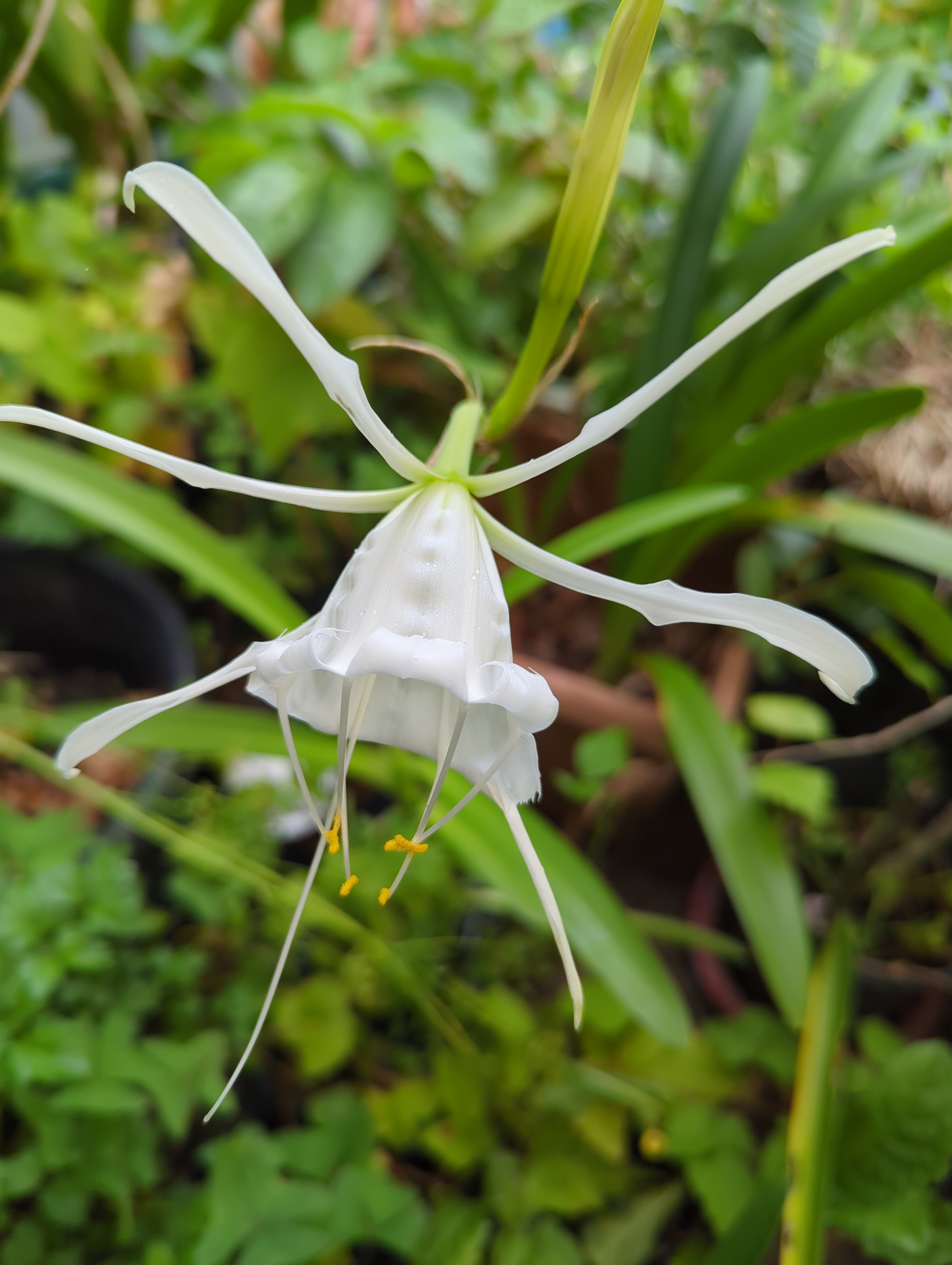
Above the green ovary, each flower is made up of six long narrow, outward-spreading-to-reflexed perianth segments( petals) that give the plant its spider-like appearance. Below these is a daffodil-like staminal central corona.
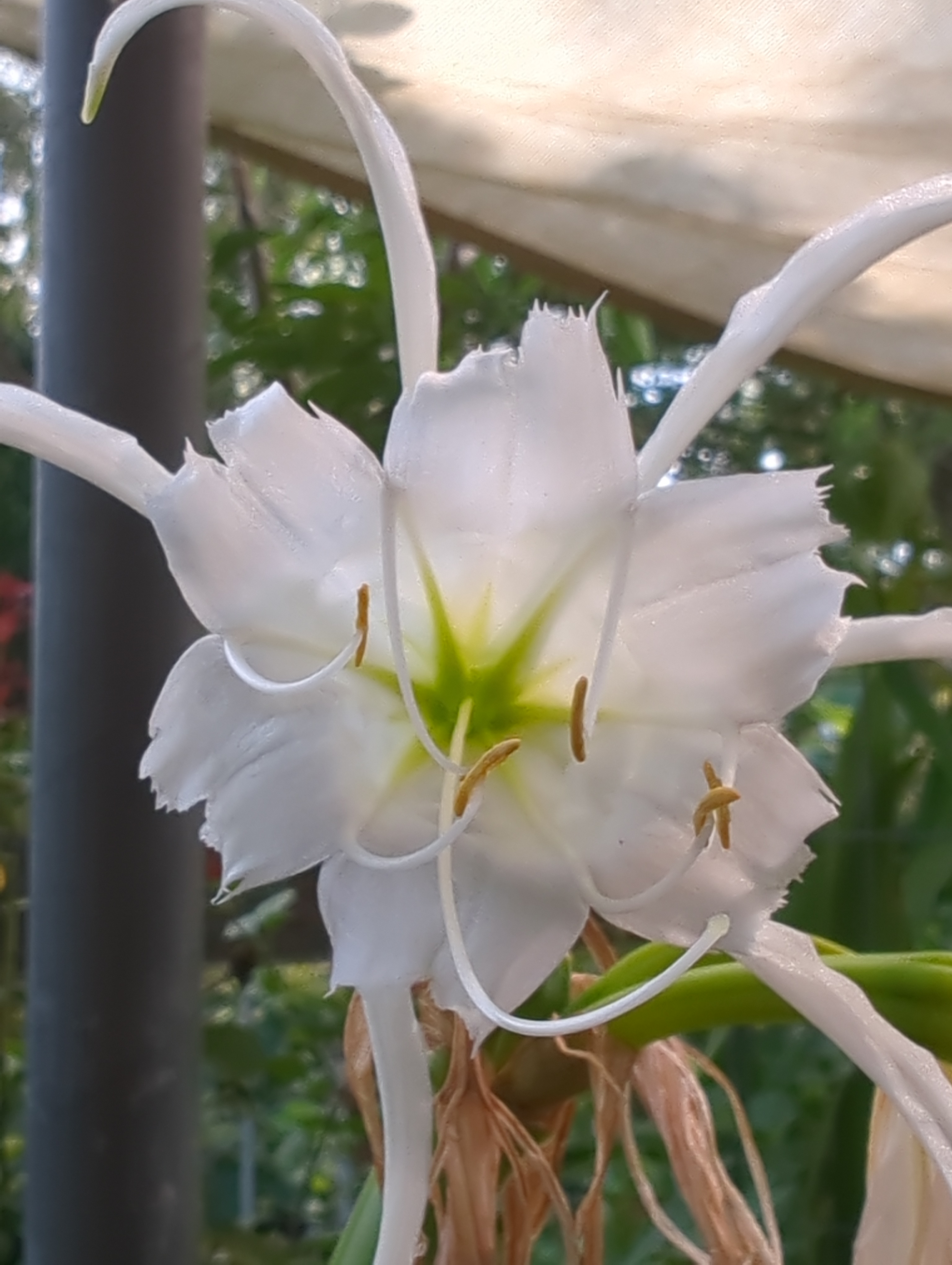
The delicate white membranous staminal cup that is about 5 cm long joins the bases of the six long, thin stamens that are fused to it and the six segments of the corona are frilled and retroflexed at the tips .The filaments are inward curving with bright orange anthers. The style arises from the ovary and the throat of the cup is tinged green.

Over the next two weeks each bud on the umbel opens, unfurling its snowy white flower that contrasts so well against the green foliage plants growing around it.

They stand out both for their delicate beauty and texture of the blooms. In addition, they emit a sweet fragrance, especially in the evenings.
When multiple plants are in flower it is a truly spectacular sight.
The spider lily enters a dormant period during winter, and it dies back to the ground. This dormancy allows the bulbs to conserve energy for the next growing season. labelling pots is really necessary to remember which ones are holding the dormant bulbs.
After winter, the bulbs will regrow and produce flowers in late spring to early summer, depending on the climate and growing conditions.
The Seed Collection.com.au
The image below was taken on a rainy day in Sydney and shows the strong scape holding the flowers. Notice how full the in curved anthers are. These are pollinated by bees and butterflies. Note also the frilly edges of the corona. This species hold the corona horizontally like a daffodil compared to other members of the genus that hold their coronas upwards.

The spider lily plants turn towards the brightest direction of light as can be seen with the plants below leaning towards the northern sunlight.

When the flowers are spent they die down and when completely dry can be removed at the base of the scape. Seeds will develop and these can be propagated though it is easier to divide bulb offsets. I still maintain that some of my plants are derived from seed.
The two images below show the fleshy green seed pod and the one below that the fully dried out seed pod.
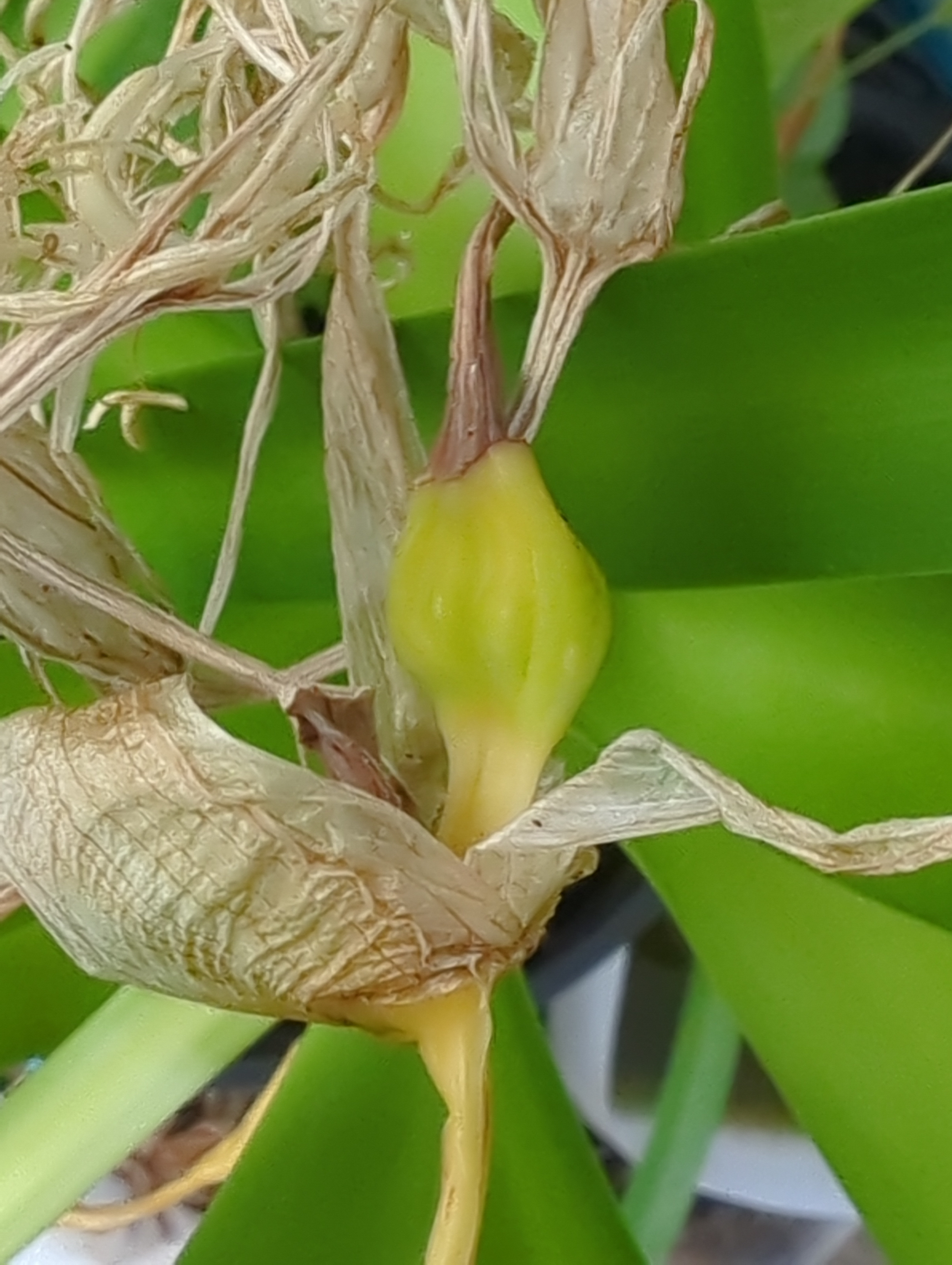
After some time the seed pods dry out completely and the as the scape dies down the seeds can be deposited in soil if in a garden bed or into another nearby pot thereby starting the long journey to a new plant. As mentioned before, this could take up to 5 years.

Cultivation:
Site and soil:
Spider lilies are hardy and vigorous in mild conditions. They can be planted directly into garden beds and borders or into pots using quality potting mix.
They thrive in moist, sunny locations in full sun or light shade in moist organically rich well drained soil.Select a site that is protected from strong winds. With Sydney’s extreme heat in summer, (today it was 38 C and extremely hot) I have found that drawing a light coloured shade cloth is all that is needed to protect the plants. Also, when grown in groups of pots a humid micro climate is created as the plants breathe.
Place a shallow dish under the pots and water as needed to keep the plants moist by ensuring the dish has some water in it. This is essential in summer but moisture levels need to be gauged in winter too, easing back but always checking the pot soil.
Preparing the Soil and Planting:
Dig over the planting site to a depth of 30 cm and enrich with well aged compost. To grow in pots, use a quality potting mix and mix in some Perlite to allow the water to drain well. Plants like to be kept evenly moist but not so wet as to be waterlogged. This could rot the bulbs.
Planting time for the spider lily is in early spring after the last frosts.
Plant bulbs to a depth of 12.5 cm with the tip of the bulb 2-7 cm below the soil and space 20 cm apart. For container grown bulbs, plant with the neck of the bulb just above the soil surface. A single bulb will grow well in a 12 cm pot.
Watering:
Unlike most bulbs, winter-wet conditions aren’t a problem with this species.
In Sydney we leave the bulbs in situ but if you live in an area that gets frost you may wish to lift them and store them is a cool, dry place in a medium like coir, while not letting the bulbs dehydrate. Thankfully, Sydney we only have issues of extreme heat in summer. The spider lily is so hardy that if moisture is taken care of the plant survives most climatic challenges.
Propagation:
Bulbs increase by offsets and should be divided every five years or so to keep the plants vigorous. Divide in late winter before new growth appears and replant or repot.
Last Words:
The genus Hymenocallis has so many beautiful cultivars that its work soing some research and finding if there are bulbs available in your area.
In Sydney, The Seed Collection.com.au does stock spider lily bulbs closer to planting time. Check out the site for these and many other seeds and bulbs. I recommend them highly.
All parts of the plant, including the bulb, leaves and flowers, are toxic to cats, dogs and humans so be careful especially if you have small children or grandchildren visiting your garden.
When these plants are in flower I can’t get enough photographs as they really are a favourite. Thanks Deborah!!!

 The Grantham Gardener