
We are now in spring and this is the first planting guide of the season. The following is a list of vegetables you can plant in September in Sydney, a temperate zone. Just click on the link for the growing guide for each vegetable or herb:
- Amaranth
- Artichokes
- Asparagus
- Basil
- Beans – climbing and bush
- Beetroot
- Broccoli
- Cabbage
- Cape Gooseberry
- Capsicum
- Carrot
- Celery
- Chicory
- Chillies
- Cucumber
- Eggplant
- Jerusalem Artichoke
- Leeks
- Lettuce
- Luffa
- Marrow
- Mustard Greens
- Parsnip
- Peas
- Potato
- Pumpkin
- Radish
- Rhubarb
- Rocket
- Rockmelon in seed trays
- Silverbeet
- Snow Peas
- Sunflower
- Sweet corn
- Tomato
- Turnip
- Zucchini
Plant of the Month: Dendrobium speciosum – ( Sydney Rock orchid )
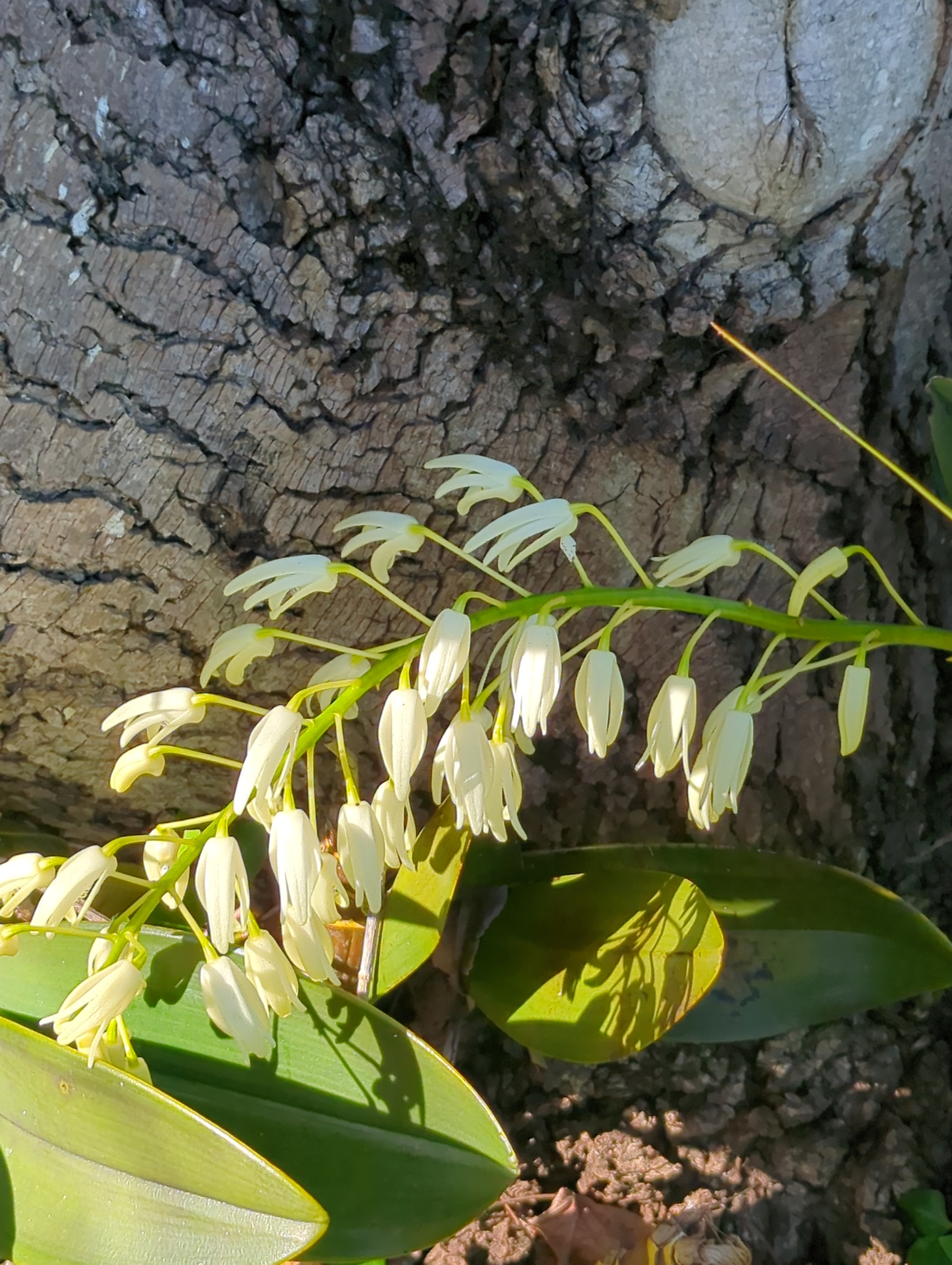
(For further detail just click on the images in this post.)
Dendrobium speciosum is a member of the family Orchidaceae in the Genus Dendrobium.
This stunning and easy to grow orchid is native to and grows all along the east coast of Australia from Victoria, through NSW to Queensland.
It can grow as an epiphyte on branches of trees in rainforests or as its common name, Rock Orchid suggests, as a lithophyte when it grows on rocks by means of a matted root system that anchors it firmly growing into large clumps that can spread out over cliffs and rocks. It can be found growing in favourable environments from sea level up to about 900 metres high.
Dendrobium speciosum grows from cylindrical or tapered pseudobulbs 50–1,800 mm long and 10–60 mm wide that anchor themselves by their thick roots to a rock or tree. Pseudobulbs are noded and covered with a sheathing bract. They can grow upright or spreading and are thickest near base and narrowing towards the top. These pseudobulbs store water and nutrients to help sustain the plant through dry periods.
Mature pseudobulbs are typically green or yellowish, turning woody and brown with age.
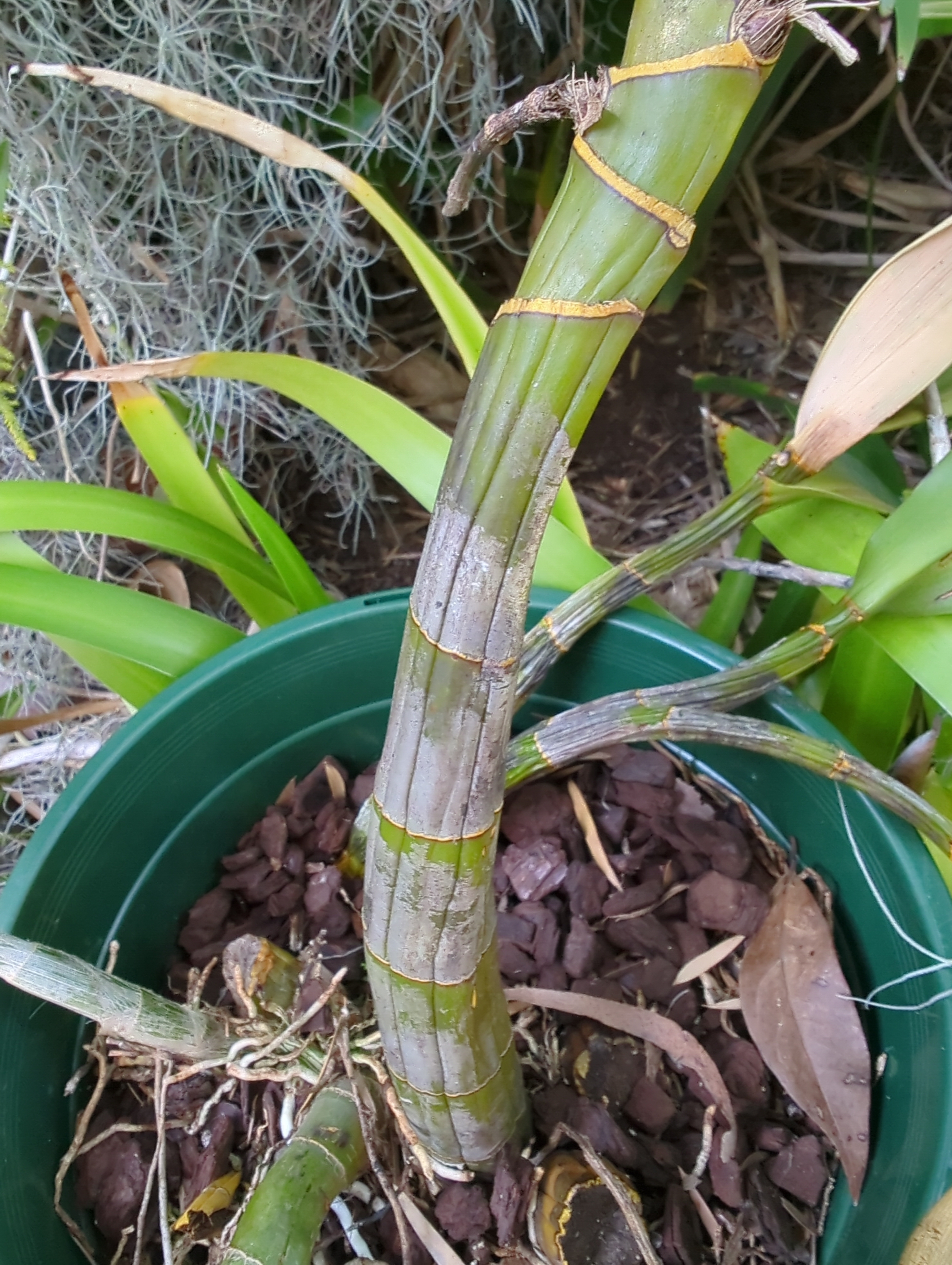
New growth emerges from the base of previous year’s pseudobulbs, with the plant forming large clumps over time.
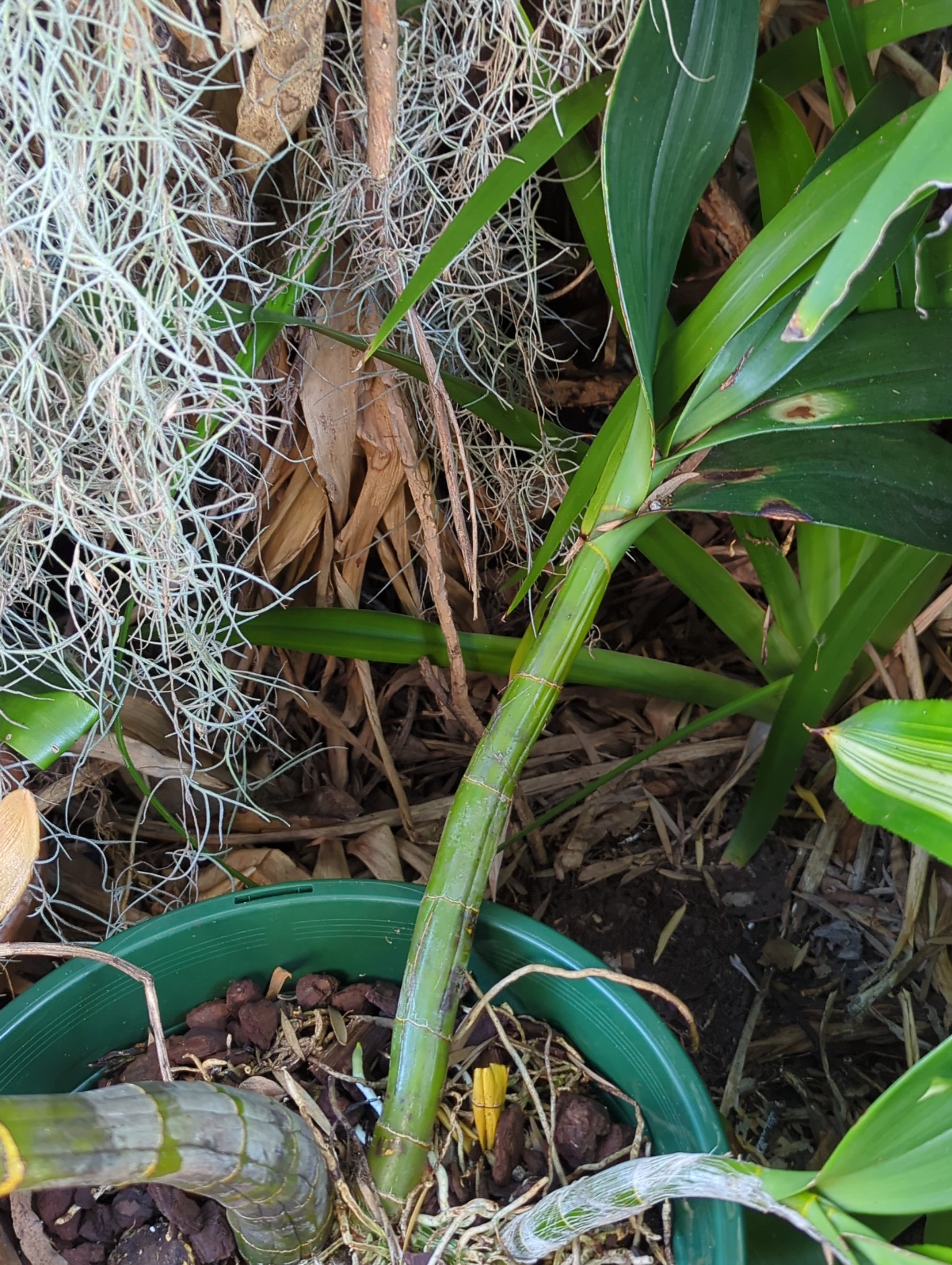
Each pseudobulb has 2-5 ovate or oblong, thick, leathery leaves with a rounded or blunt tip originating in pairs from its top. Theses leaves are 50–250 mm long and 10–80 mm wide and can remain on the plant for up to twelve years. The efflorescence emerges from a leaf axil or the end of the pseudobulb.
The flowers of the efflorescence are white or yellow and emerge along the length of the raceme. The length of a raceme can range from 50–800 mm long carrying from 2 – 200 hundred flowers. Each flower is borne on a sturdy pedicel that is as long as the flower itself. The buds emerge around the raceme along all its length and when mature this arrangement gives a bushy appearance.
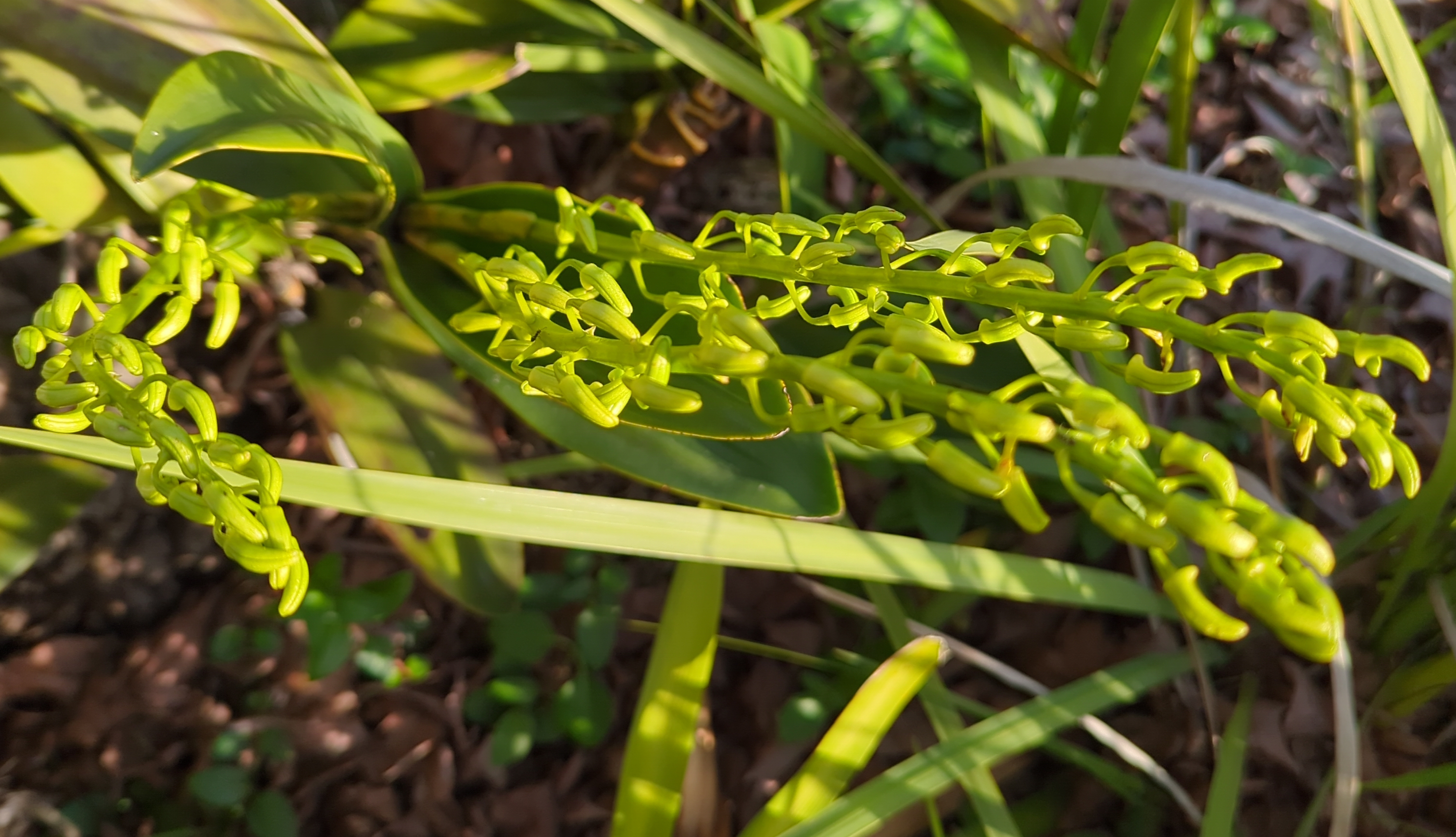
Dendrobium speciousum mostly flowers between August and October. From the emergence of the effloressence to bud development to flowers opening takes about a month.
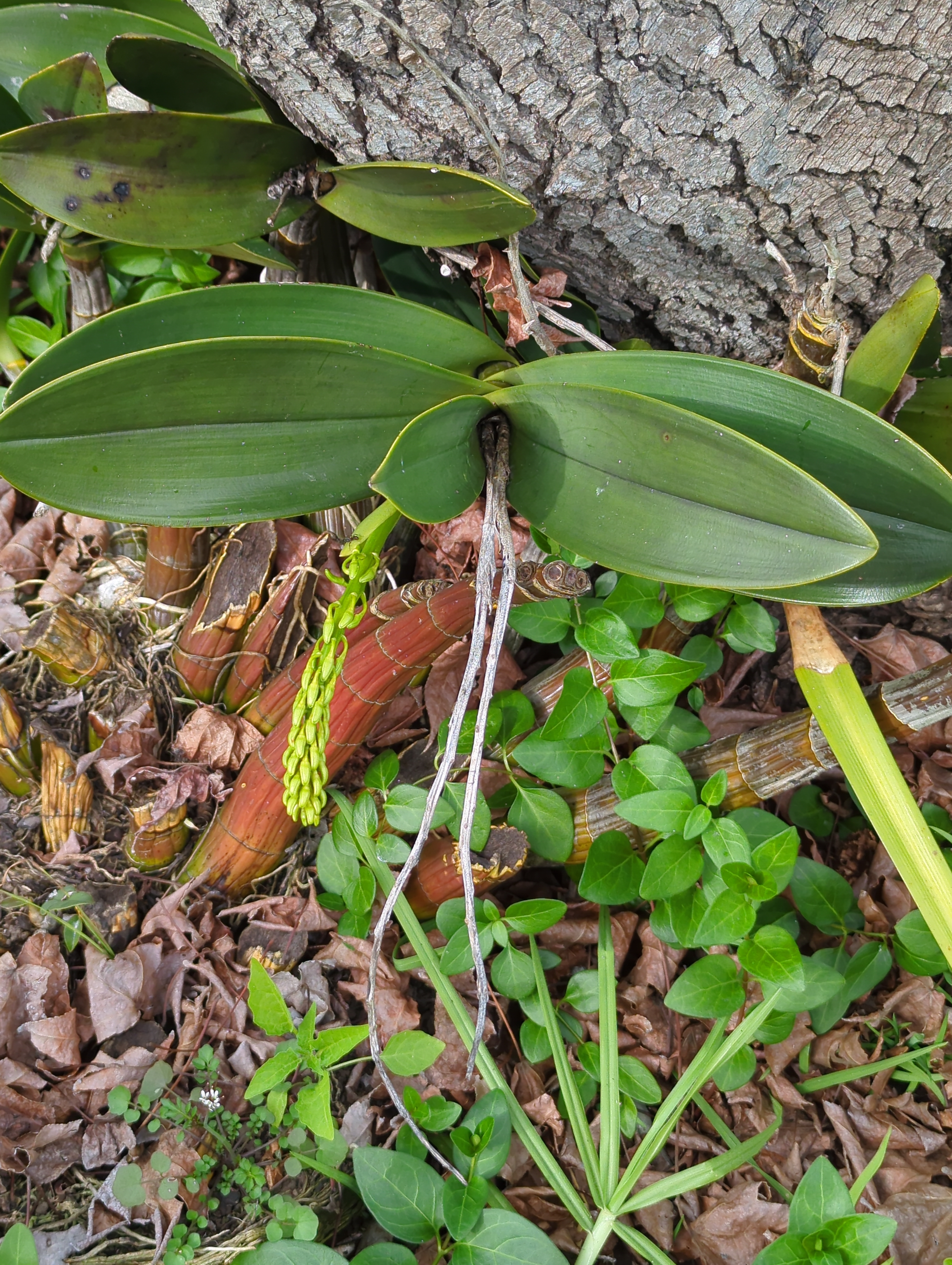
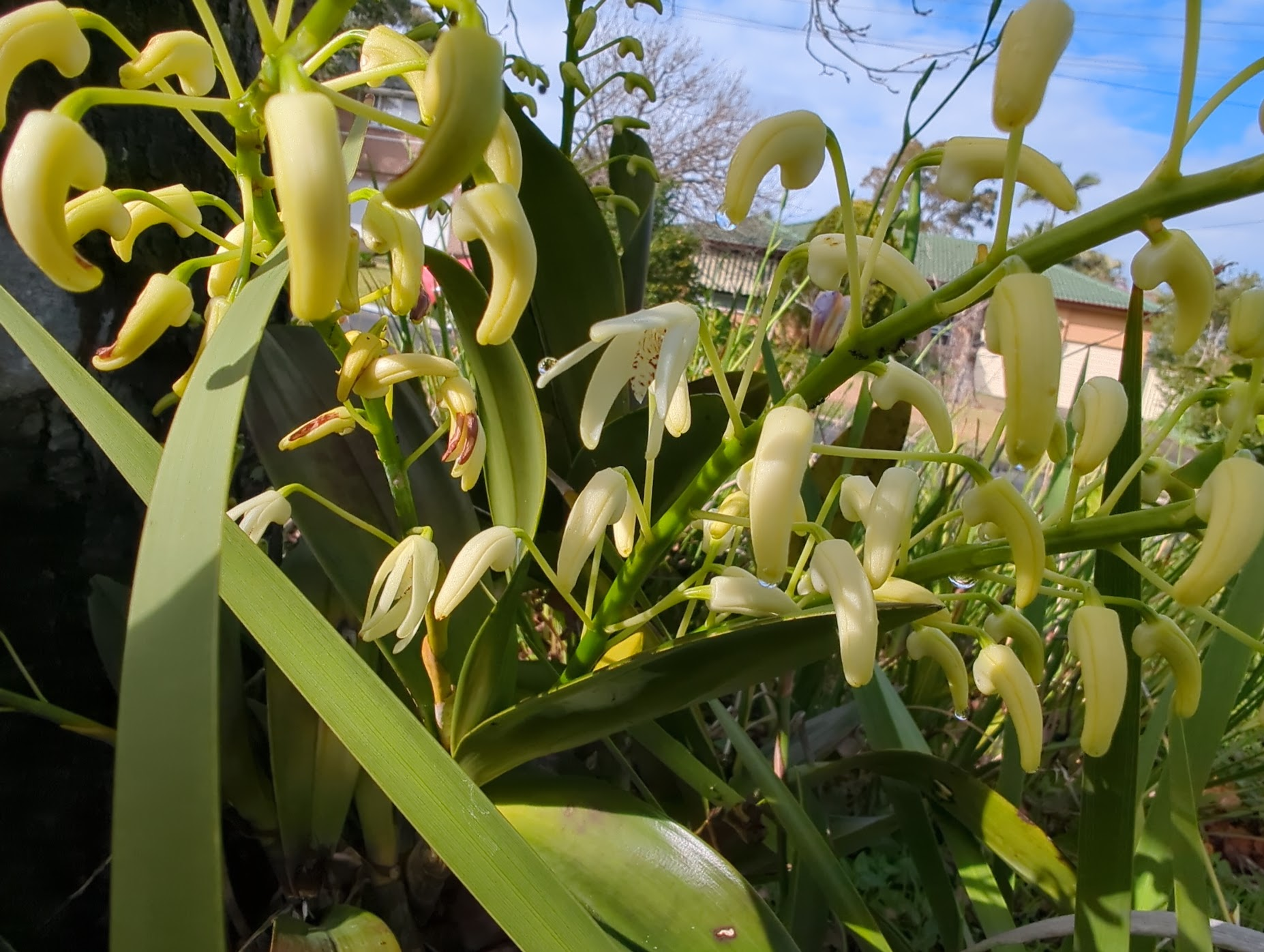
The image above was taken in early August, and the ones below with the flowers fully open were taken at the end of August.
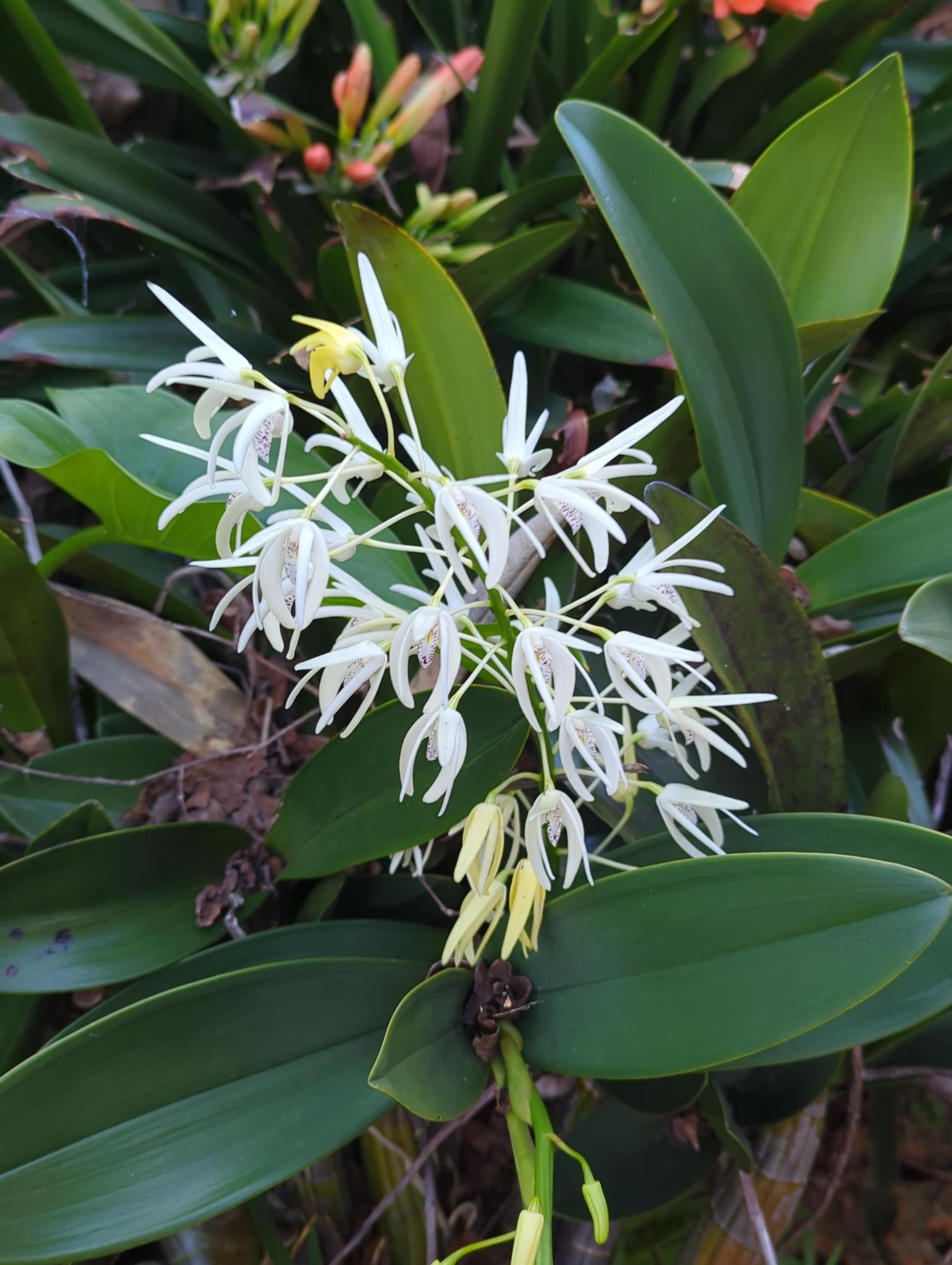
The image below shows a mature Dendrobium speciosum growing in a pot. notice the beauty of both the racemes of flowers and the fleshy leaves.
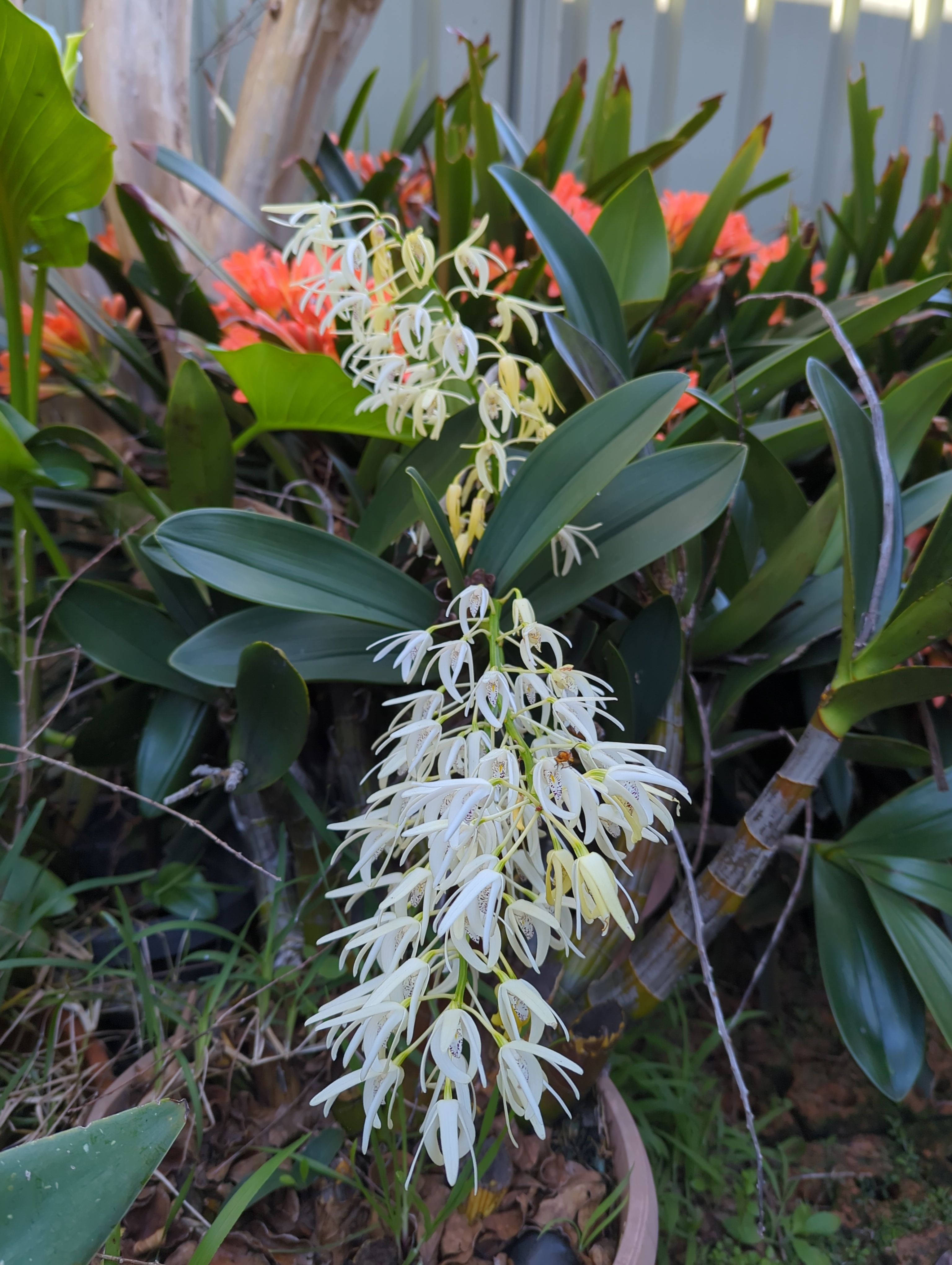
The flowers of Dendrobium speciosum are 12–70 mm long and 20–80 mm wide and have bilateral symmetry. The dorsal sepal is longer than the lateral sepals but narrower. The lower sepal, or labellum (lip), is 8-15 mm long and has reddish purple spots or streaks and three lobes. The side lobes are erect and curved and the middle lobe pointed. This part of the flower serves to attract and to be landing platform for pollinators.
The flower of Dendrobium speciosum has three sepals (one dorsal, two lateral) and one lower petal modified into a distinctive labellum (lip) that serves as a landing platform for pollinators.
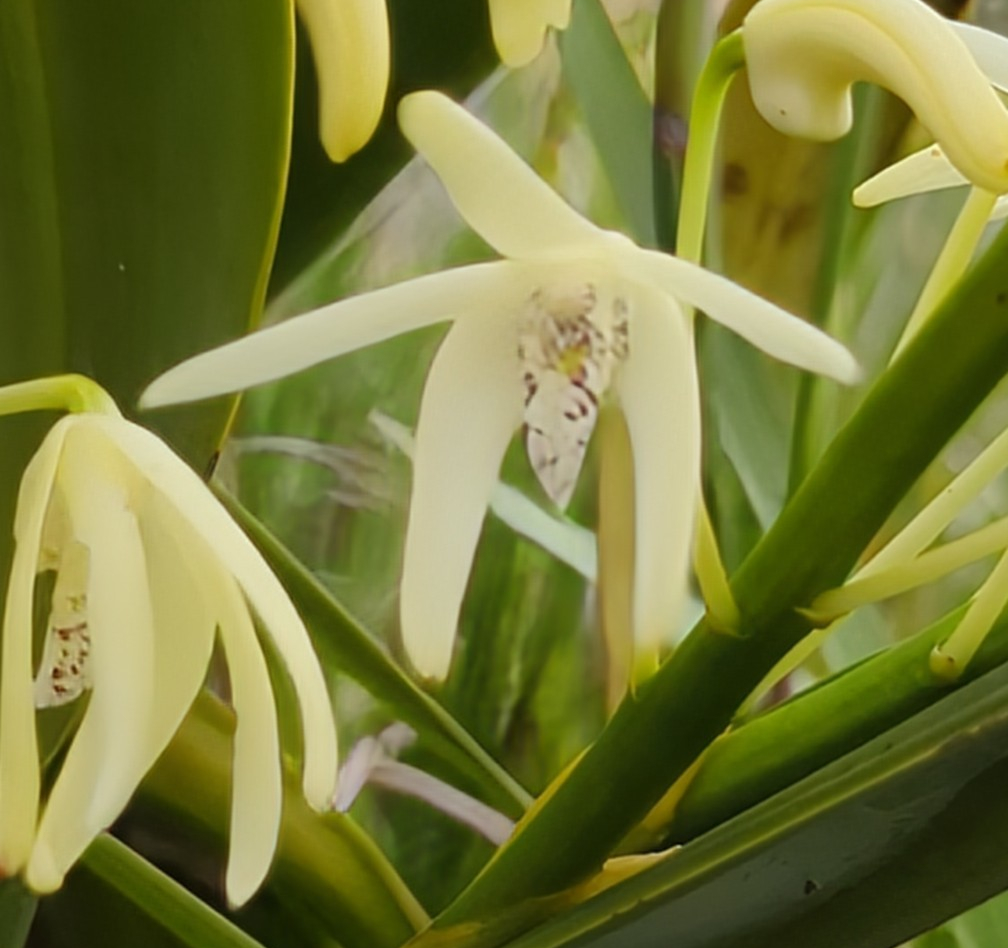
The labellum (lower petal) features reddish-purple spots or streaks and is divided into three lobes: the side lobes are erect and curved, while the middle lobe is pointed, rounded, or square. Flower sizes typically range from 12–70 mm in length and 20–80 mm in width, with colors varying from white to bright yellow.
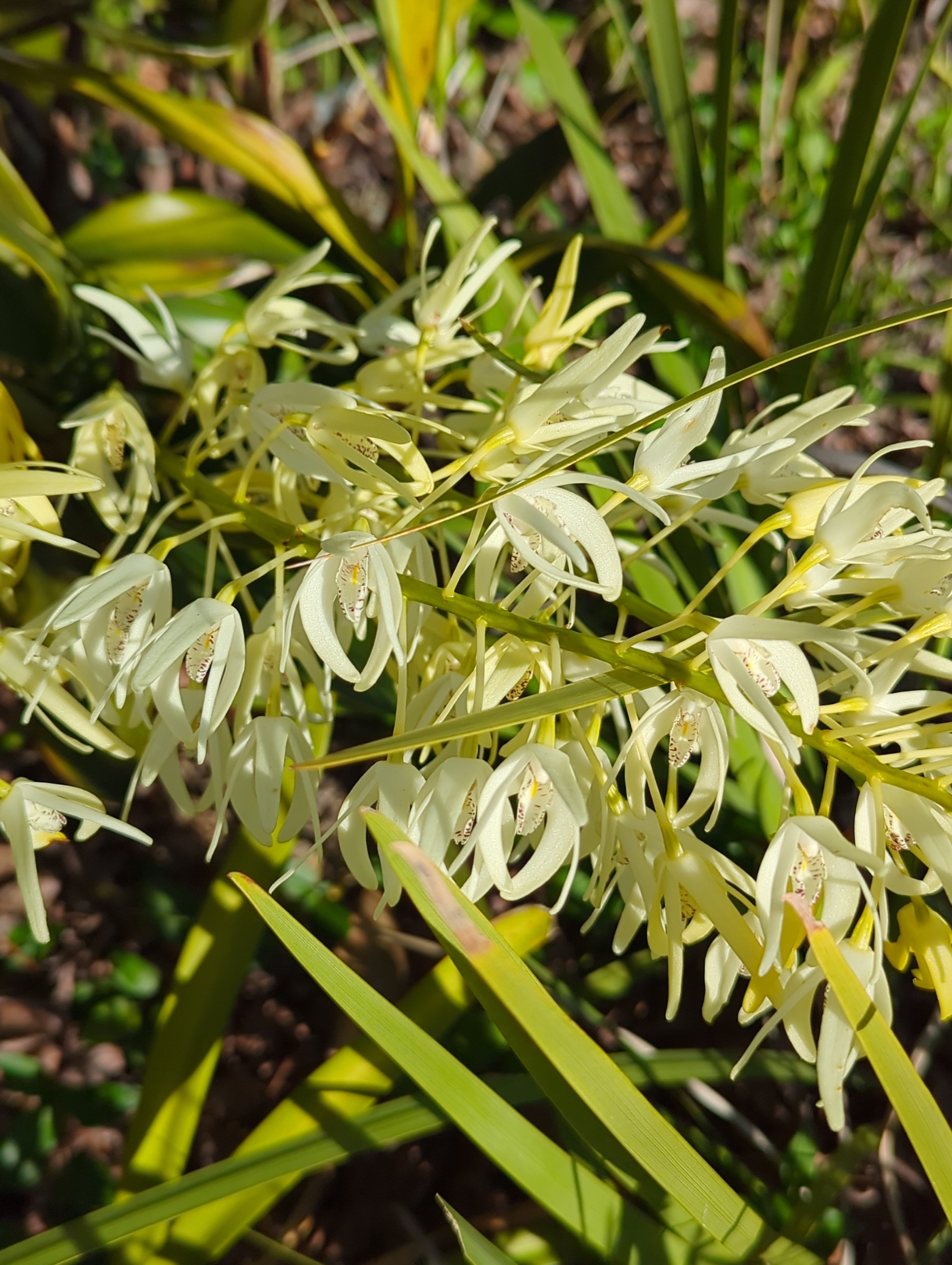
Nectar-seeking insects are guided to the central, reproductive area of the flower by the colour gradation of the perianth, including an area of high U.V. reflection near the centre, and a bright yellow ridge along the labellum. A tube formed by the labellum and column directs the potential pollinators. The flower, however, produces no nectar but relies on the fragrant, musky scent of its hundreds of flowers to attract at least three species of Trigona bee to visit its flowers.
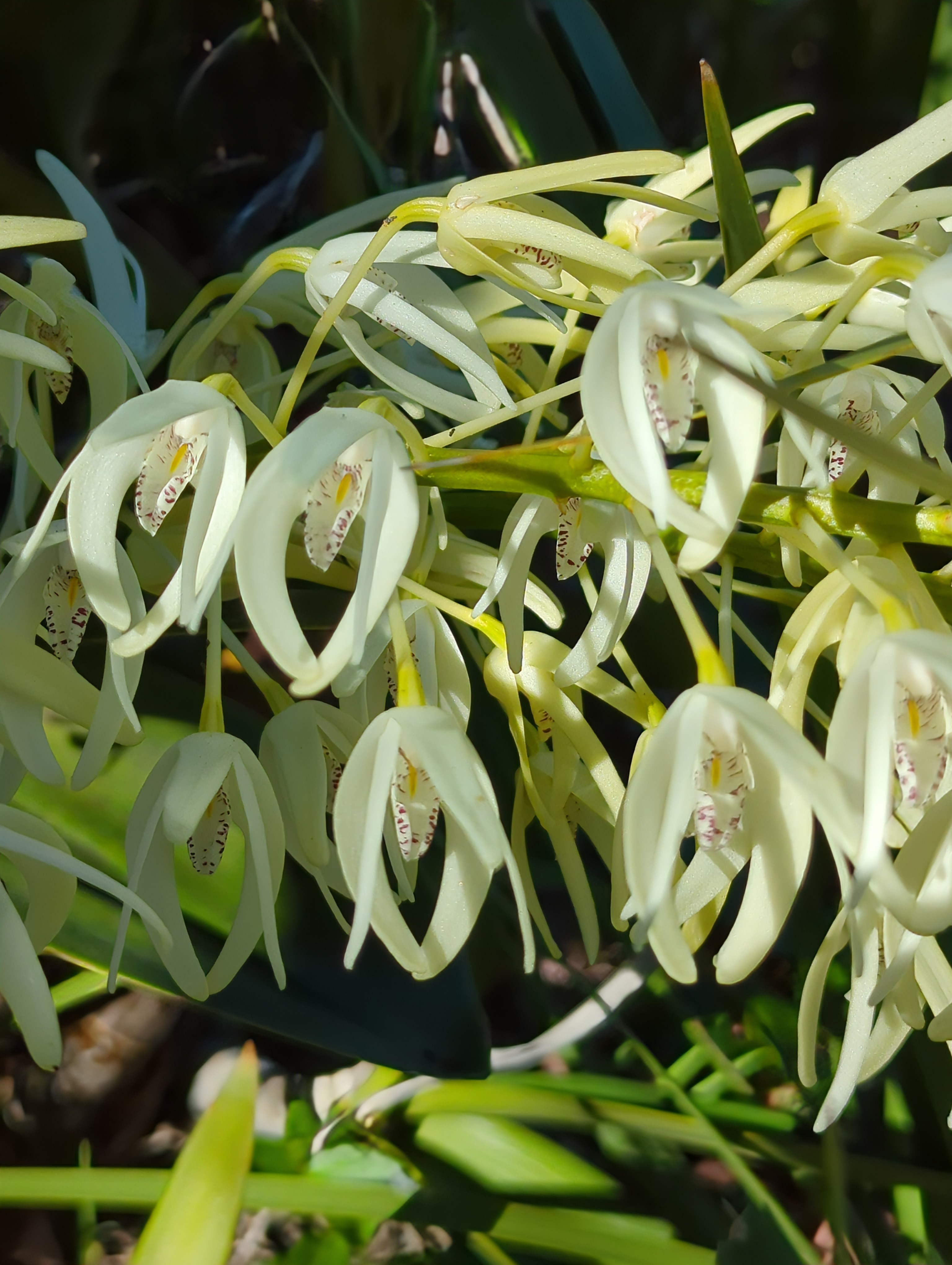
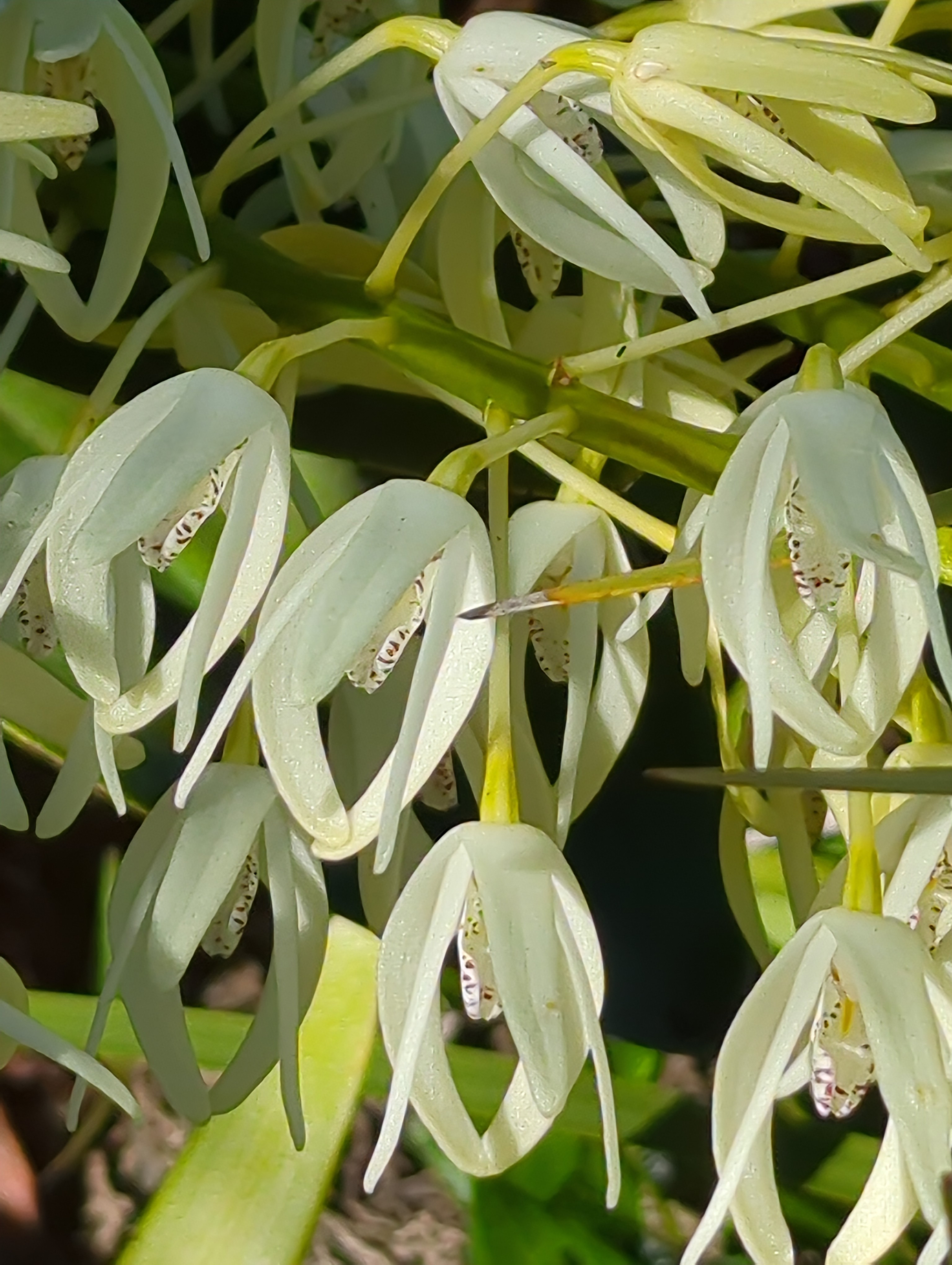
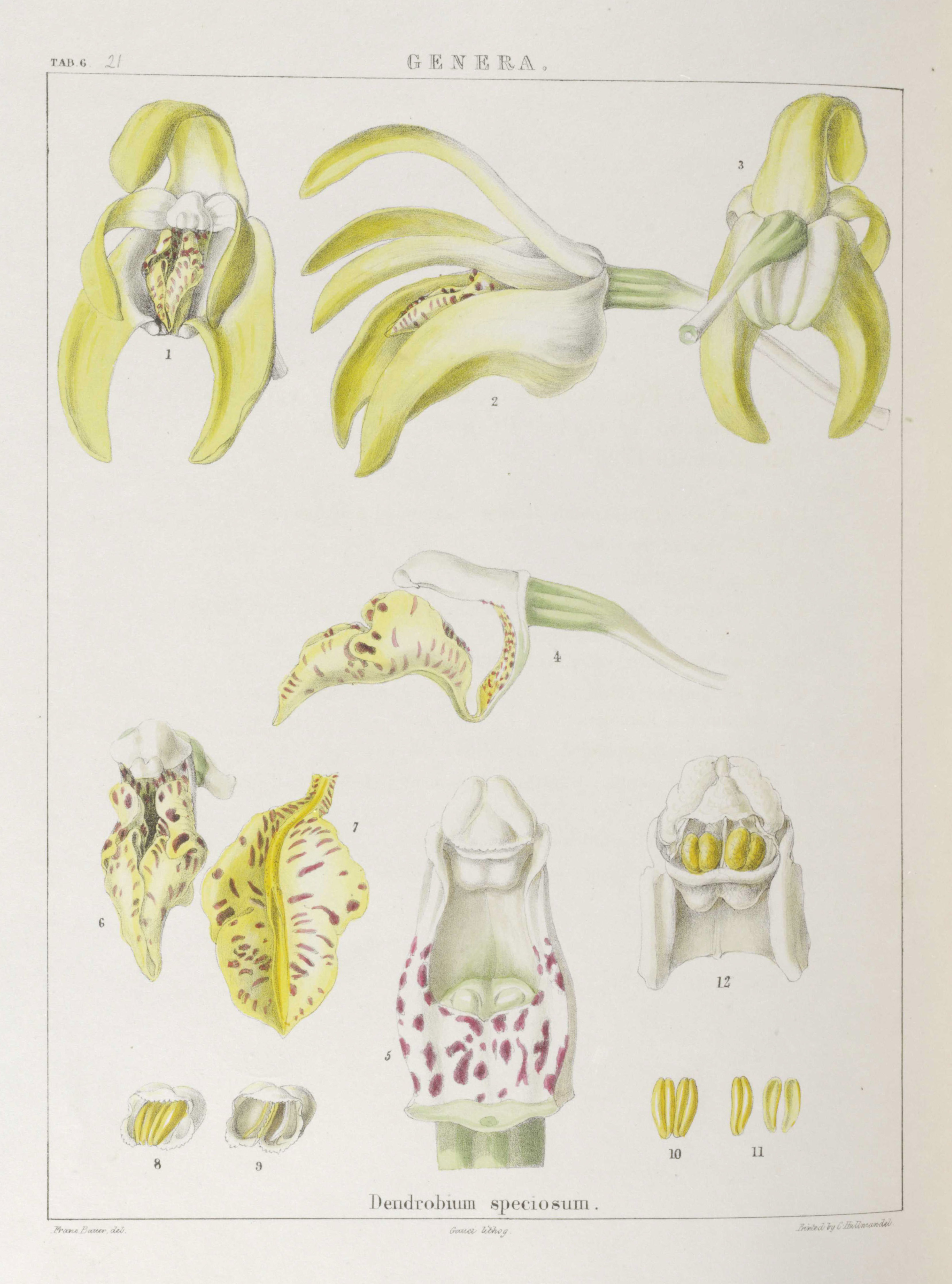
The image below is “The parts of fructification of Dendrobium speciosum from a sketch by Mr. Bauer in 1793”. Bauer, Franz Andreas and Lindley, John. Illustrations of Orchidaceous plants. 1830-1838. Contributed in BHL from Natural History Museum, London.
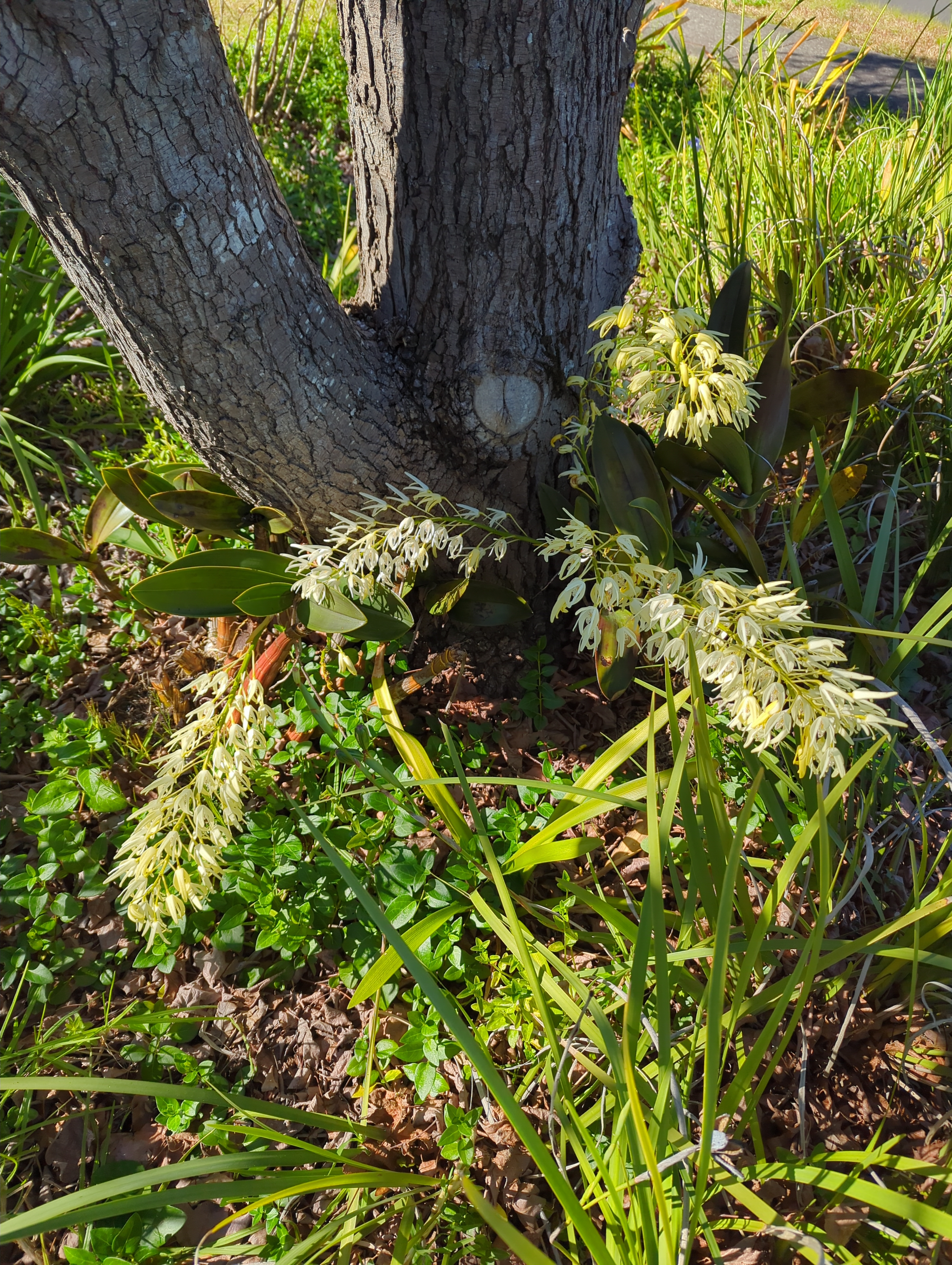
The clumps of Dendrobium speciosum is growing at the base of an old tree. This provides light over winter and dappled light during spring and summer.Amidst other plantings it has also some protection at ground level.
Cultivation:
Location and Growing medium:
As the Dendrobium speciosum can naturally grow as a lithophyte (on rocks) or epiphyte (on trees), it adaptable to various outdoor setups provided it receives bright, indirect light and excellent drainage. It can grow in temperatures from 0-45 with some protection and can even grow in full sun for some part of the day.
It can be successfully grown both in pots and mounted outdoors.
To grow in pots: select a pot only slightly larger than the root ball because the plant likes to be tight within the pot. It should also be squat shaped as the roots are shallow. Choose terracotta that naturally breathes.
Use a coarse, fast-draining mix such as coarse pine bark, weathered bark, river stones, or charcoal and not regular potting mix or other garden soil.
To grow outdoors: select a site that receives plenty of light and airflow. If the climate has extreme heat in summer ensure that the site that will have some protection from the afternoon sun so leaves do not get scorched. Locating the plant under the canopy of a large tree that still allows sunlight will benefit the plant and encourage flowering.
The orchid can be mounted on bark slabs, logs, or tree fern mounts to recreate its natural habitat and provides good air circulation. Dendrobium speciosum can also be wired over rocks over planting mix as well.
The site should offer protection from frost, harsh winds and heavy rain in winter.
Most Dendrobium orchids thrive in acidic soil or media with a pH around 6.5. Check from time to time and ammend with dolomite to raise the pH and provide calcium during repotting.
Watering:
Where possible use rainwater to water pots as well as mounted specimens.
Water frequently during the active growing season (spring/summer) but let the medium to approach dryness between waterings.
Reduce watering in autumn/winter to induce a dry rest, which is essential for blooming.
Propagation:
Dendrobium speciosum can be propagated by dividing pseudobulbs or separating pups that develop along with their roots.
 The Grantham Gardener