This month’s post has been much delayed but sometimes life can take unexpected turns. So far Sydney in November 2026 has experienced lower temperatures and more rainfall than last year. Planting has benefited from these climatic conditions. I wish all followers to this site the opportunity to take advantage of the late spring planting season to boost your garden’s production. Happy gardening!
The following is a list of vegetables and herbs you can plant in November in Sydney, a temperate zone. Just click on the name for the growing guide for each vegetable or herb:
- Artichokes
- Asparagus crowns
- Basil seedlings
- Beans (bush and climbing)
- Beetroot
- Borage
- Broccoli
- Cabbage
- Cape Gooseberry
- Capsicum
- Carrot
- Celery
- Chives
- Coriander
- Cucumber
- Eggplant
- Jerusalem Artichoke
- Lemon Balm
- Lettuce
- Luffa
- Marrow
- Okra
- Parsley
- Peanut
- Pumpkin
- Radish
- Rocket
- Rockmelon (cantaloupe) seedlings
- Sage
- Silverbeet
- Spring Onions
- Sunflowers
- Sweet Corn
- Tarragon
- Tomato
- Turnip
- Watermelon
- Yacon
- Zucchini
Plant of the Month – The Joy of the Beautiful Jacaranda mimosifolia
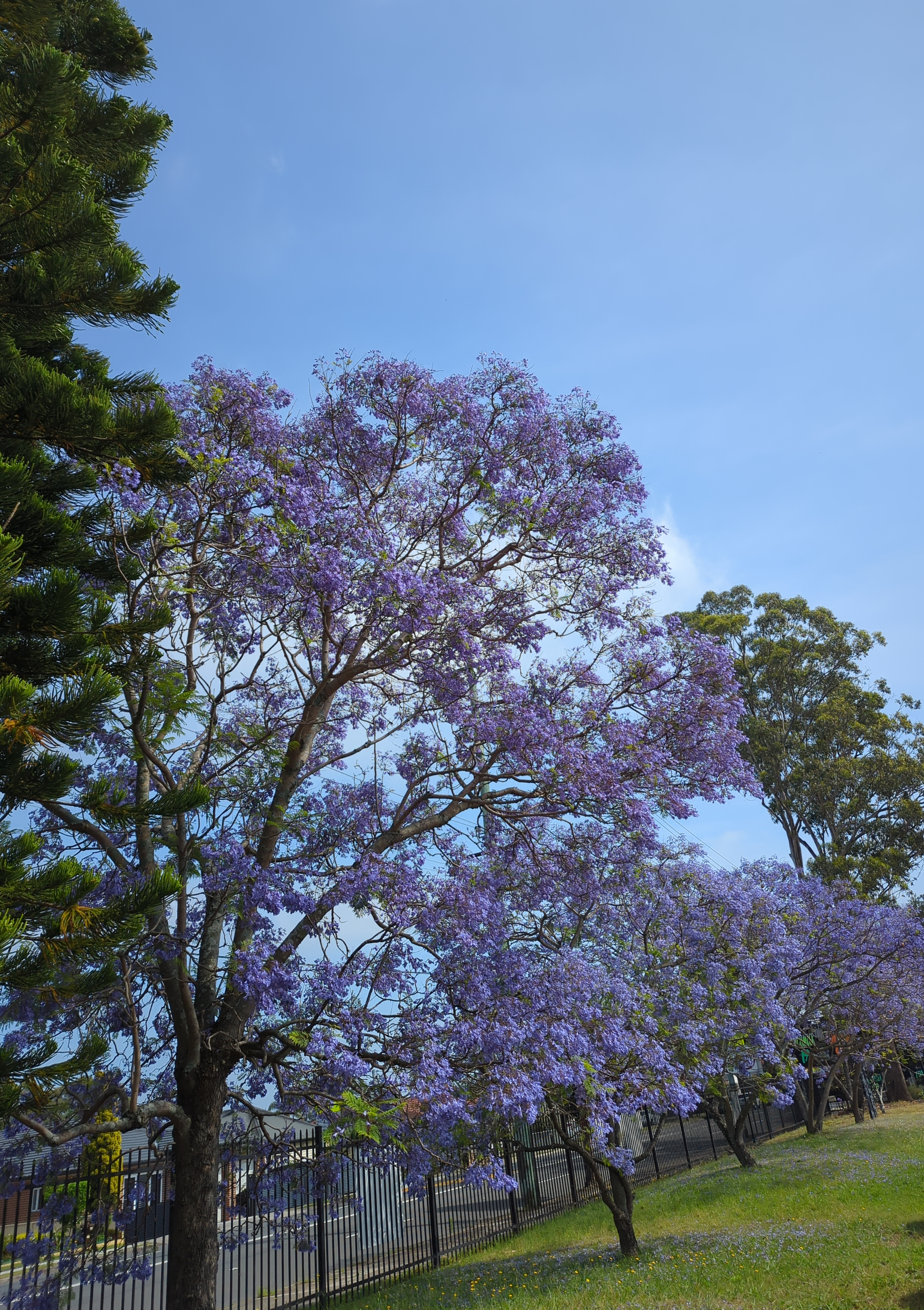
Jacaranda mimosifolia is native to southern Brazil, Uruguay, Paraguay, northern Argentina and southern Bolivia, and is a genus comprising approximately 49 species of trees and shrubs in the family Bignoniaceae.
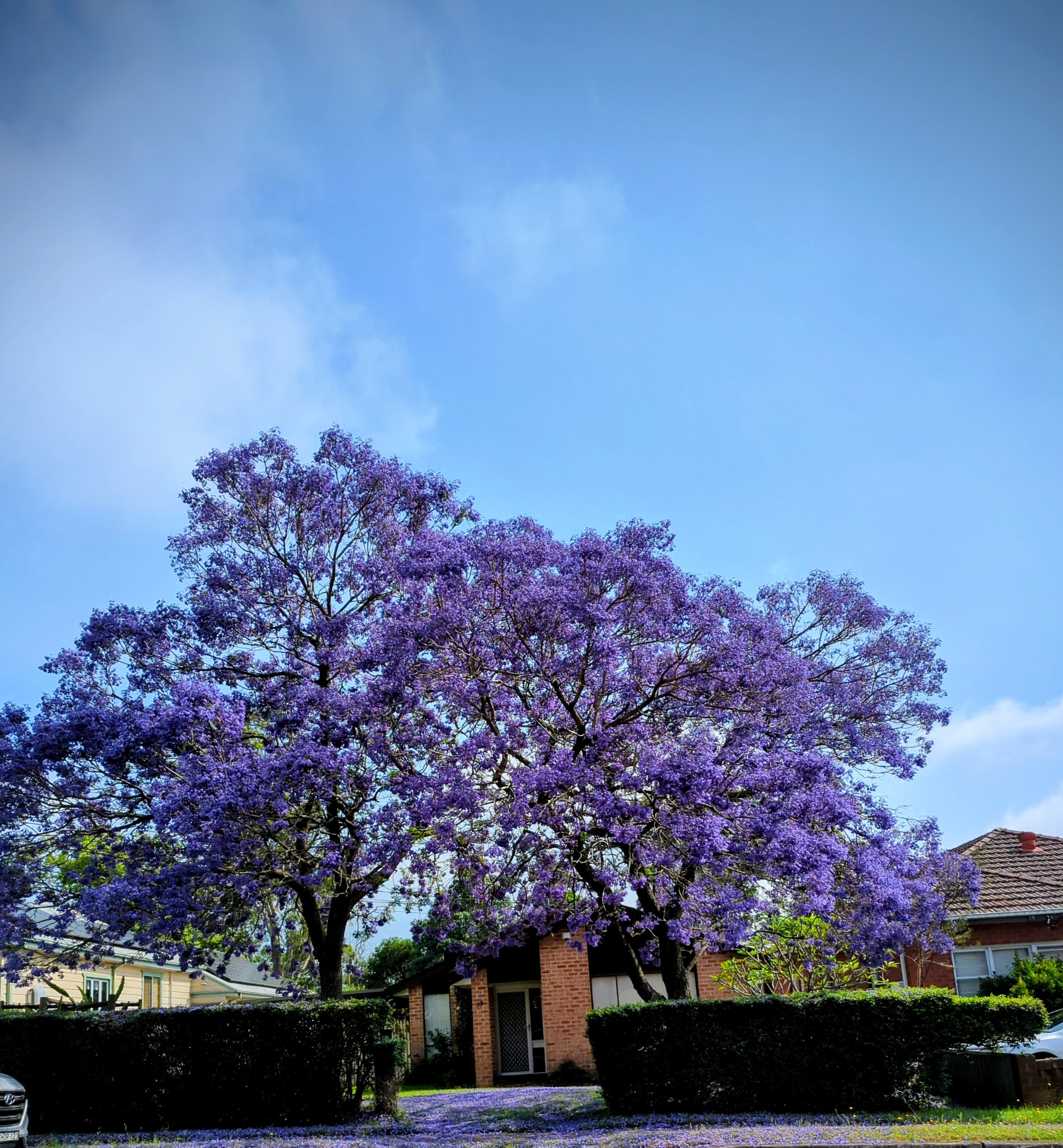
The jacaranda grows well in the warm climate of Sydney and from elevated positions puffs of purple can be seen sprinkled across suburbs where the space exists to accommodate their spreading, twisting architecture of branches with their panicles of delicate flowers.
In cities around Australia, Jacaranda trees are loved and planted in many settings. In parts of Sydney tourists are attracted and visit the beautiful jacaranda lined streets and parks, covering the area in colour. In fact, in Grafton NSW the Jacaranda Festival is the longest running floral festival in Australia, showcasing the spectacular flowering of over 1,000 Jacaranda trees in late October.
The Jacaranda tree grows to a height of up to 7.5–15 m, with some specimens reaching up to 18–21 m in ideal conditions. The canopy spread ranges from 4.5–12 m, though mature trees in open spaces can spread 13.5–18 m wide and features a broad, vase-shaped crown that offers substantial shade.
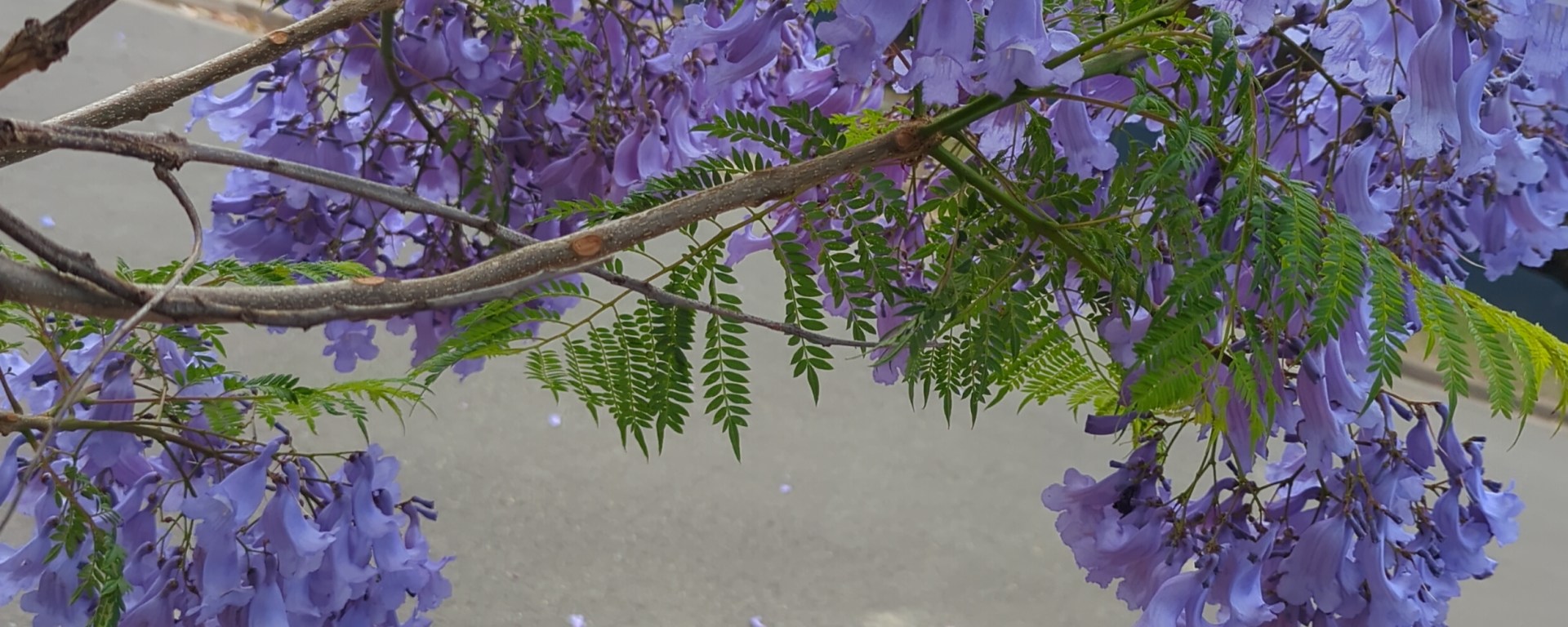
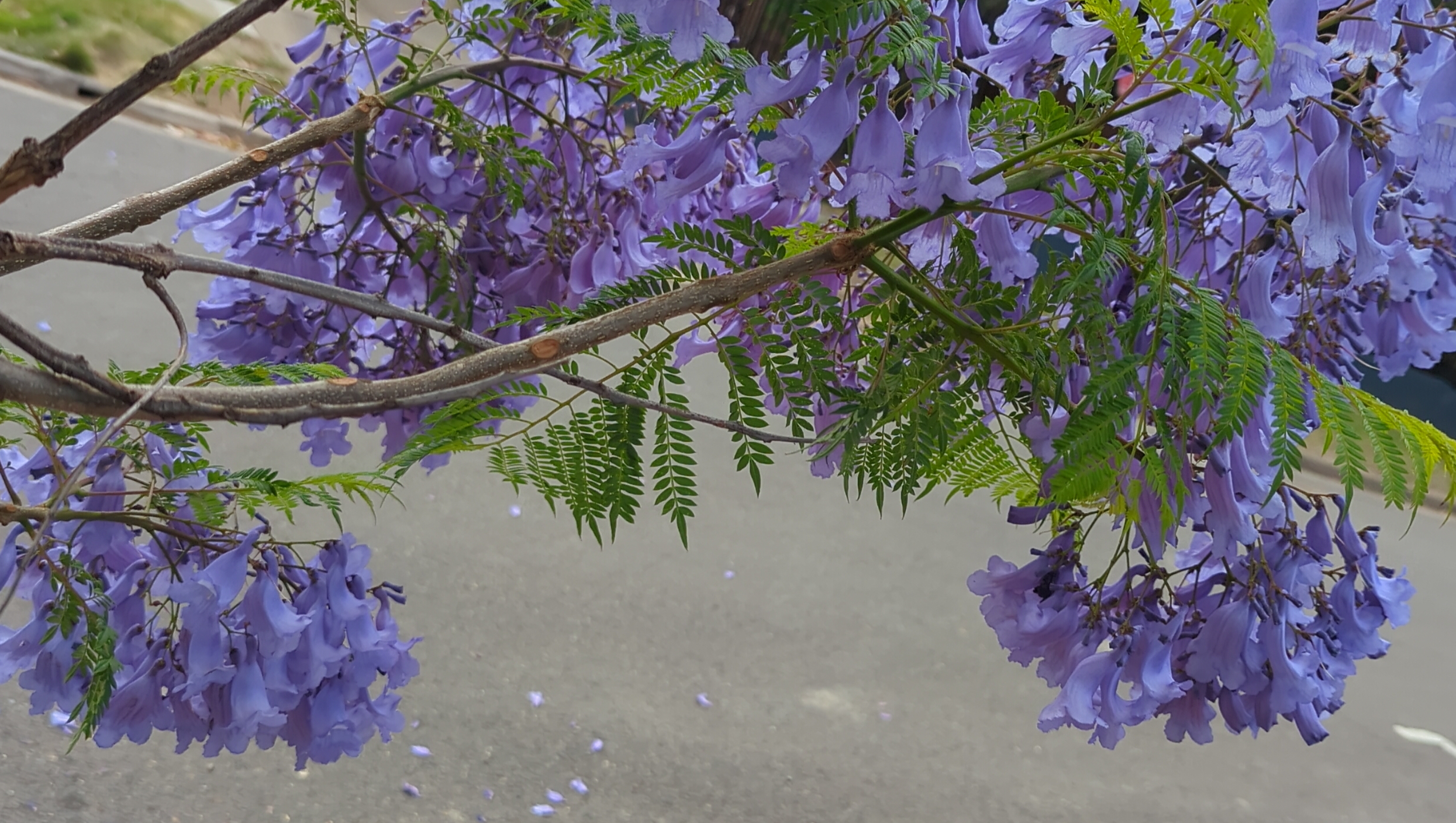
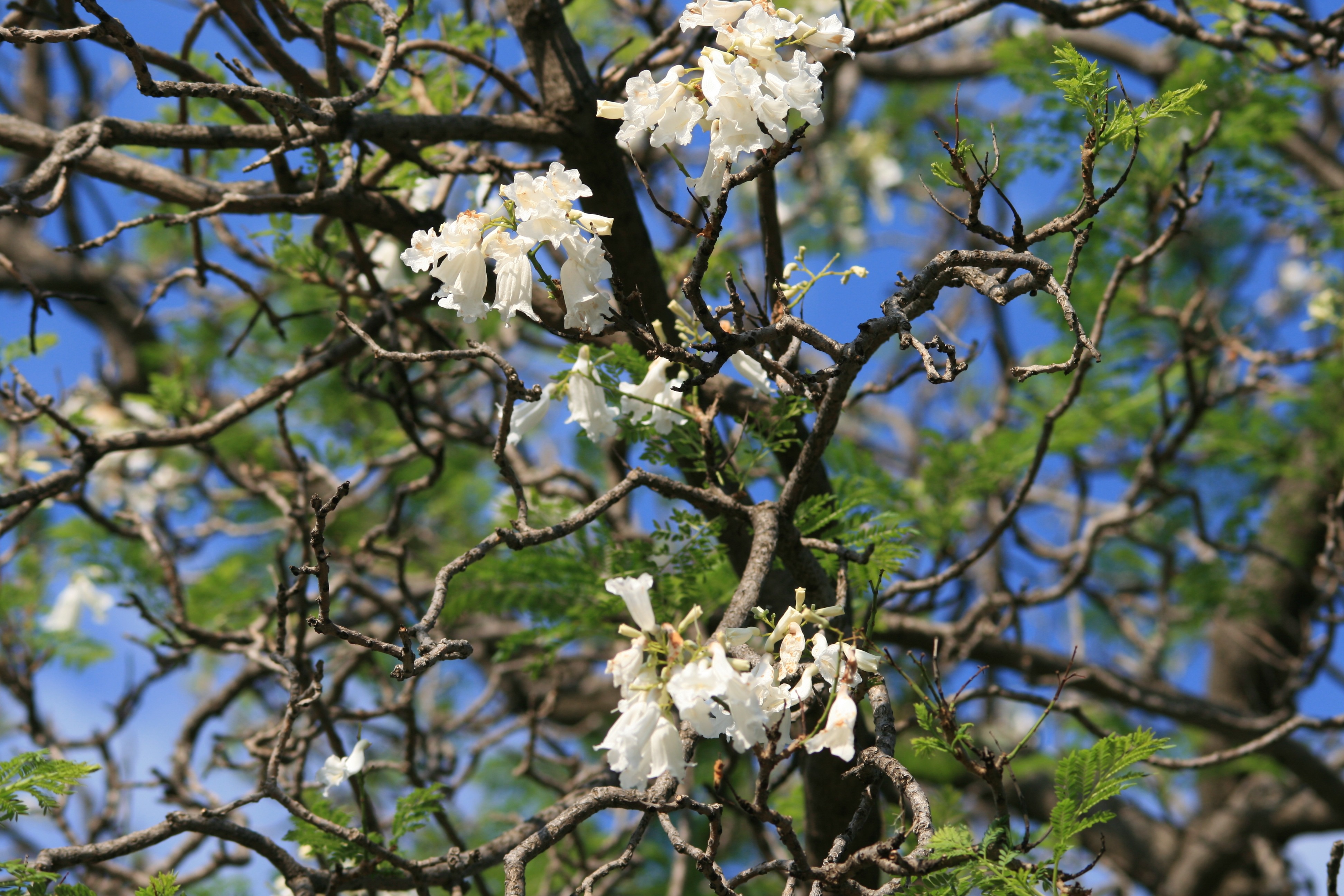
The blue jacaranda is cultivated for the sake of its large compound leaves, even in areas where it rarely blooms. The leaves are up to 45 cm long and bi-pinnately compound, with leaflets little more than 1 cm long. There is a white form available from nurseries!
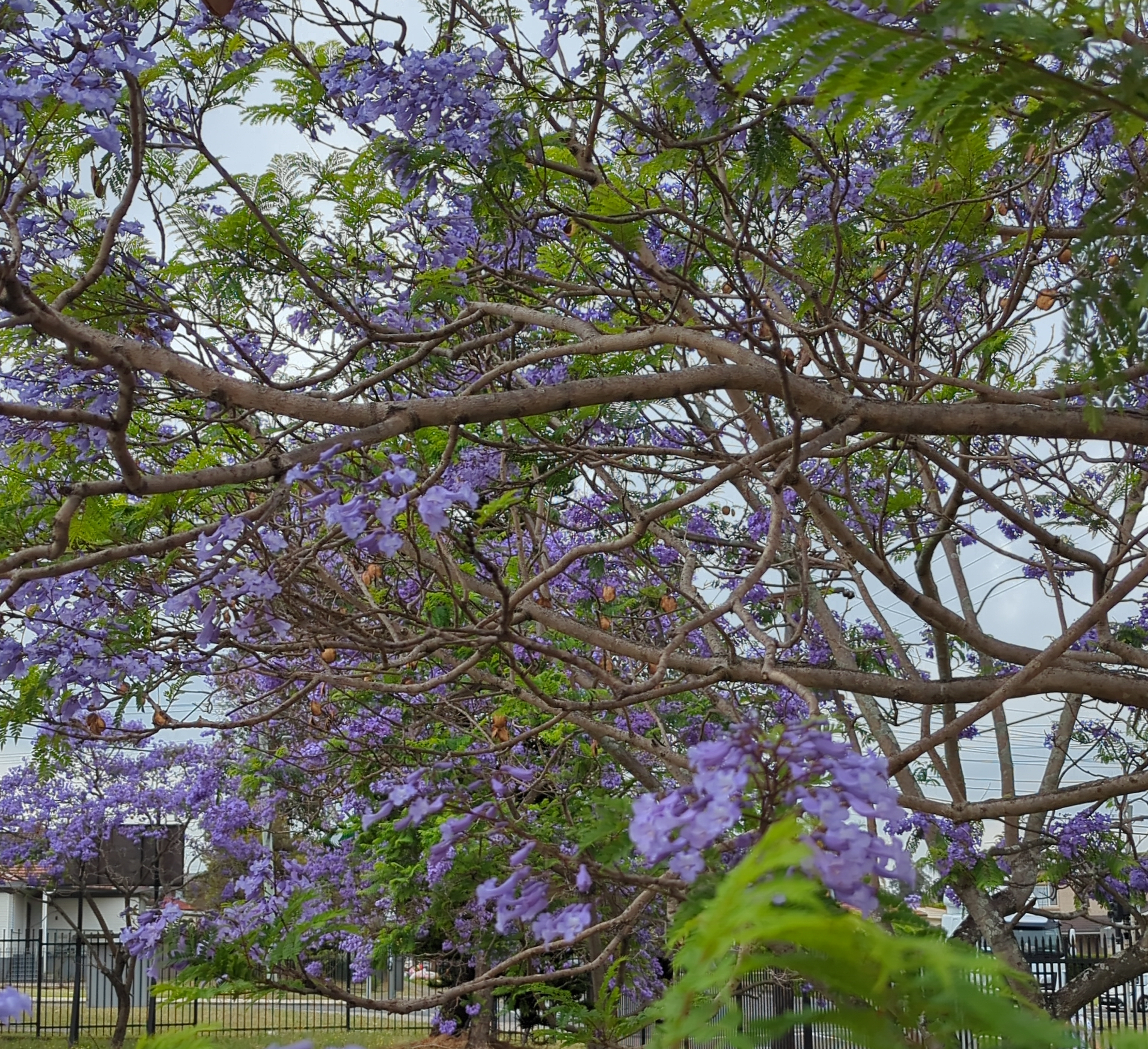
The bark of the Jacaranda mimosifolia varies based on the tree’s age. Young trees have thin, smooth, light reddish brown bark.
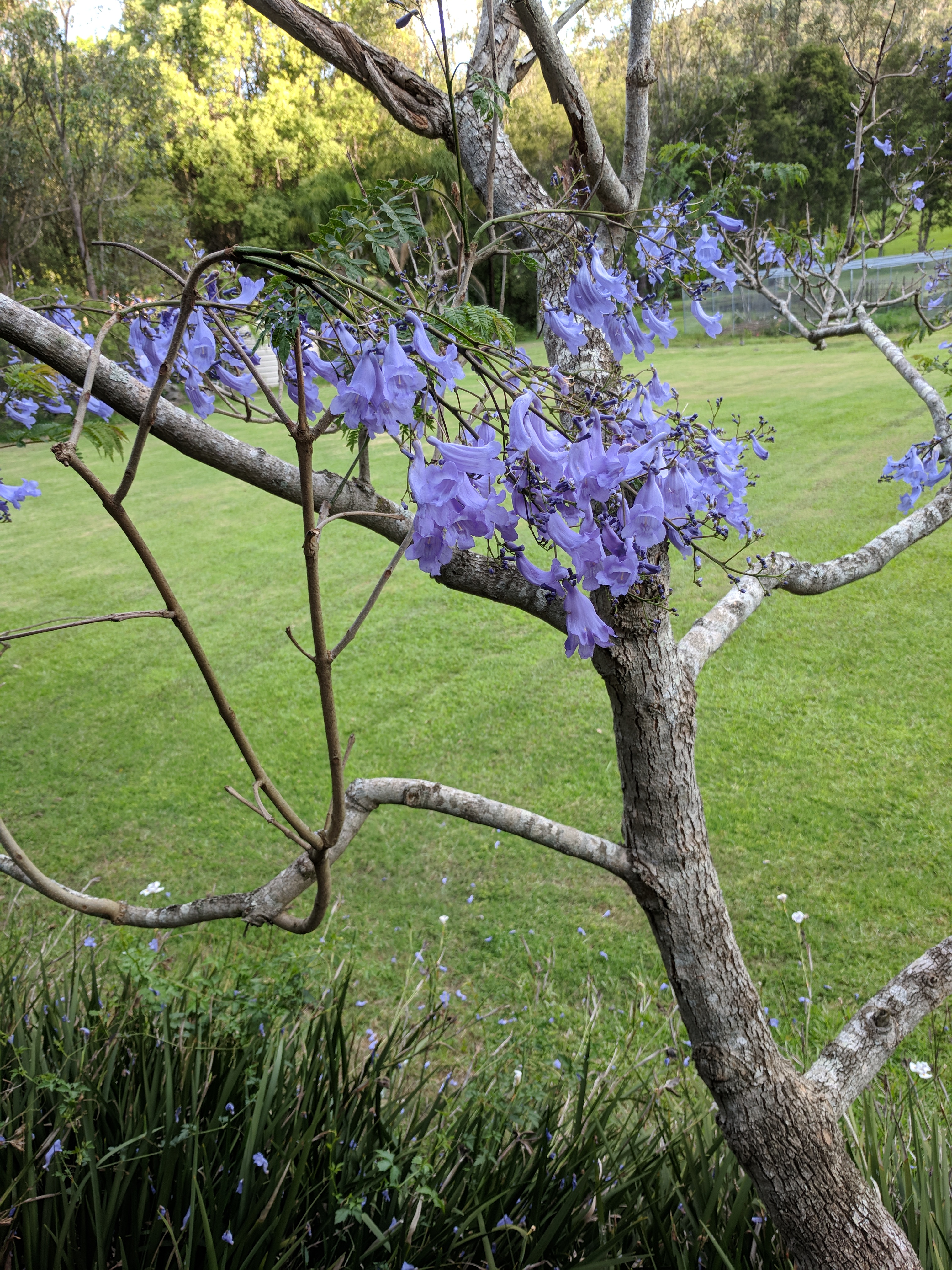
As the tree matures, the bark changes first to a finely scaled grey and then to a rough, dark grey surface with fine vertical fissures or a finely scaly appearance. The twigs are slender and slightly twisting; they are a light reddish-brown.
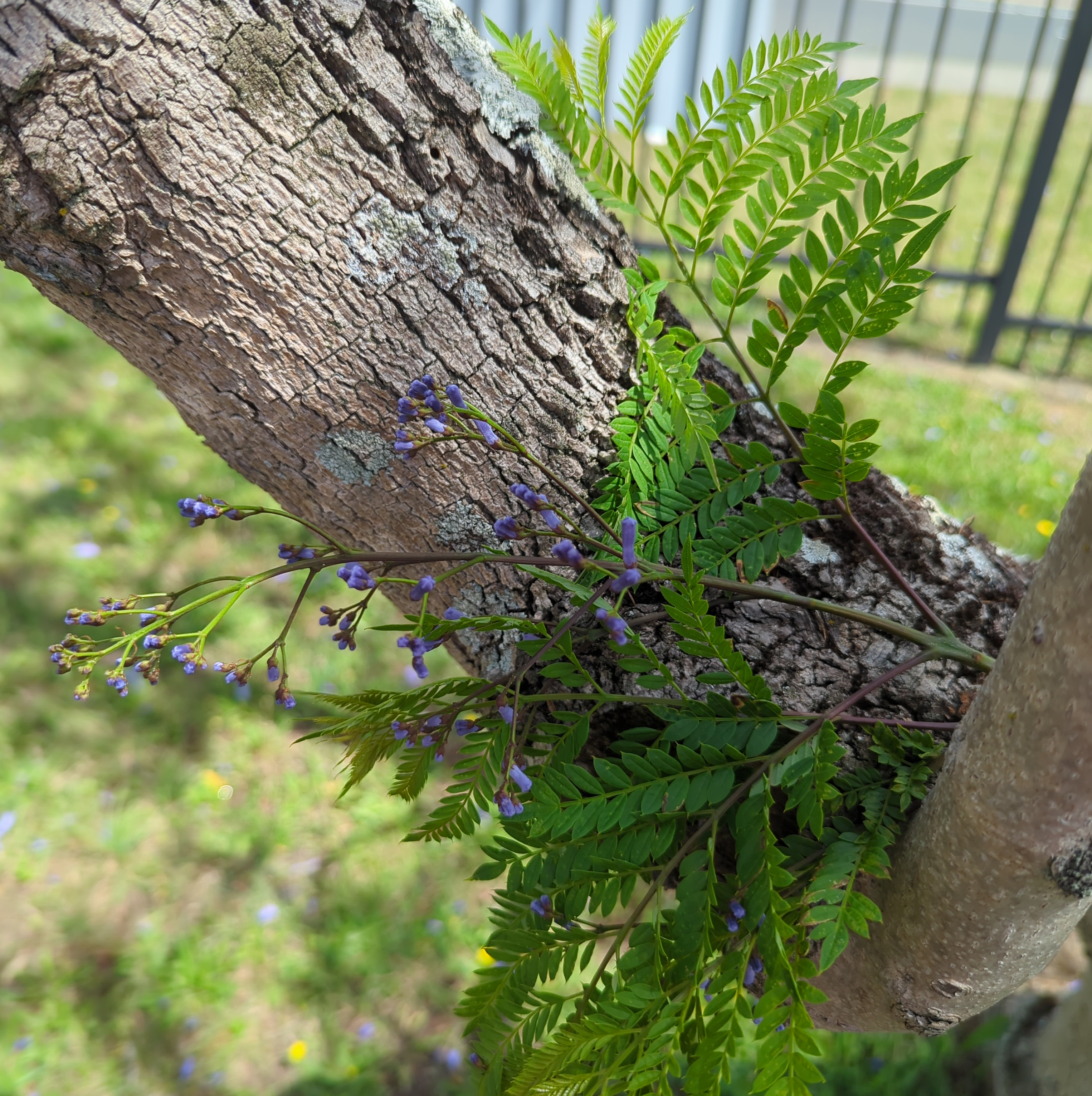
Jacaranda leaves are deciduous and bipinnately compound about 22 to 45 cm long.
The rachis or central stem (main leaf axis) is brown to reddish-brown with lateral wings. The upper surface has a distinct groove that supports the structure that is made up of 13-25 pinnae or primary leaves 12 cm long and arranged alternately along the racis as seen in the image below. Secondary leaflets or pinnules of obvate shaped leaflets about 0.25 – 0.5 cm are attached.
Each primary pinnae carries about 20 secondary leaflets giving the foliage a delicate, fern-like appearance.
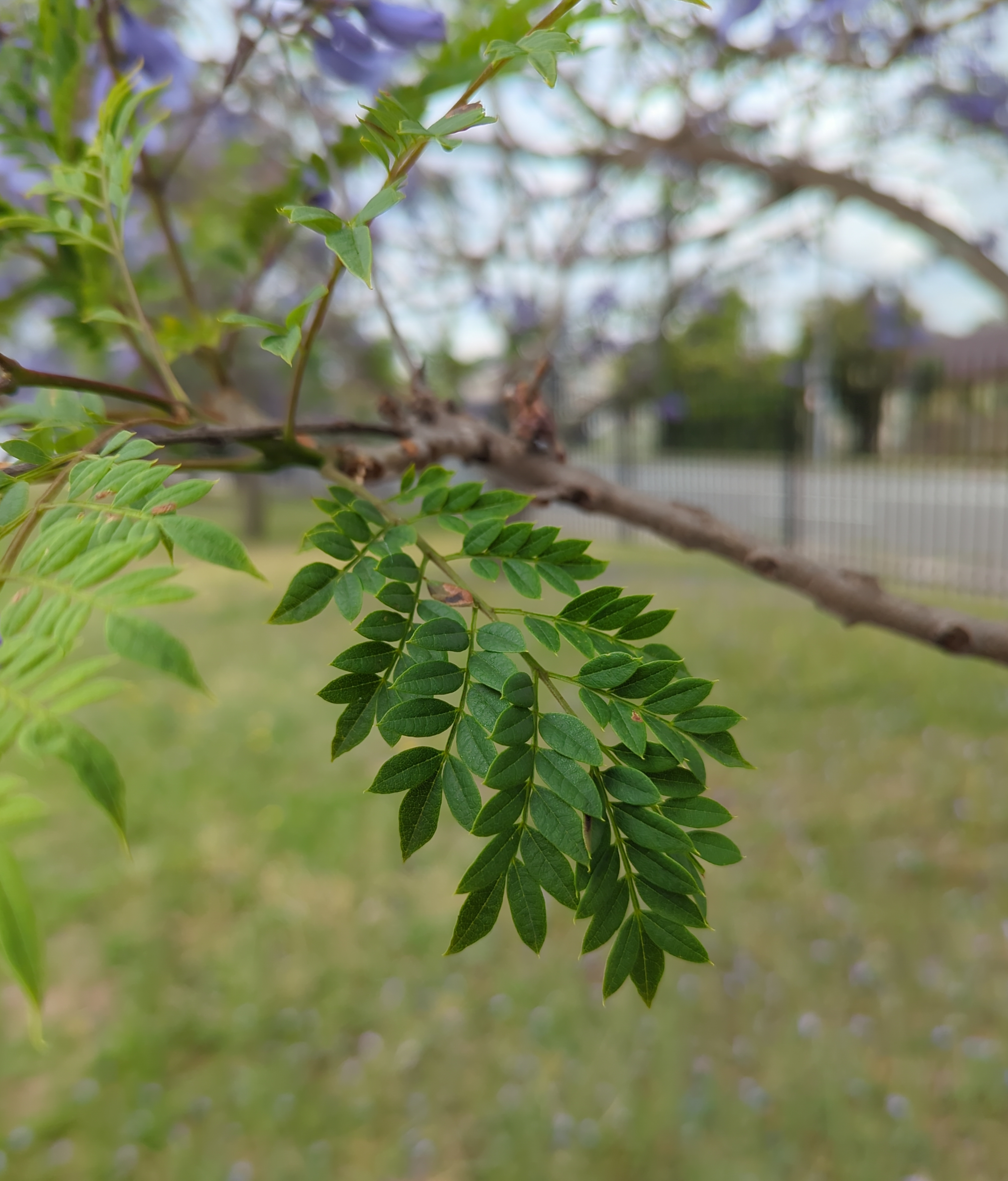
The full blooming period on a Jacaranda mimosifolia tree lasts 4 – 8 weeks. Individual flower panicles last 2-3 weeks depending on the climatic conditions at the time. Dry springs extend the blooms,while heavy rain and wind of cool weather shorten it and cause the flowers to drop earlier. In very favourable warm, dry conditions can last up to 8 weeks.
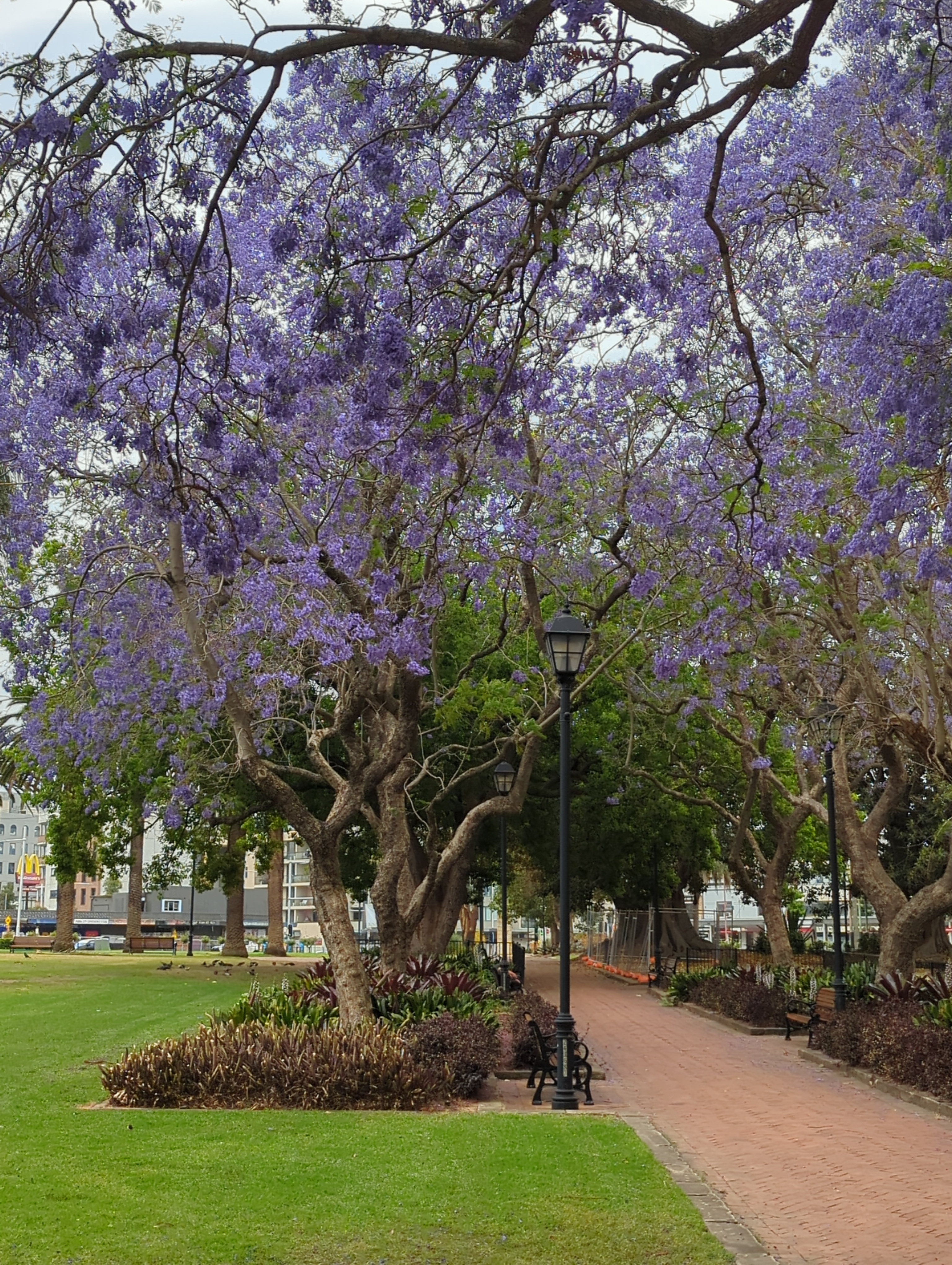
Once the flowers fall, they form the iconic purple carpet on the ground, which holds its colour for a while and extends the beauty beyond the tree itself.
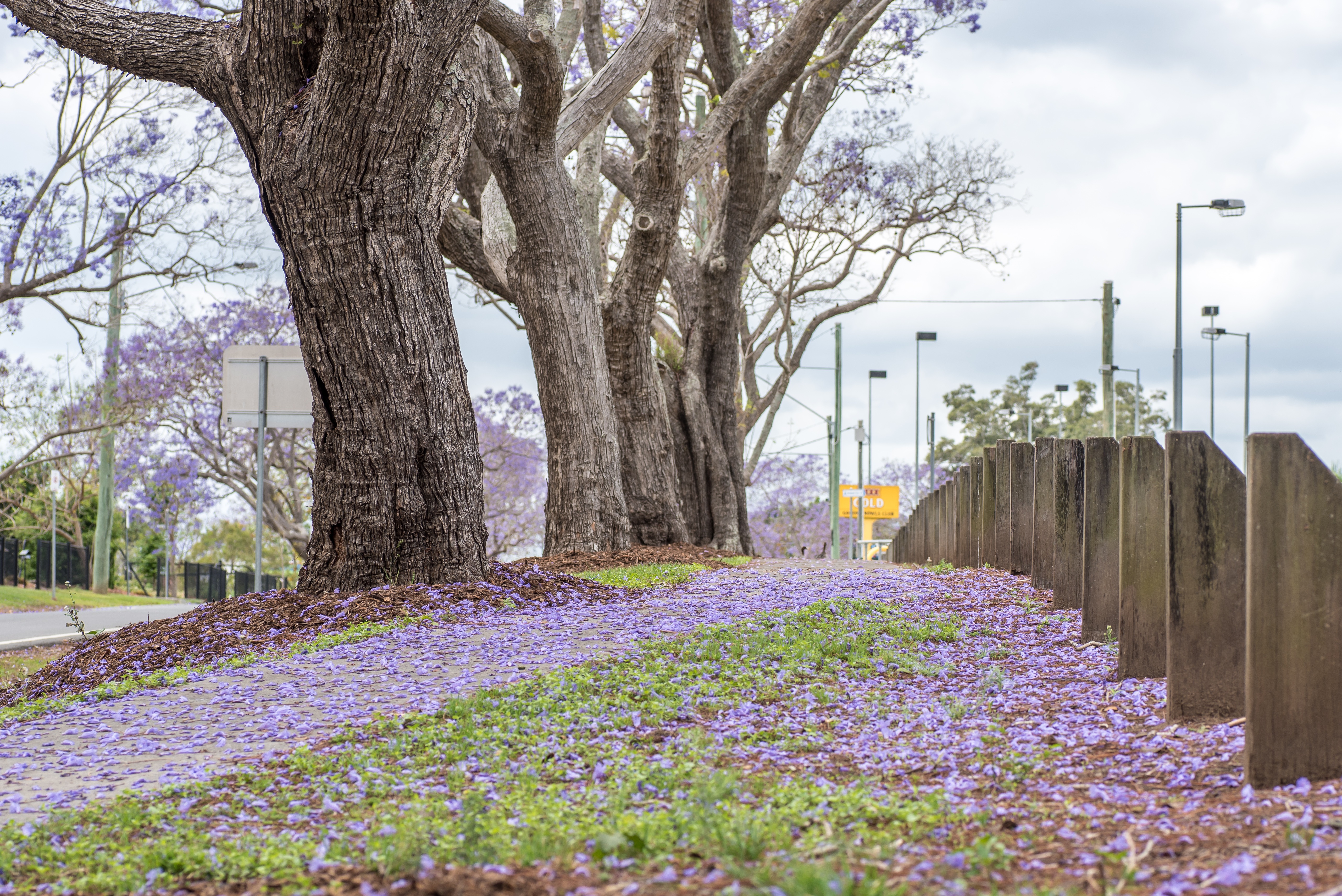
Some find the carpet of flowers a nuisance needing extra work. In some cultures however, the jacaranda tree has great symbolic meaning with its vibrant purple blooms evoking spring renewal and rebirth. The falling looms are signify good fortune, wisdom and new beginnings. A bloom landing on one’s head brings luck. Before planting such a tree considerations of its natural seasons of flower and leaf dropping thought about.
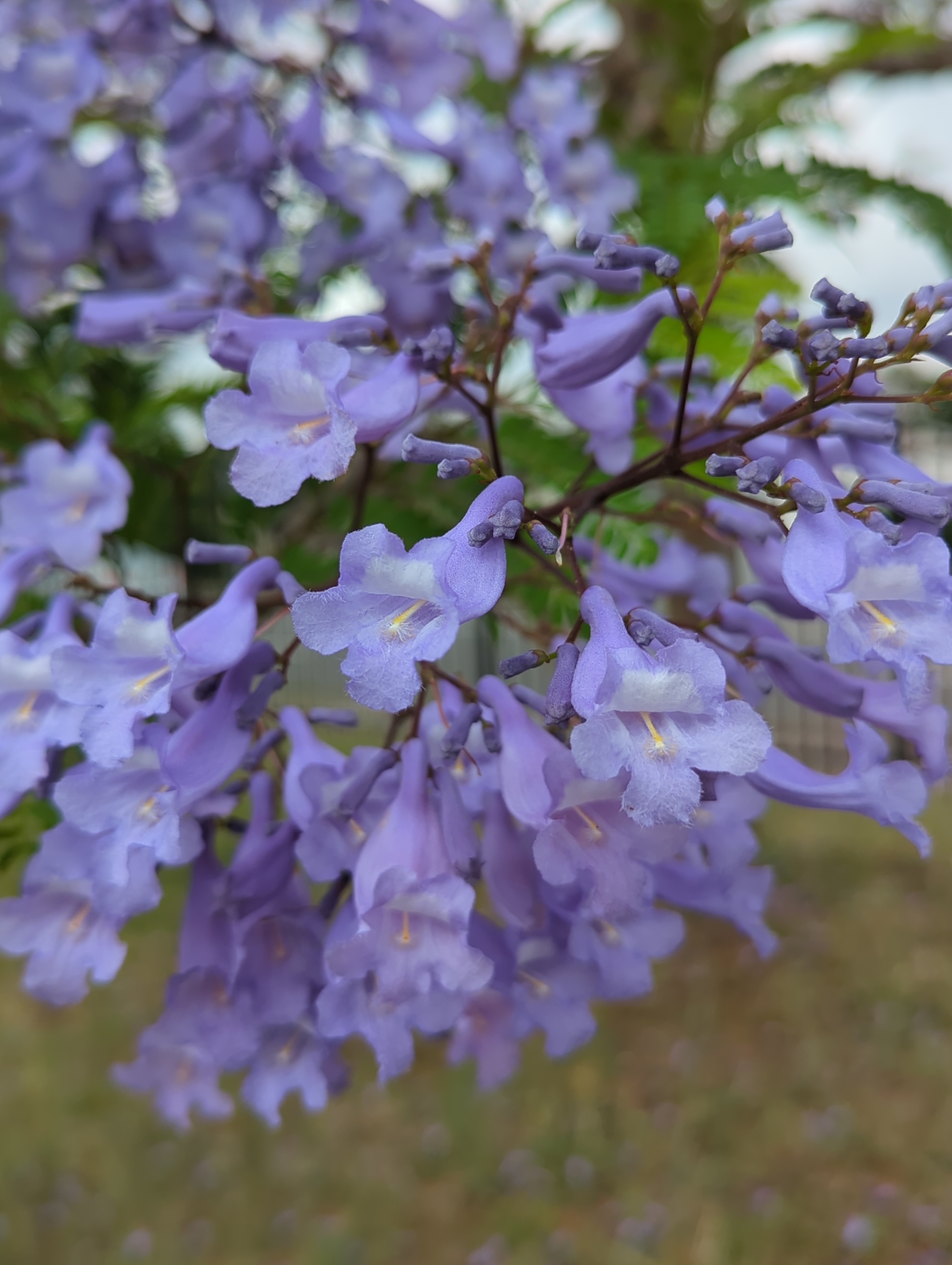
The jacaranda flower is a tubular or funnel-shaped bloom with a five-lobed corolla that is is bilabiate (two lipped) and is lavender-blue, purple, or violet, or white in colour depending on the cultivar. The image below shows the white jacaranda.
Each flower is 5 cm long and is arranged in large, terminal panicles that can be up to 30–45 cm long.
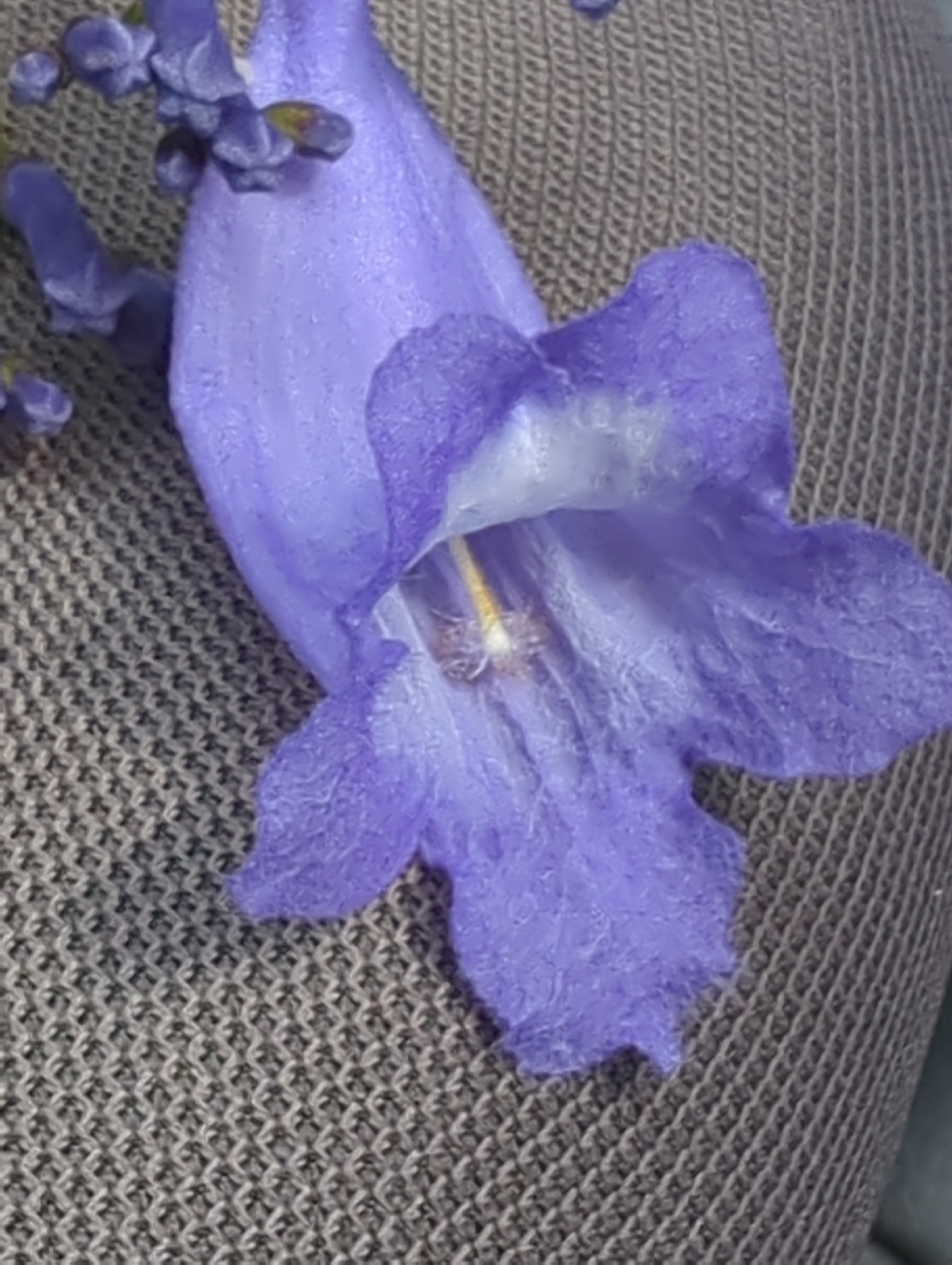
The flowers are hermaphroditic, i.e. containing both male and female reproductive parts, and emit a light, pleasant fragrance. It has a five-lobed calyx which is a fused cup at the base of the flower that sometimes appears two-lipped.
The male part of the flower has 4 stamens made up of two pairs of unequal length that produce pollen. The anthers have a single pollen sac.
The female part of the flower has a single filiform style that is shorter than the staminode. The stigma is narrow and oblong at the end of the pistil and is bi-lobed and designed to capture pollen. The ovary is flattened and elongated and contains about 243 ovules which develop into seeds after fertilization.
The flower has a staminode (sterile stamen-like structures) that are longer than the fertile stamens with a features a bifurcated apex and bears glandular trichomes (tiny hairs) that secrete metabolites that attract pollinators.
The image below shows a dissection of a jacaranda flower and shows the long staminode with its glandular hairy trichomes. It also shows the 4 male stamens with their anthers and the longer filiform style covered with clavate papillae.
(Click on image for a more detailed view)
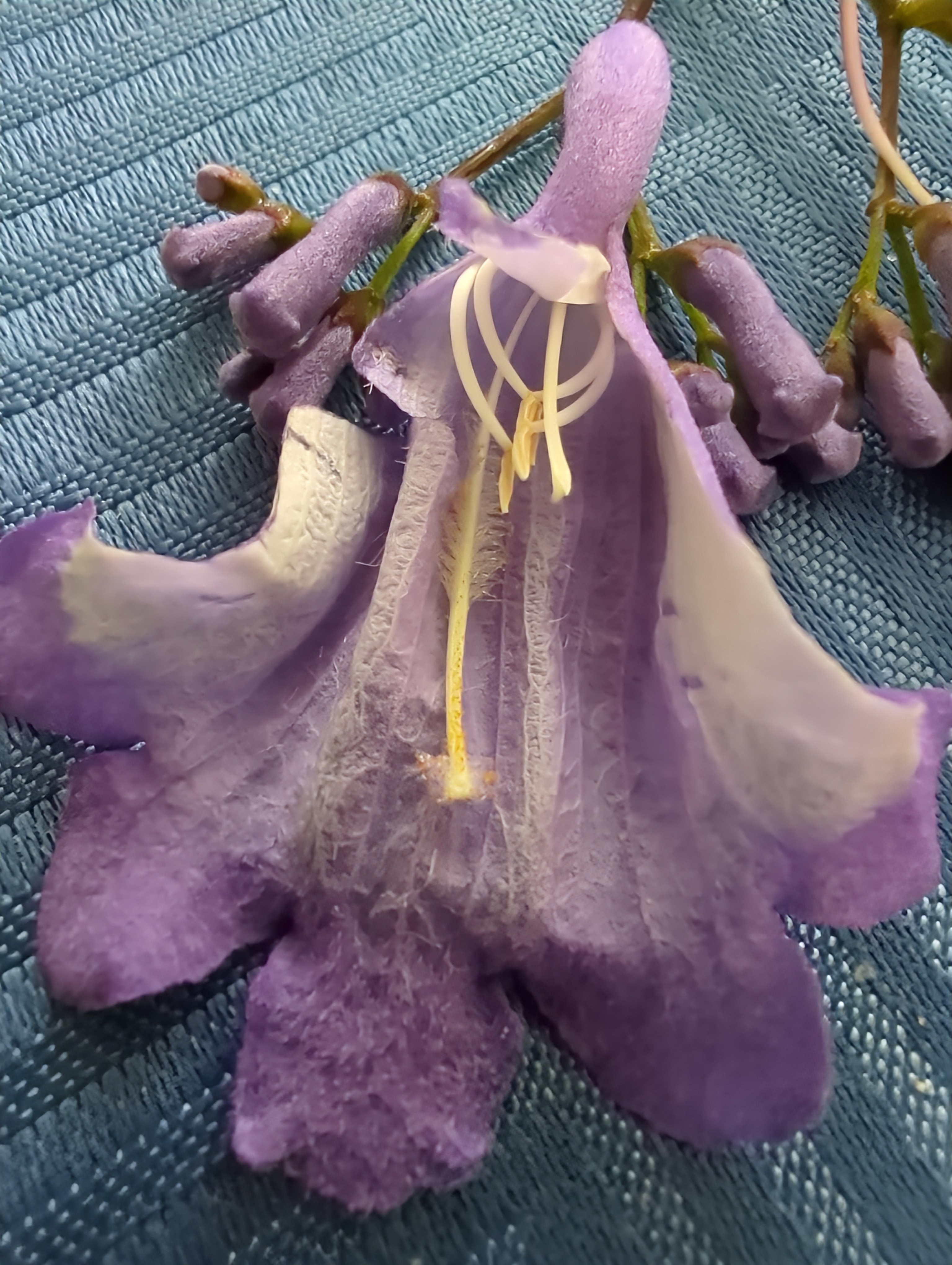
The jaccaranda flower has a superior ovary containing two carpels, leading to a two-valved woody capsule fruit after fertilization.
After blooming, the flowers fall to the ground, often creating a coloured carpet, and are replaced by woody, flat, round seed pods containing winged seeds.
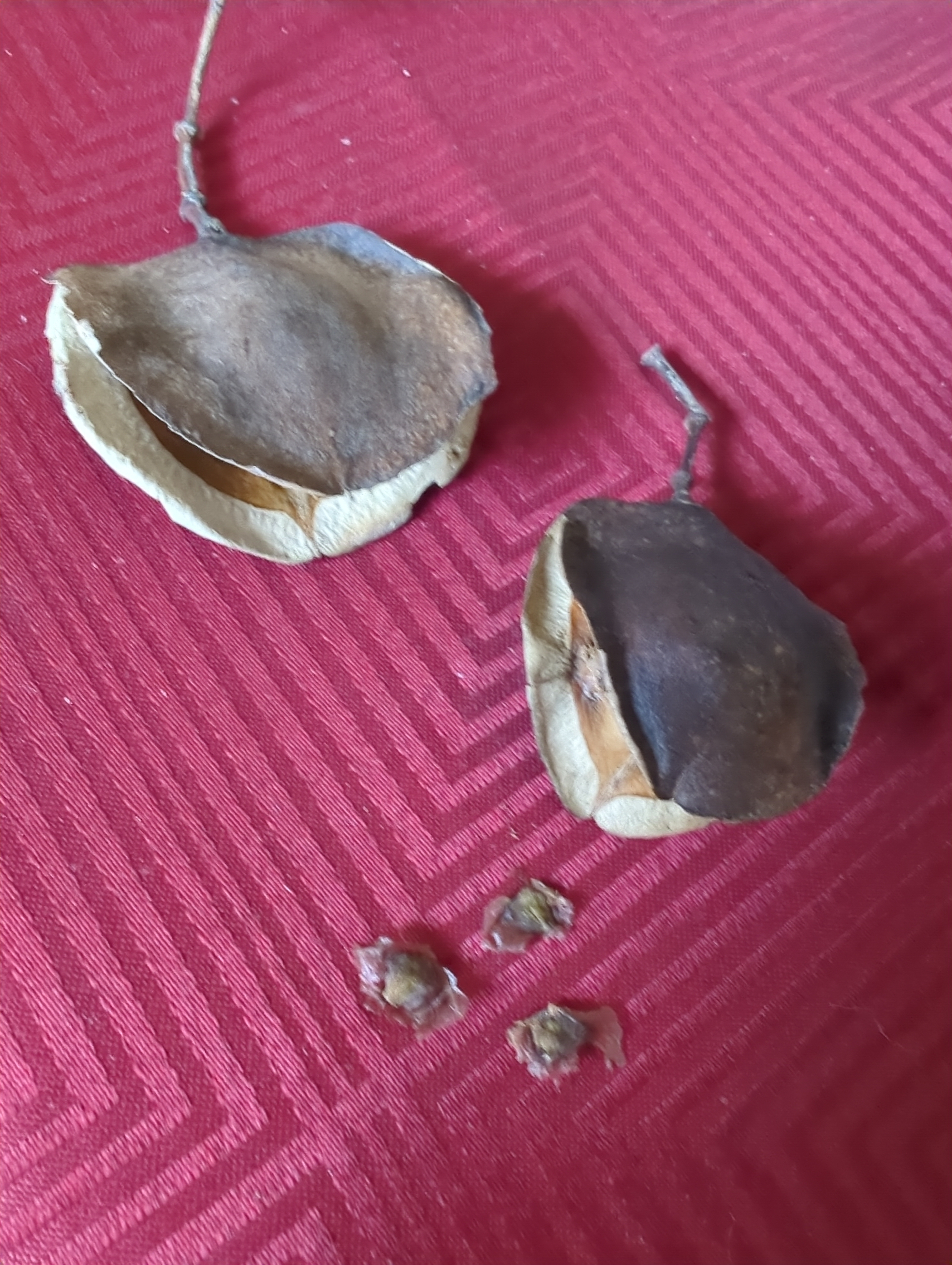
These capsules are initially green, turning brown, and split into two valves after about a year to release the seeds
The uniquely shaped seed pods are used in crafts and in floral design.
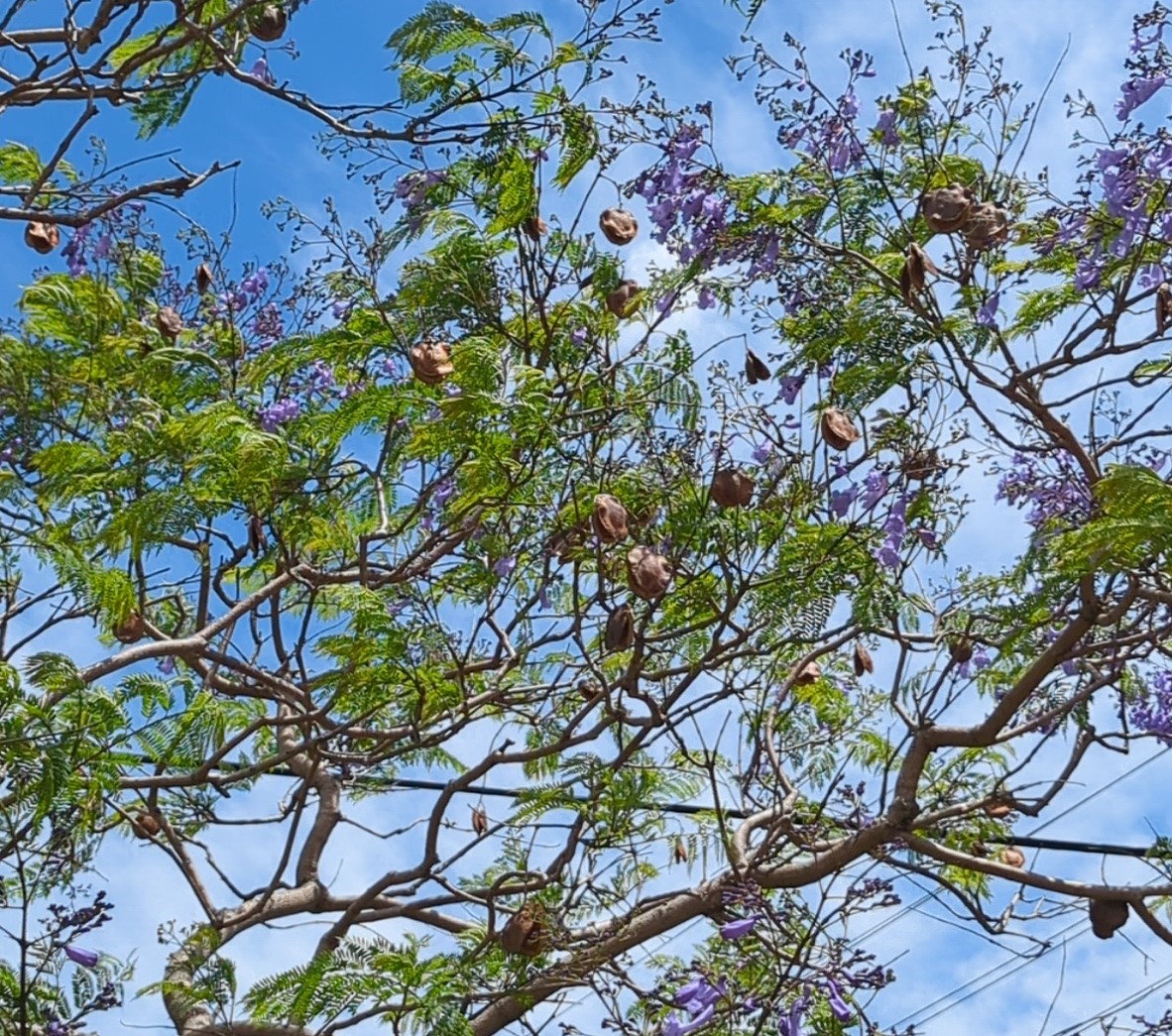
The Jacaranda needs warm weather and lots of moisture to grow well. It can survive brief cold snaps but not frost. I Jacarandas drop their leaves in dry or cold weather.
Cultivation:
Site and Soil:
The Jacaranda needs warm weather, humidity and lots of moisture to grow well, surviving brief cold snaps to -3°C but uffering damage from prolonged freezes below 5°C. Jacarandas will drop their leaves in dry or cold weather
Surface roots of the Jacaranda can disturb paving and other nearby constructions so the positioning in your garden will need thoughtful planning. The mature tree will need the width to accommodate the canopy because pruning will damage the natural beauty of its branches by inducing upright growth patterns.
Full sun is ideal for the jacaranda to bloom best and grow optimally so select a location that gets at least 6 to 8 hours of sun per day.
Planting soil should be rich, well-draining soil with a slightly acidic pH 5.5 to 7.5 for good growth. Jacarandas tolerate other soils adapting to a variety of textures including sandy, loamy, or clay types with proper ammendment.
Watering:
Newly planted jacaranda trees must be regularly watered to establish healthy root systems but will become drought tolerant once established. Over-watering trees can lead to root rot. Mature trees are drought-tolerant and only need extra watering during extended dry periods to maintain vigour and flowering
Water your tree around its base when the top 8 to 10cm of soil feels dry.