The following is a list of vegetables and herbs you can plant in October in Sydney, a temperate zone. Just click on the name for the growing guide for each vegetable or herb:
- Amaranth
- Asparagus
- Basil
- Beans – climbing and bush beans
- Beetroot
- Borage
- Broccoli
- Cabbage
- Cape Gooseberry
- Capsicum
- Carrot
- Celeriac
- Celery – in seed trays
- Chicory
- Chives
- Chillies
- Cucumber
- Daikon
- Dill
- Eggplant
- Jerusalem artichoke
- Leeks
- Lemon Balm
- Lettuce
- Luffa
- Marrow – in seed trays
- Mint
- Mustard Greens
- Okra – in seed trays
- Oregano
- Parsley
- Parsnip
- Peas
- Potato
- Pumpkin
- Radish
- Rhubarb
- Rocket
- Rockmelon– in seed trays
- Rosella – in seed trays in greenhouse
- Rosemary
- Sage
- Silverbeet
- Spring onions
- Sunflower
- Sweet corn
- Thyme
- Tomato
- Turnip
- Water melon
- Yacon
Plant of the Month – Pomegranate – ( Punica granatum)
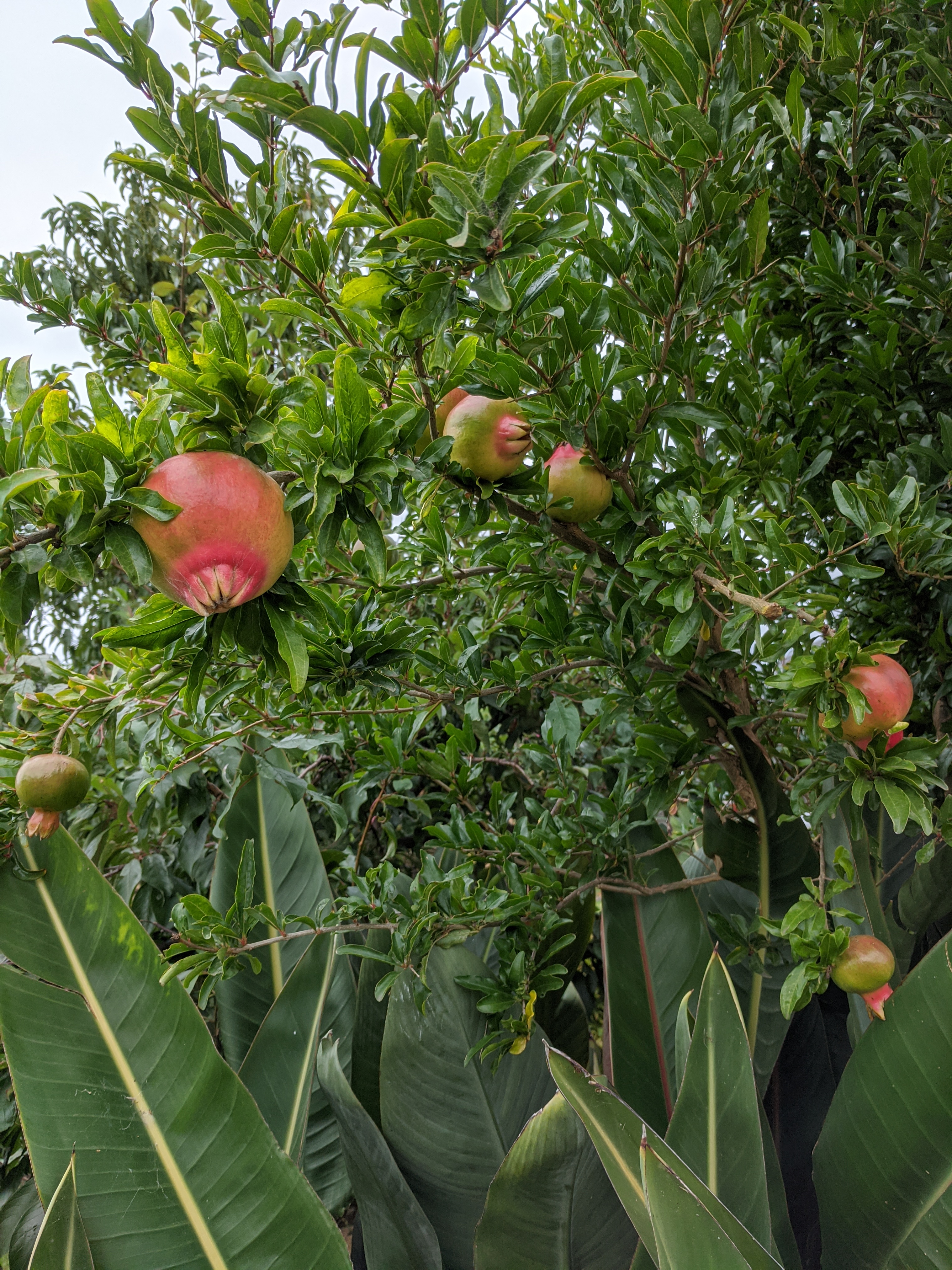
(Click on any image in this post to see more detail).
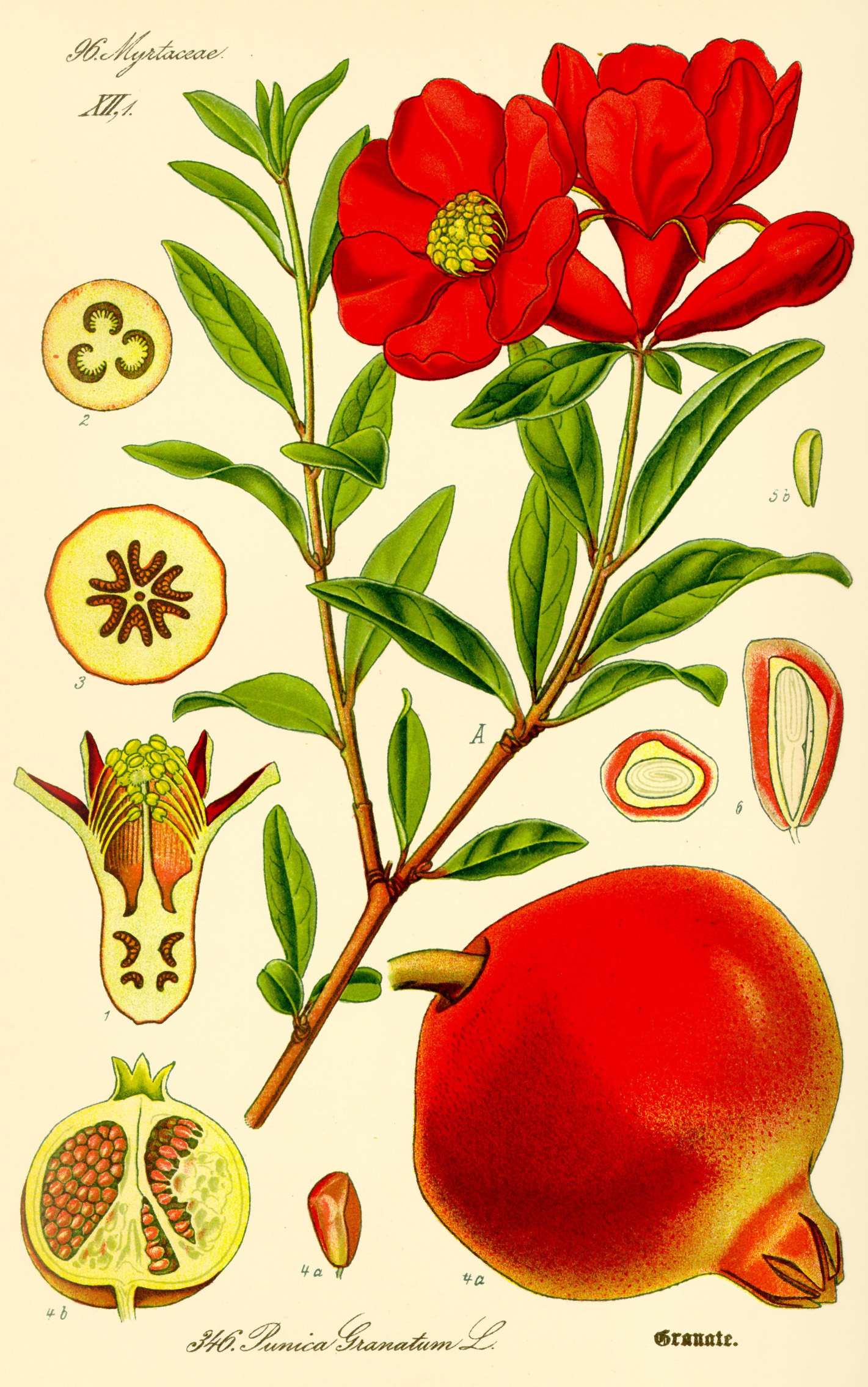
The pomegranate (Punica granatum) is a fruit-bearing, deciduous shrub in the family Lythraceae subfamily Punicoideae.
Evidence shows that Pomegranate was first cultivated in ancient Persia (Iran) in 3000 BC in the Iranian plateau and nearby regions of Egypt and India then introduced by traders to the Mediterranean as far as Spain and Portugal and the new world. It is extensively cultivated for its fruit. It is long-lived, with some specimens in France surviving for 200 years.
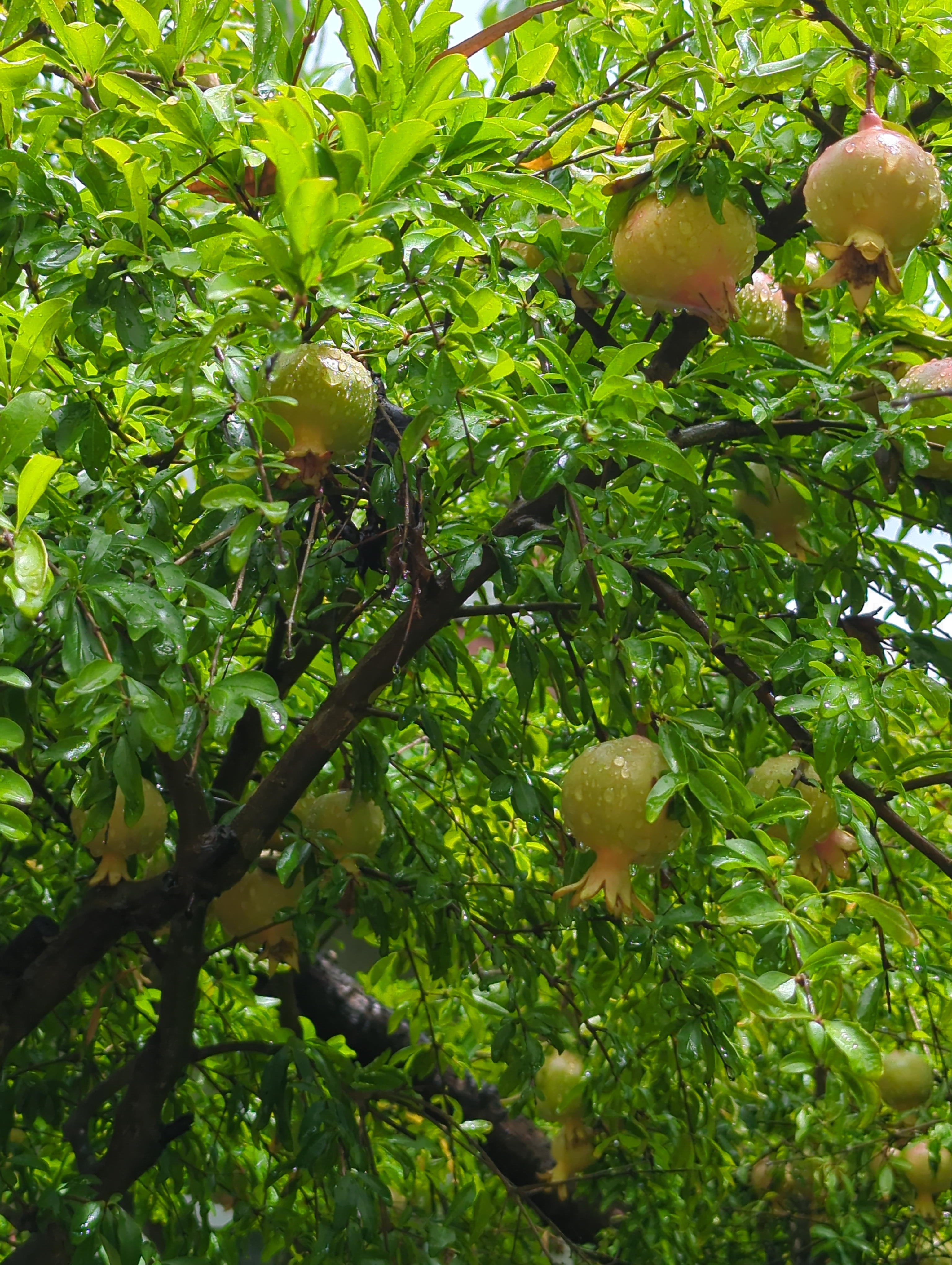
The pomegrate is a dense, naturally bushy, deciduous shrub, 1.5-5 m tall that, if left will naturally increase its bushiness by way of suckers that arise from the base. The plant has slender branches. New spring shoots are thin and arching and often thorny. It may be trained as a vase shape or as a single trunked small tree. It can even grown into hedges by spacing plants and allowing its natural tendency to grow suckers in the spaces between plantings to fill out the planting..
There are some pomegranate varieties available for ornamental purposes, which do not produce good fruit and are grown for the beauty of its many flowers, some with multi-petaled “double” flowers.
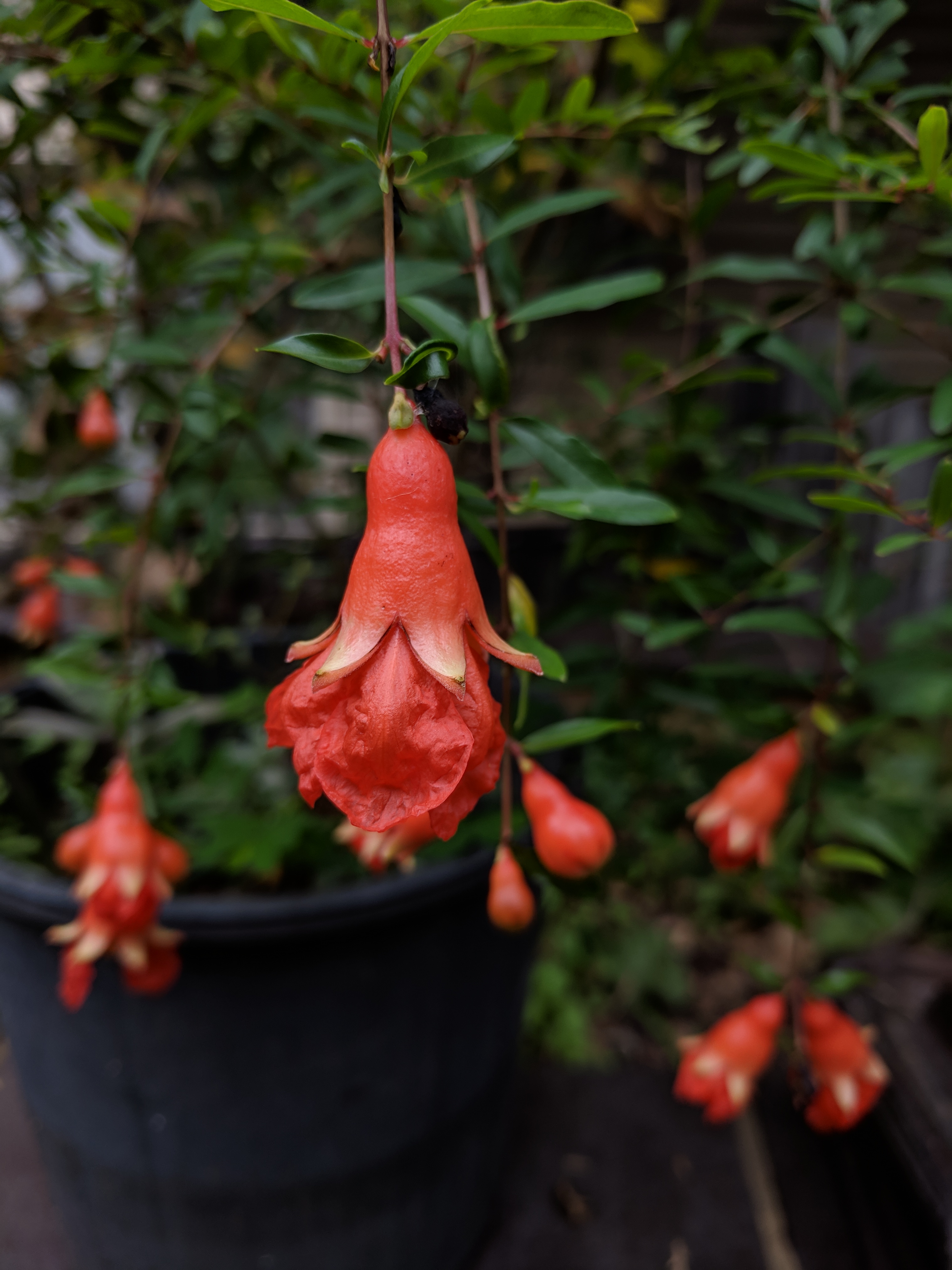
The pomegranate plant is monoecious, that is, it has stamens and pistils in different flowers on the same plant. with two types of showy flowers produced on new growth each spring.
Flower colour for many cultivars is orange-red to brilliant red and there are some that are pink, white, or some combination of those colours. Pollination primarily by insects (bees) leads to fruit set and the development of the inferior ovary.
Flowering may occur from spring over several months with some flowers still being produced into late summer and autumn, but the main flowering period is spring.
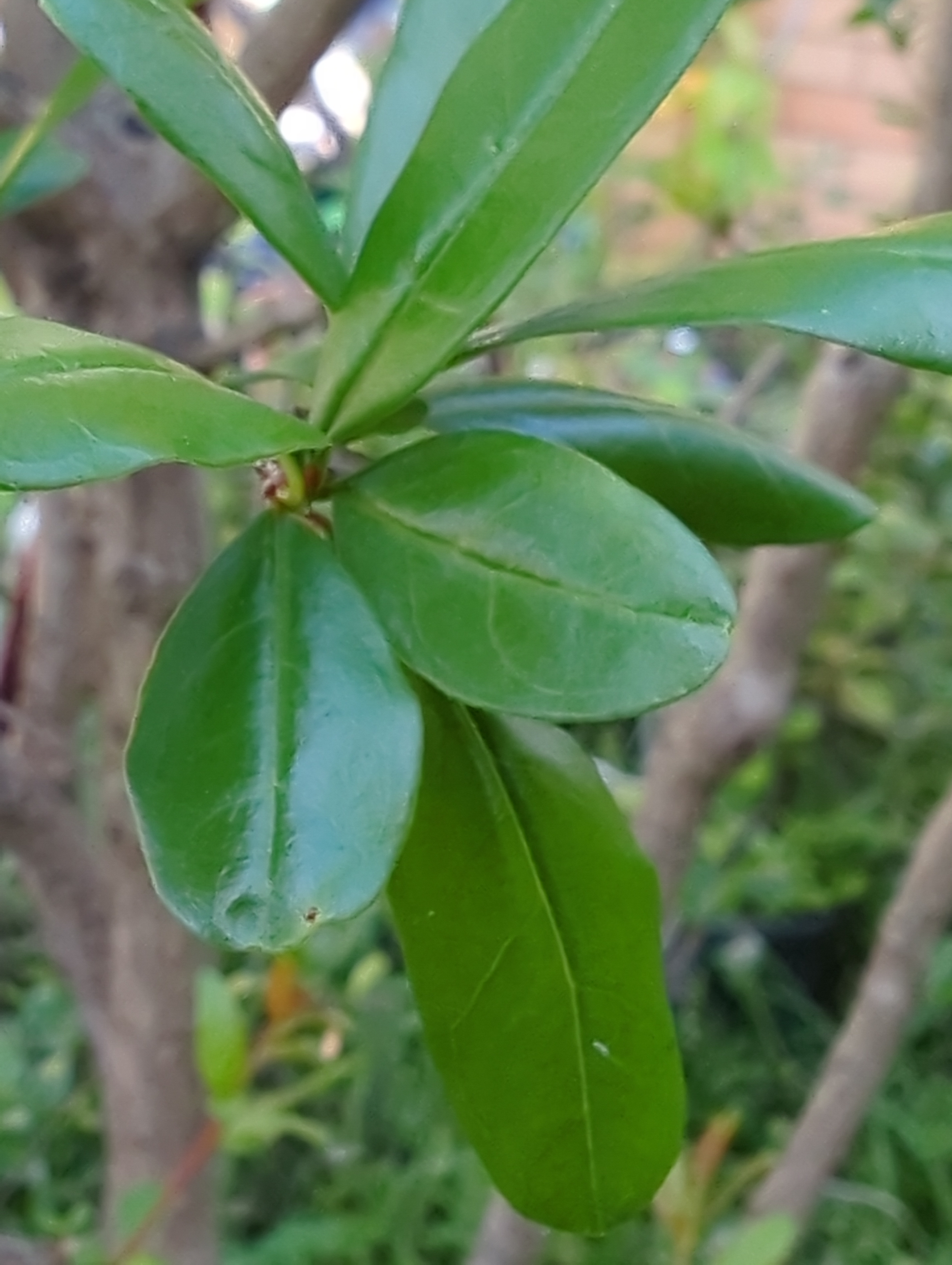
Pomegranate leaves are glossy, dark green, oblong to oval, and 2.5‒3 cm long. Leaves are arranged in opposed and pairs alternately crossing at right angles forming whorls and clustered on short branches.
Buds are important for the vegetative (leaves) and reproductive (flowers) growth of trees. Buds can be terminal or lateral.
Compared to other fruit trees, Pomegranate buds are tiny and about 0.1–0.3 cm and are brownish-green.
Small axillary buds form on the current year’s twigs or on secondary (thorny) twigs as can be seen in the image below.
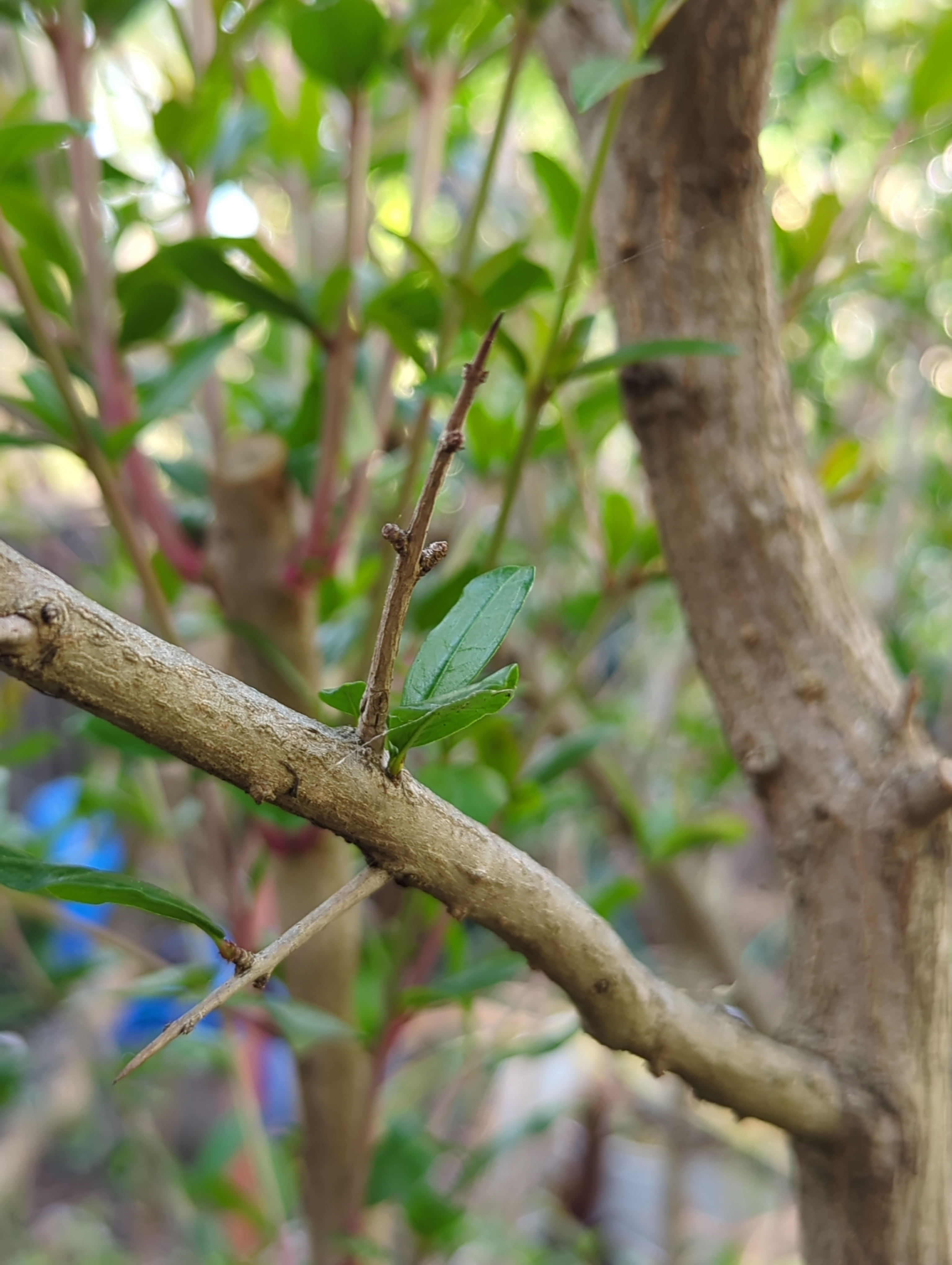
Larger-sized buds are generally located in the upper part of spurs.
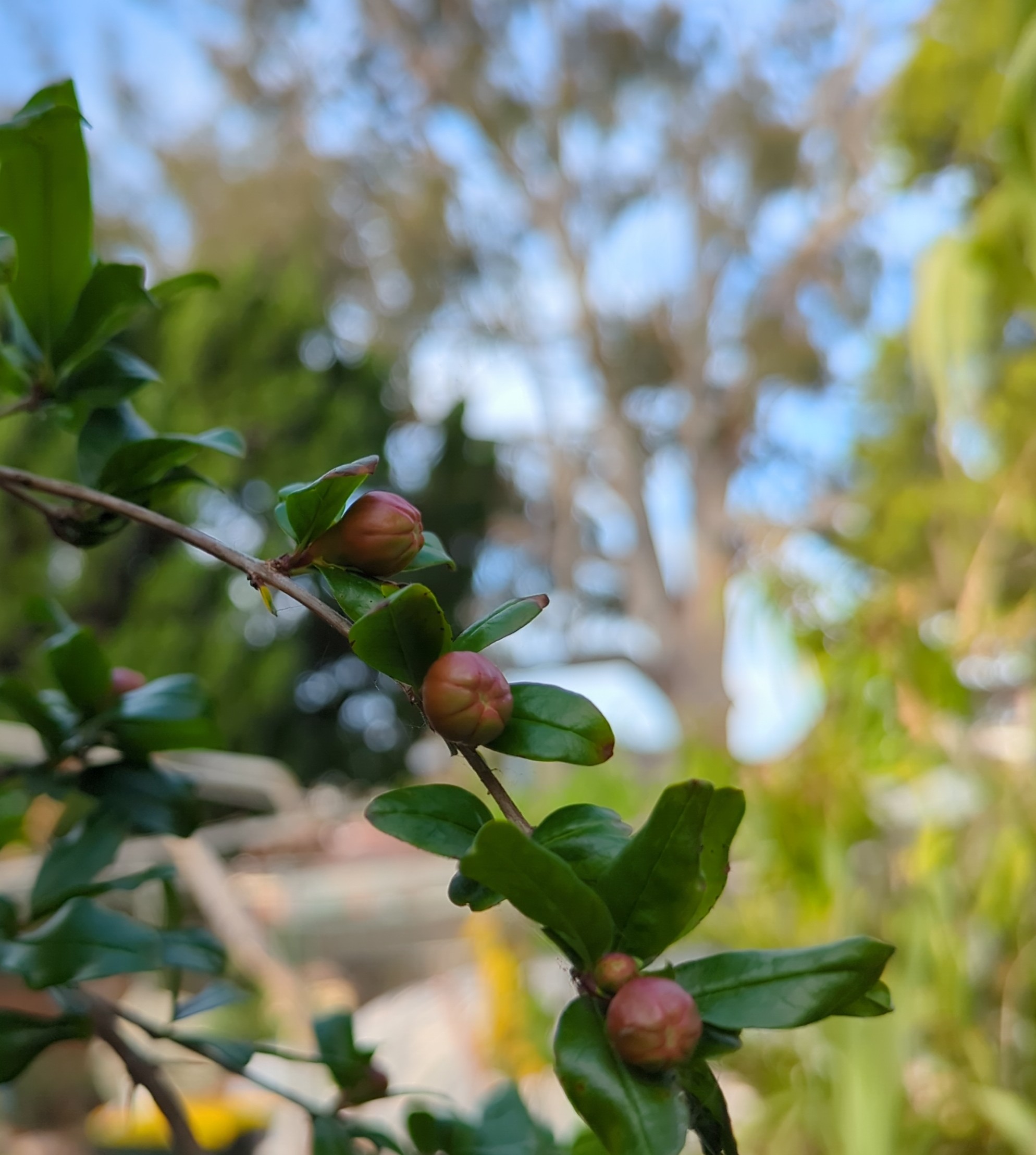
Pomegranate flowers buds emerge on the shoot terminals, singly or in clusters of two or more. when the trees become 3-4 years old.
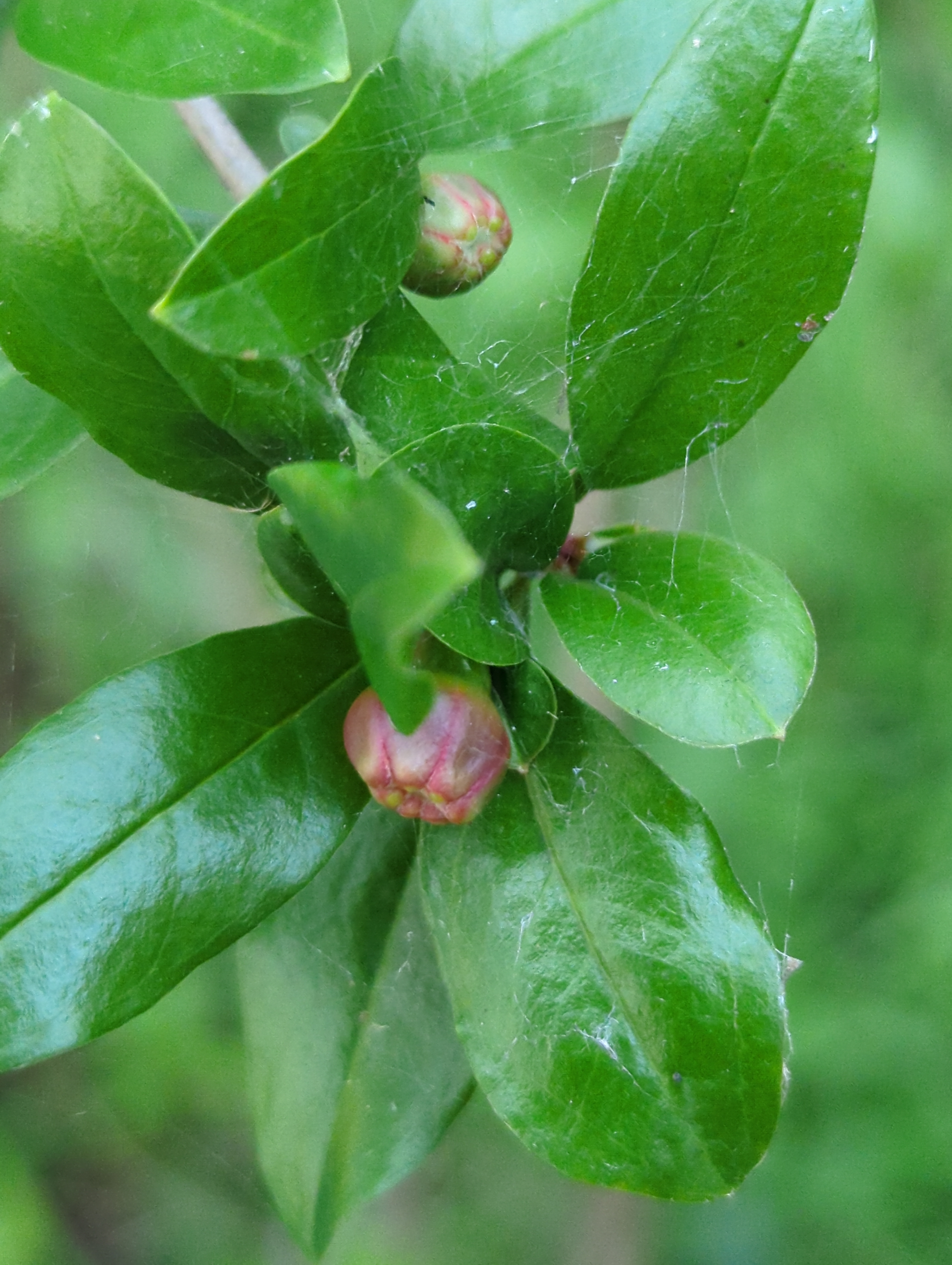
The female flower is self-fertile. and produces fruit while male flowers do not set fruit. The pomegranate flower that emerges first usually sets, but lateral ones, are often sterile and fall soon after blooming.
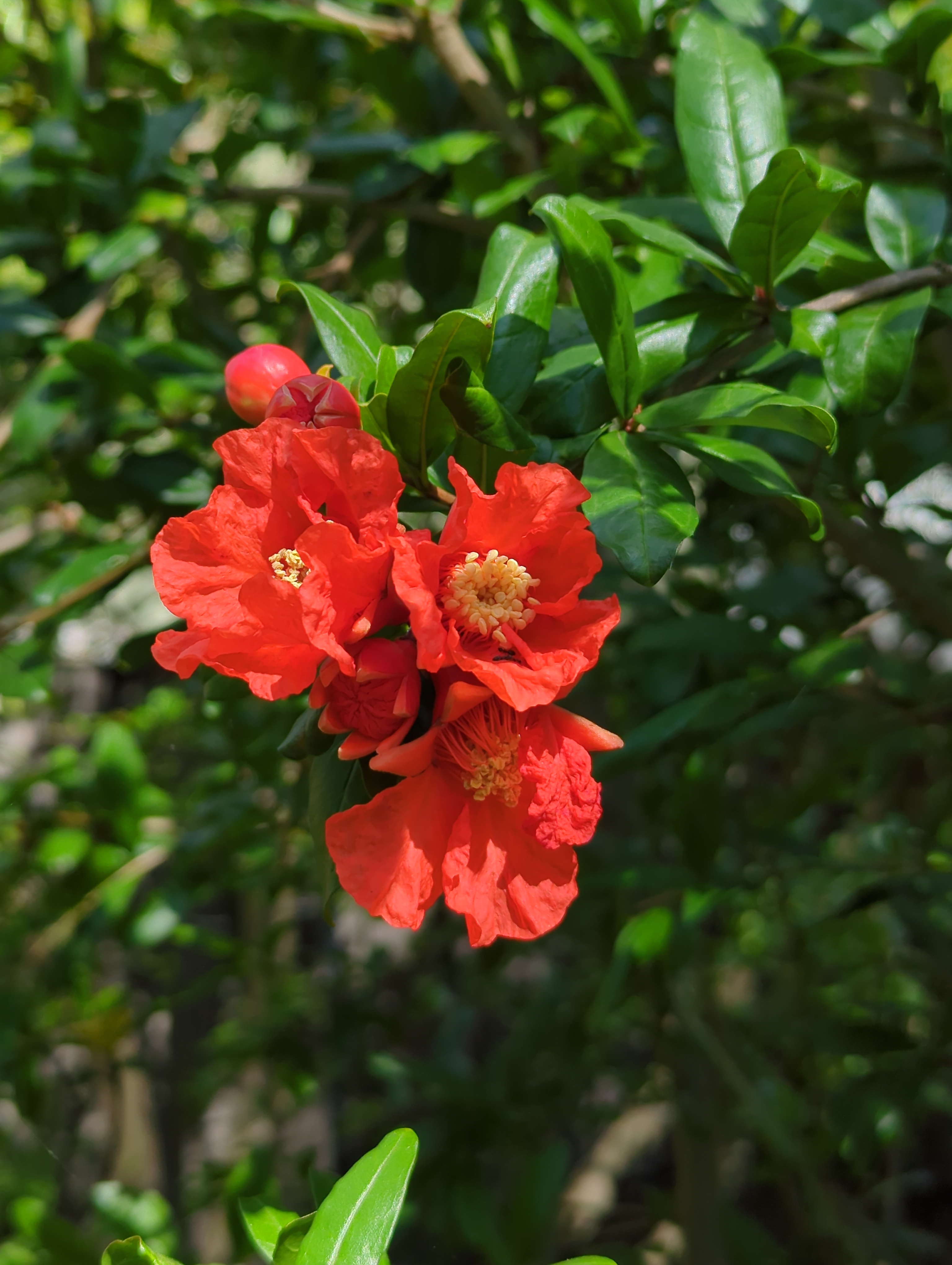
Pomegranate flowers are a flame orange-red, 4‒6 cm in diameter with crepe-like, crinkled petals and numerous stamens. Flowers are borne solitary or in small clusters angled towards the end of branchlets.
The central terminal flower that emerges first usually sets fruit, whereas the lateral ones, which are often sterile, fall away soon after blooming.
This can be seen in the image below. One stem has a terminal flower with two adjacent buds on one thin stem
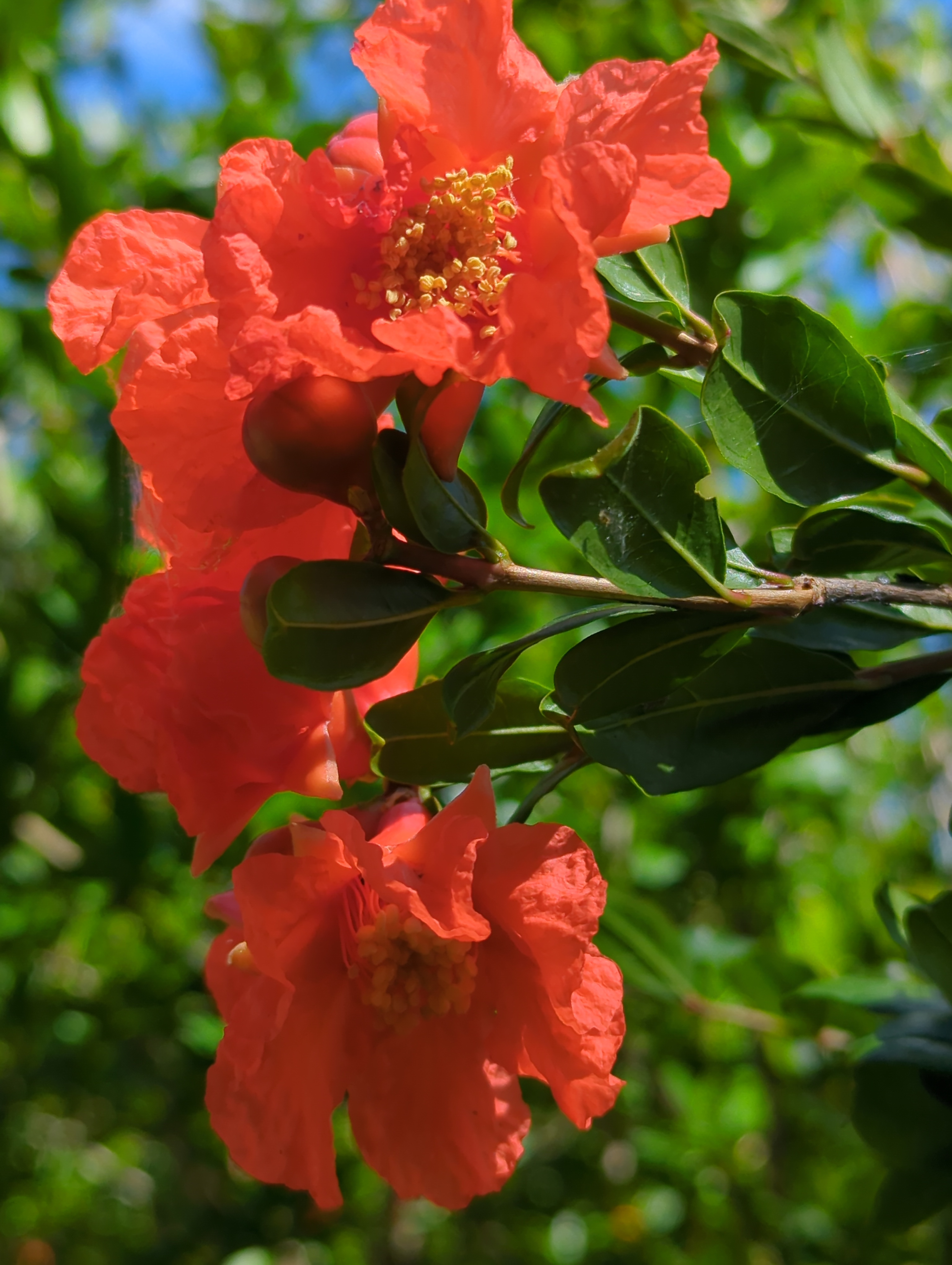
The position of buds vary from a typical two buds per node to a single bud or more. Two types of buds were observed: small and thin on the twigs (short, medium, and long) and large and round on the spurs; large buds were also observed on twigs but in a reduced number.
Pomgranate cultivars have 5-7 petals on flowers. Hermaphrodite (female) flowers are larger and longer than the staminate (male) flowers and also more abundant. Moreover, flowers developing from a single flower bud are longer than flowers developing from mixed buds.
They are 3 cm wide and have a thick, tubular, red calyx that has 5 to 8 fleshy, pointed sepals forming a vase from which emerge the 3 to 7 crinkled, red, white or variegated petals enclosing the numerous stamens.
The image below is of a female hermaphrodite vase-shaped flower after pollination and the petals dropped. It has a well-developed ovary and a long style that extends to or above the anthers, allowing for self-pollination and fruit set.
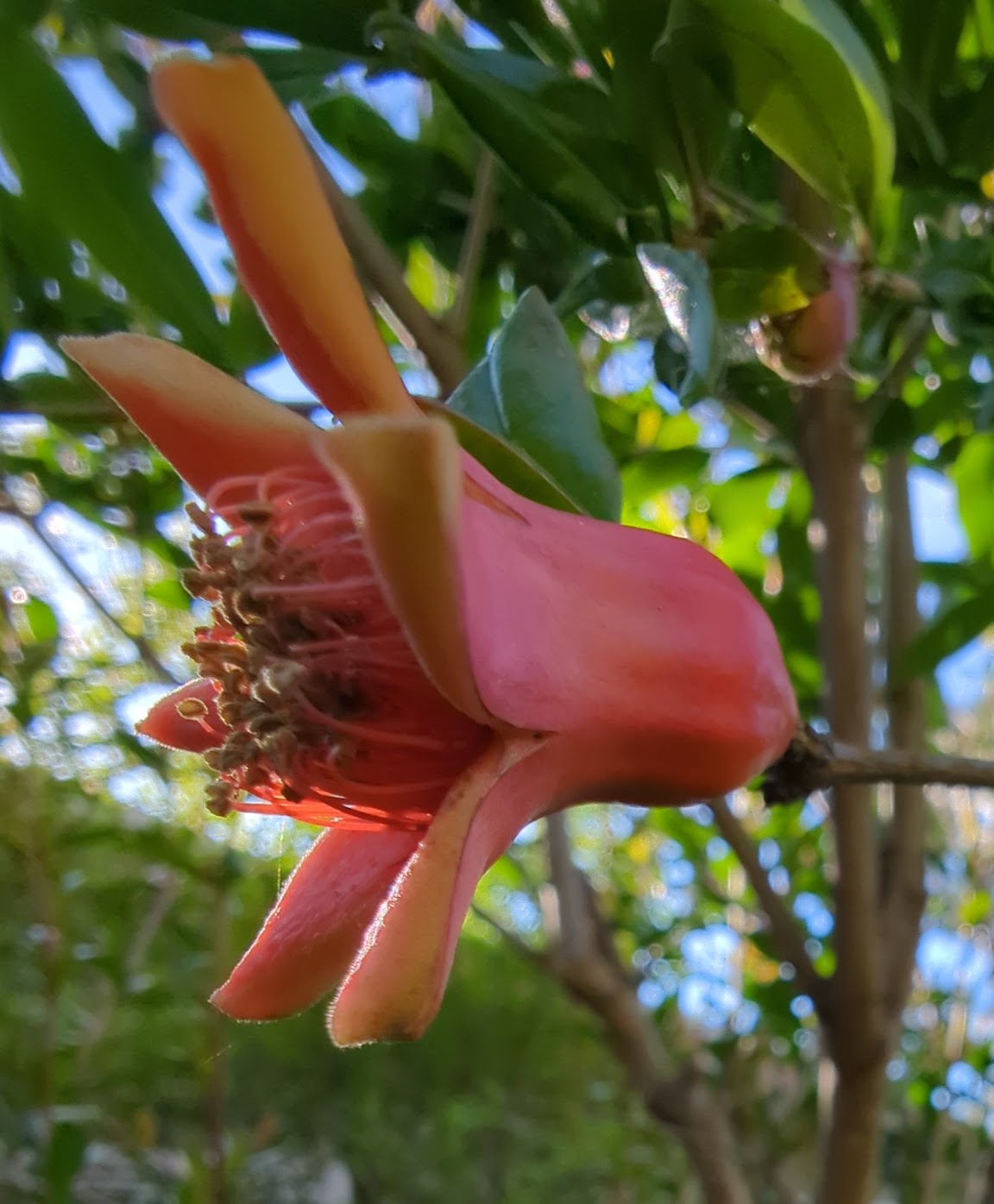
The image below is of a male, bell-shaped male flower after pollination and petal drop. It has an underdeveloped pistil and short style
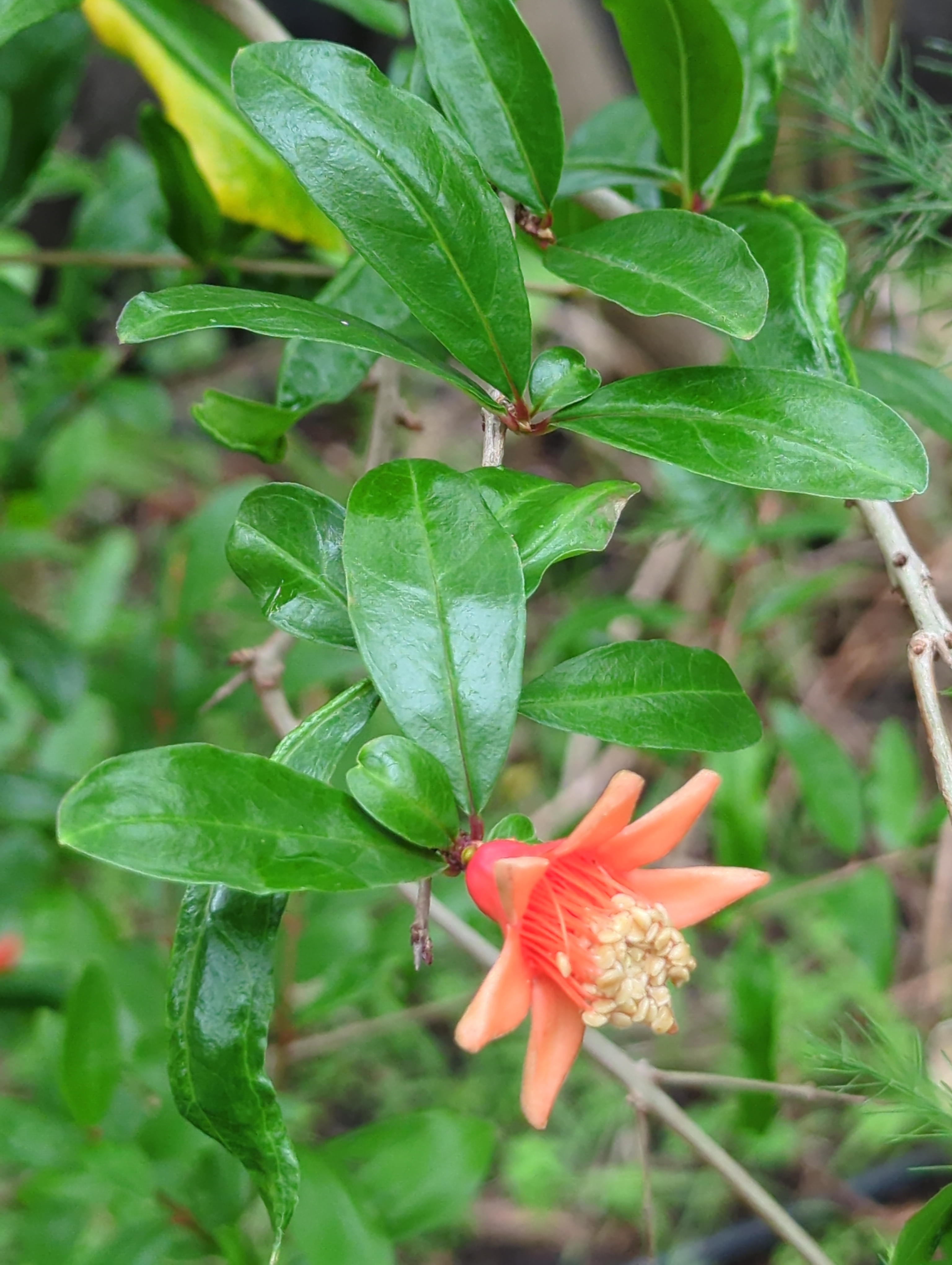
The image below shows pomegranate flowers at different stages: fully opened closed bud (far right) and developing bud (centre rear).
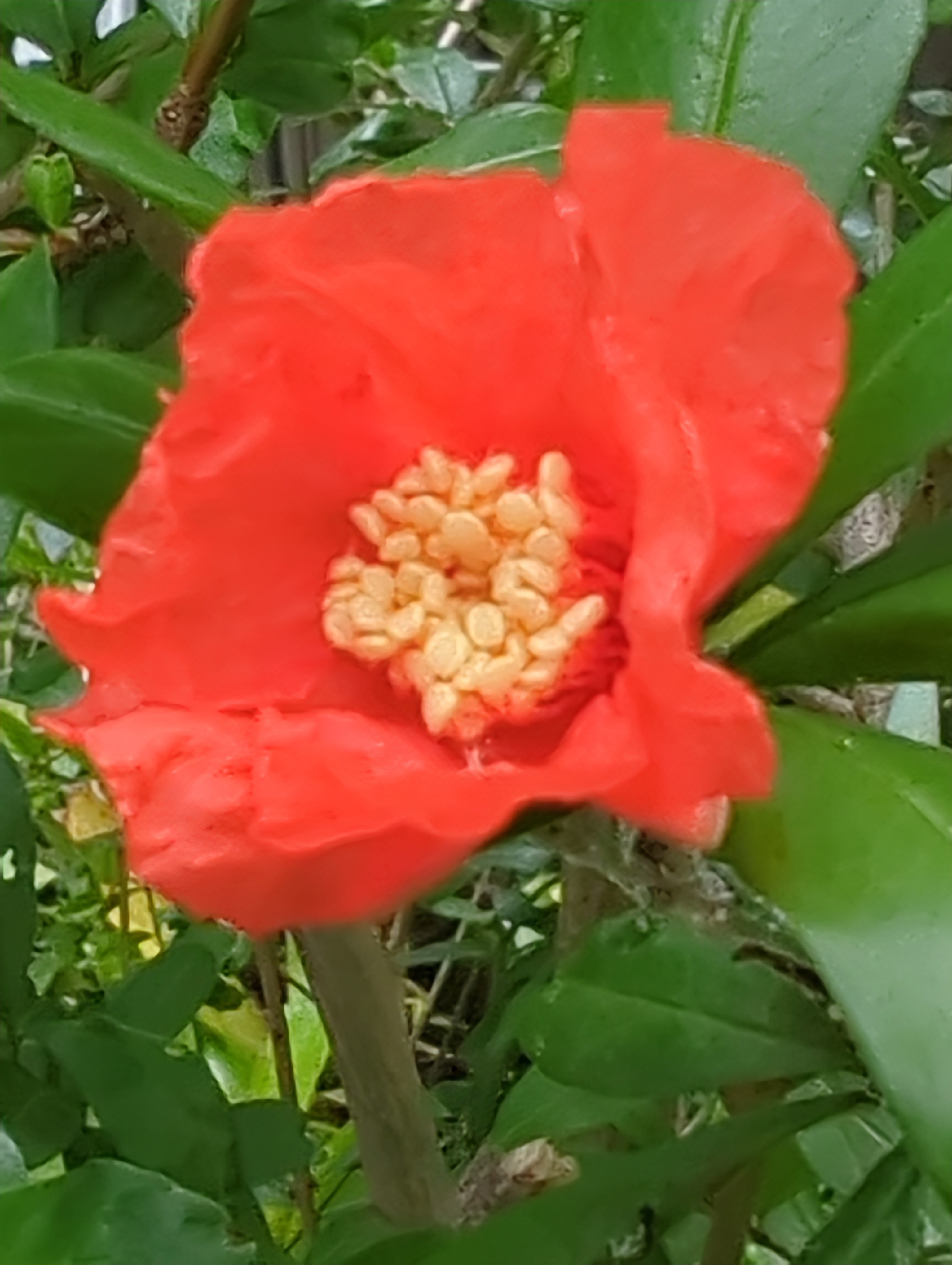
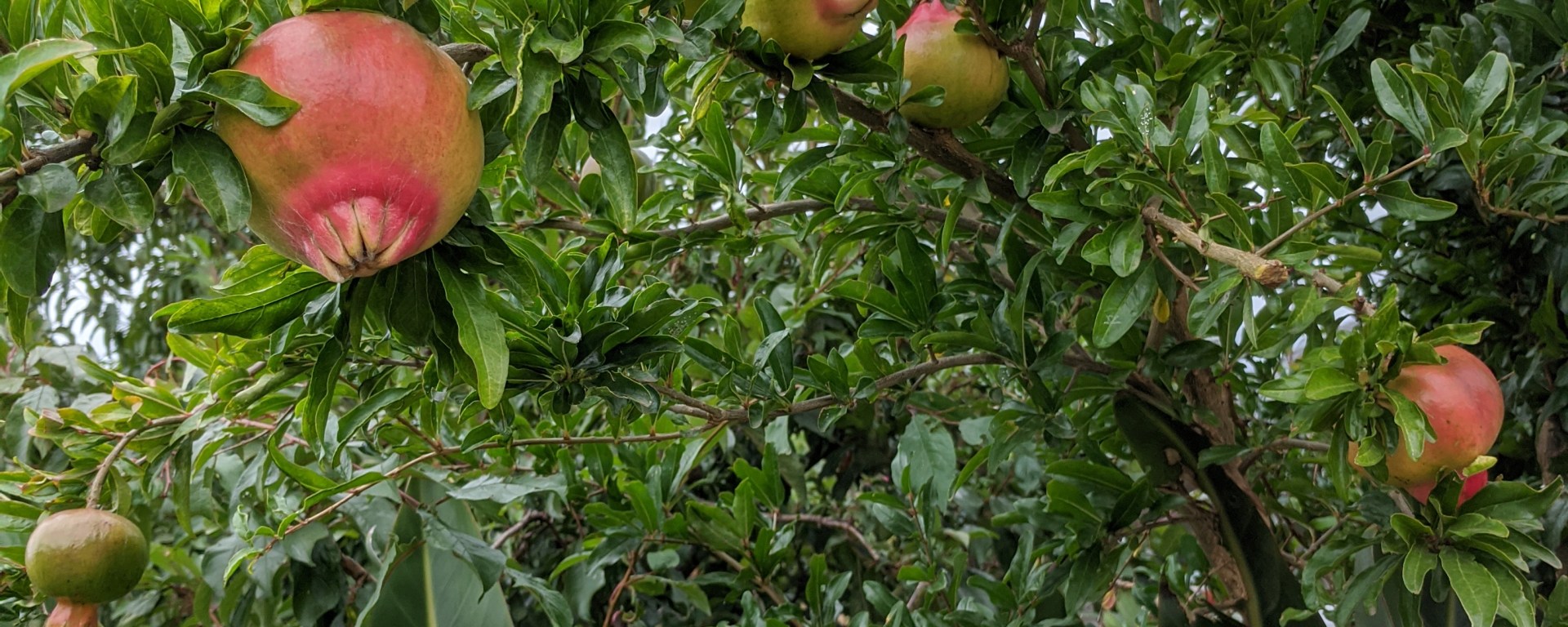
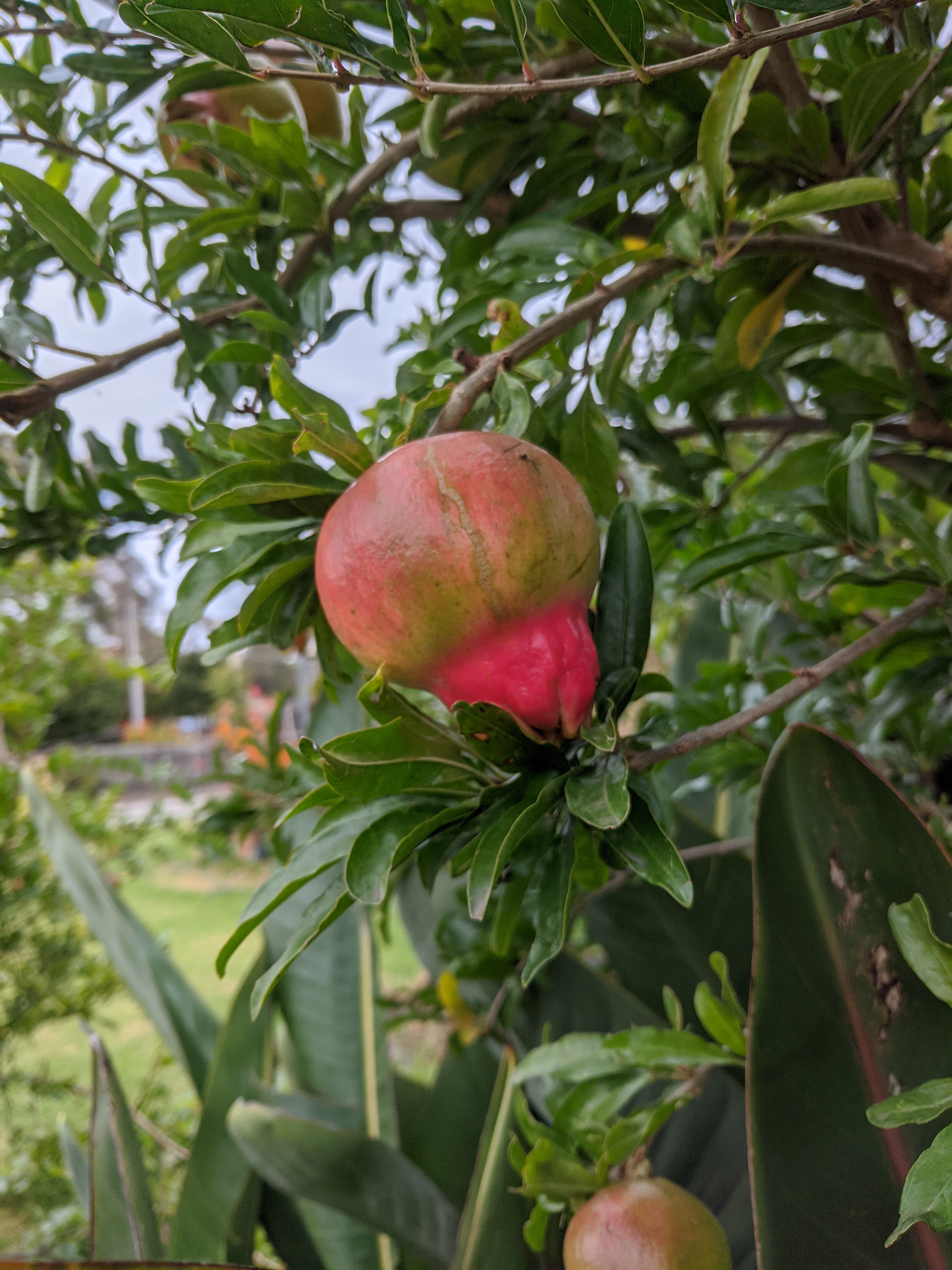
The pomegranate fruit is nearly round with a prominent crown-like calyx at the base. The fruit is 6.25-12.5 cm wide, with a tough, leathery skin or rind, that can be yellow overlaid with light or deep pink or rich red. The interior is separated by membranous walls and white spongy tissue (rag) into compartments packed with transparent sacs filled with tart, flavourful fleshy, juicy, red, pink or whitish pulp (technically the aril). In each sac, there is one white or red, angular, soft or hard seed. The seeds represent about 52% of the weight of the whole fruit.
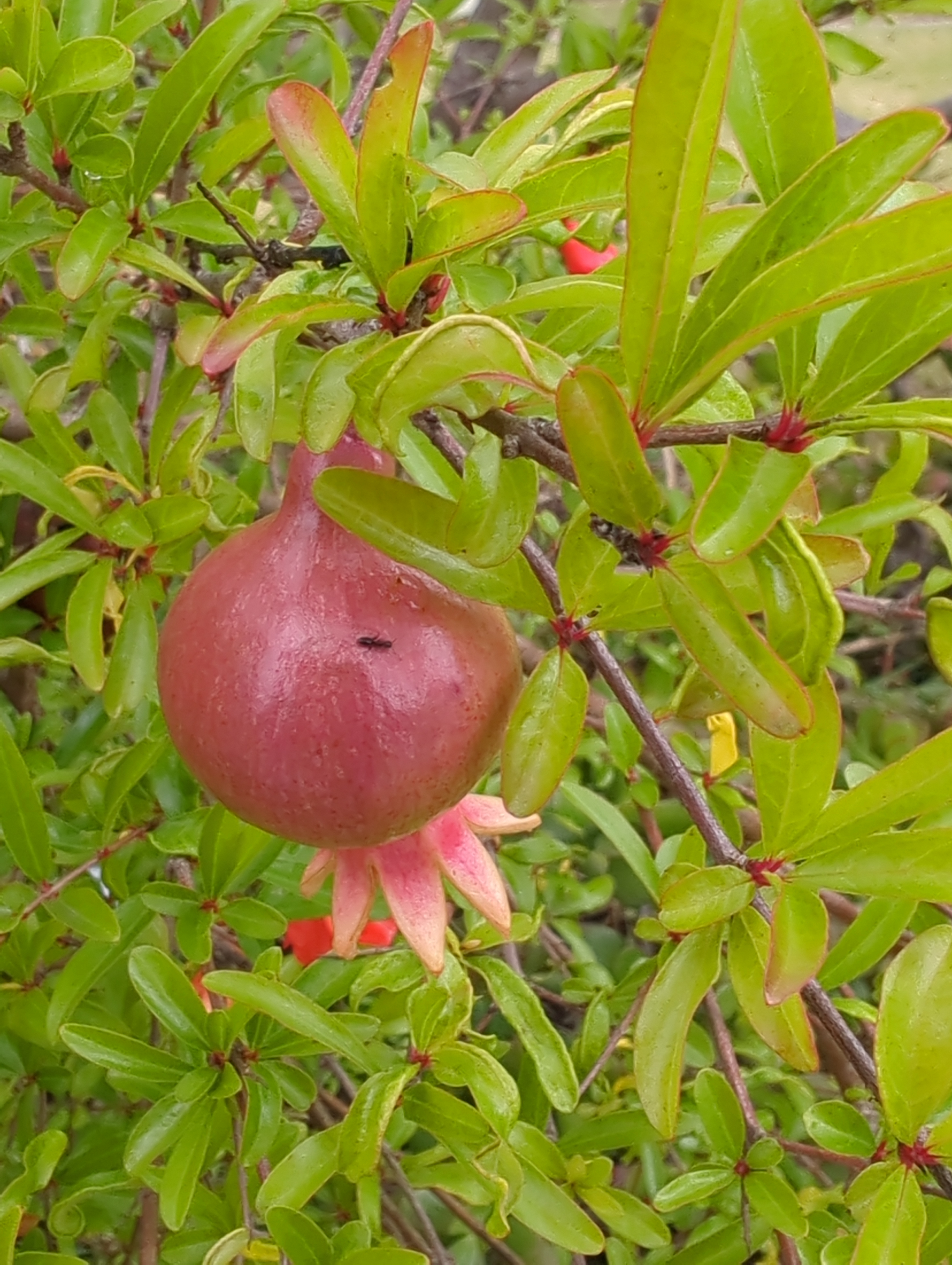
The pomegranate fruit has a red-purple husk with a hard skin. The most common rind color is red, but it can also
be yellow, orange, green, or black.
The fruit can vary in size, from 2–8 cm in diameter in wild plants and to 12 cm in some cultivars with a rounded shape.
The interior of the pomegranate fruit has membranous walls of white spongy tissue separated into compartments packed with transparent sacs called arils. These are filled with tart, flavourful, fleshy, juicy, red, pink or whitish pulp In each sac, there is one white or red, angular, soft or hard seed. The seeds represent about 52% of the weight of the whole fruit.
Arils an appear red, light red, pink, light pink, yellow, or clear.
The number of seeds in a pomegranate can vary from 200 to about 1,400. Botanically, the fruit is a berry with edible seeds and pulp produced from the ovary of a single flower.
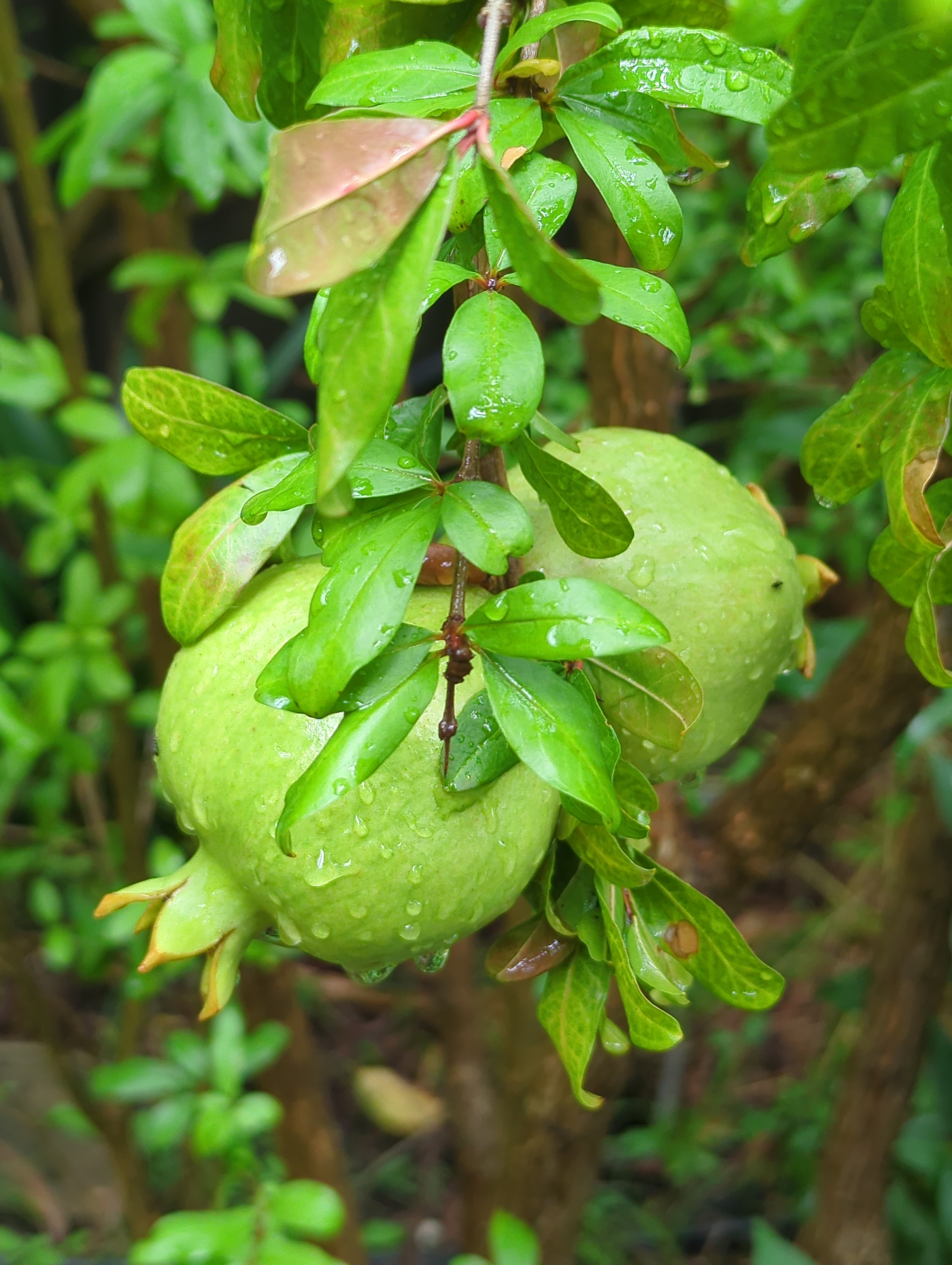
It takes 5 to 7 months for a pomegranate fruit to mature and ripen from the time of pollination
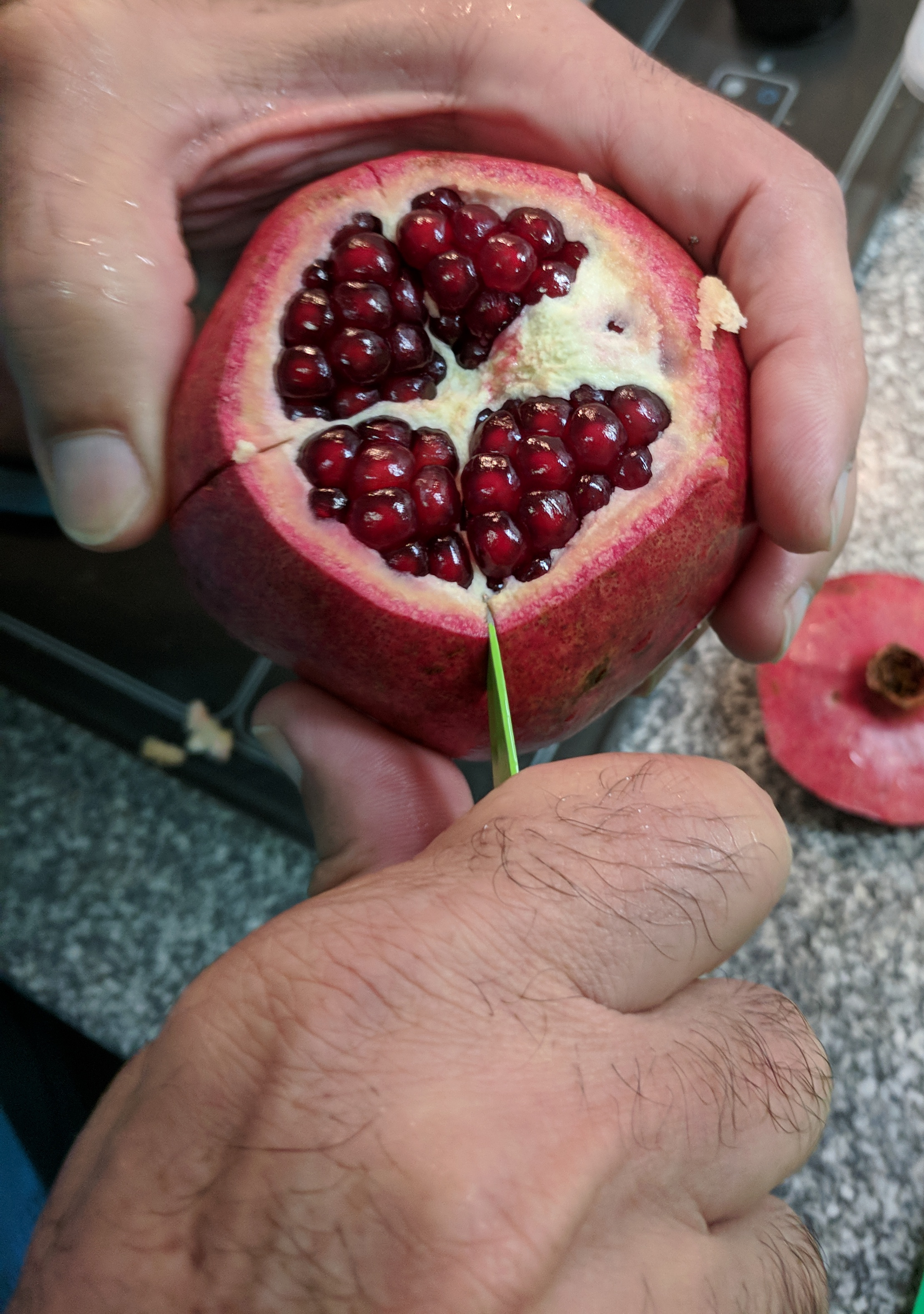
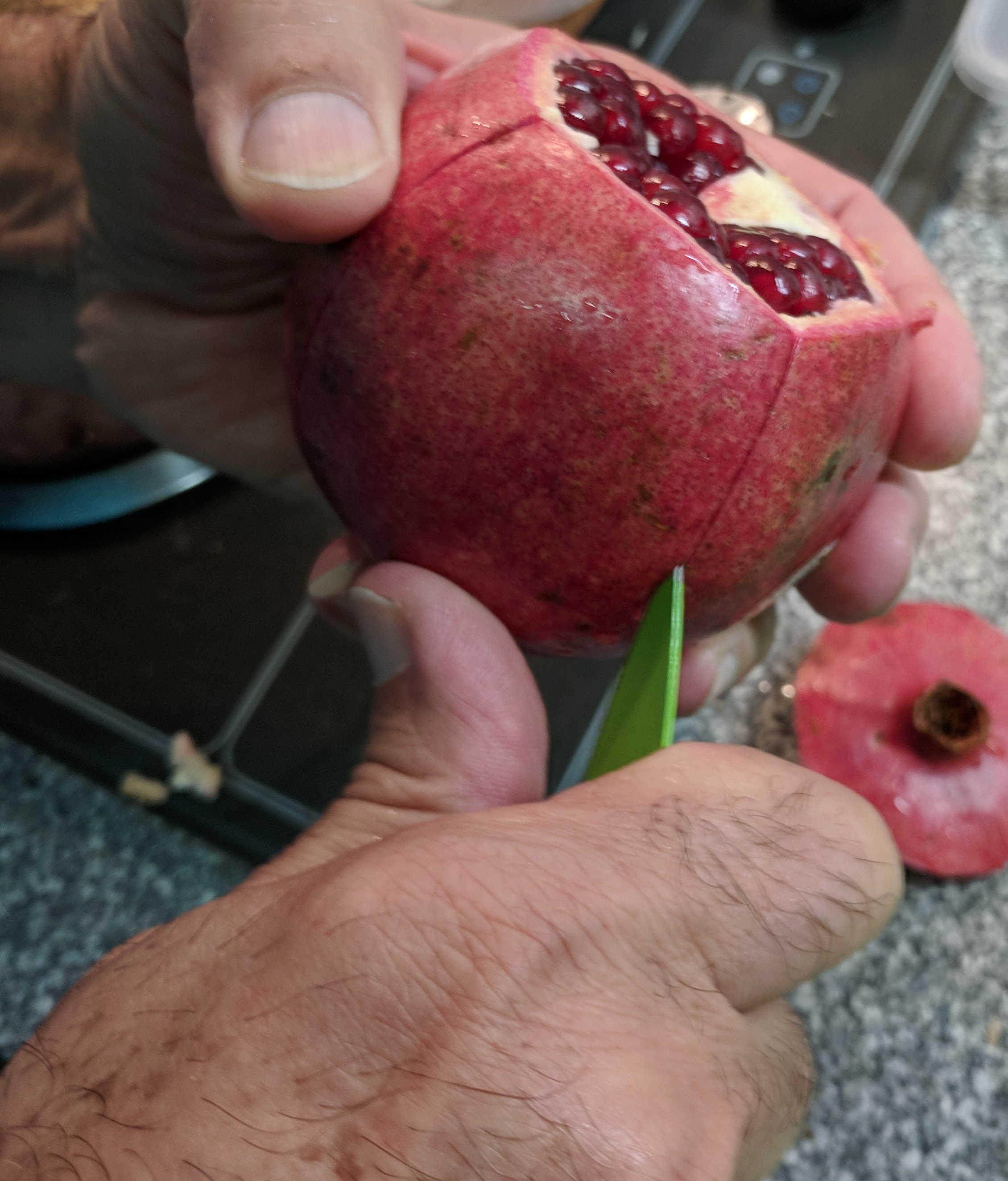
The number of seeds in a pomegranate can vary from 200 to about 1,400. Botanically, the fruit is a berry with edible seeds and pulp produced from the ovary of a single flower.
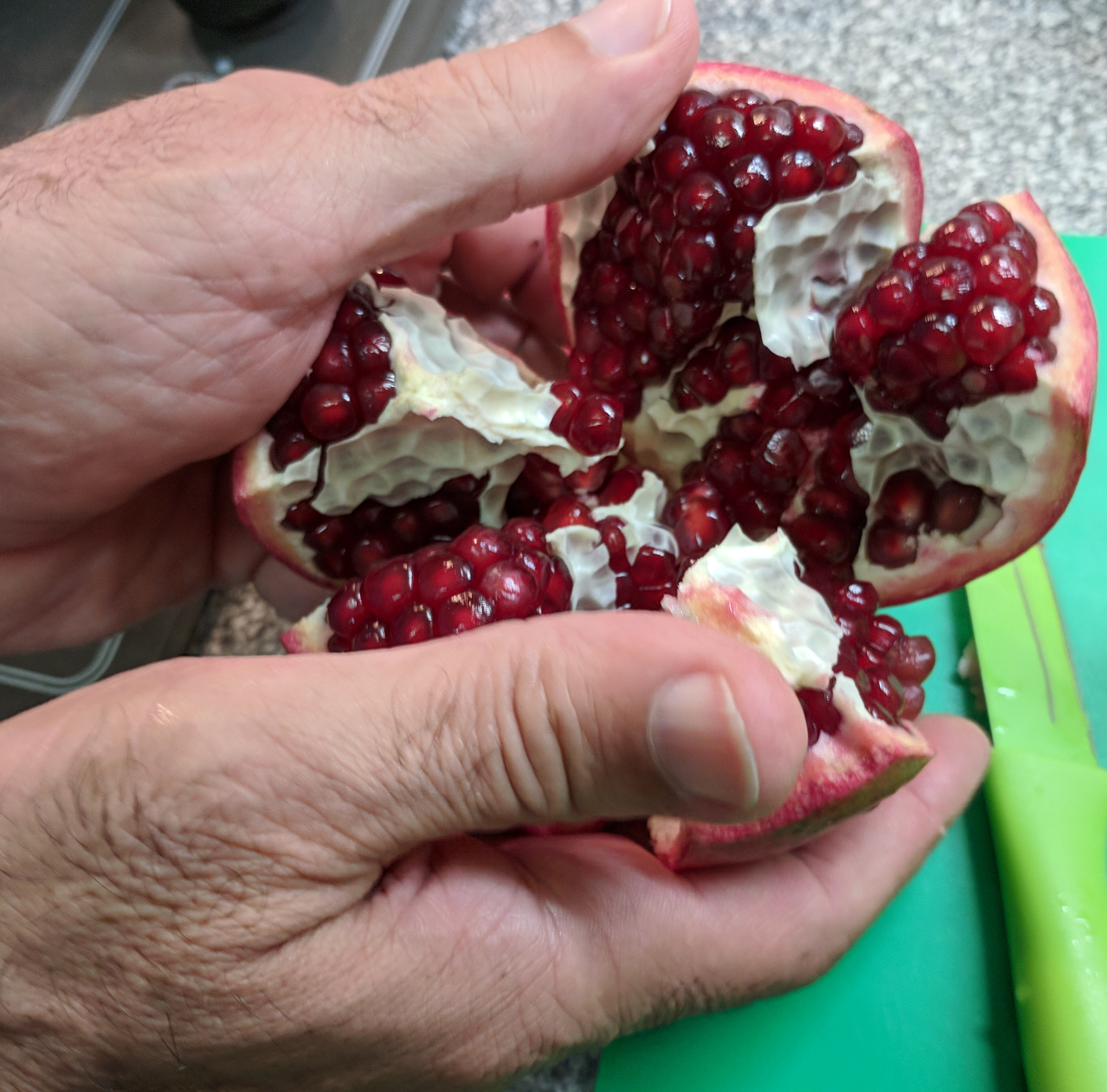
In each aril there is one white or red, angular, soft or hard seed. The seeds represent about 52% of the weight of the whole fruit.
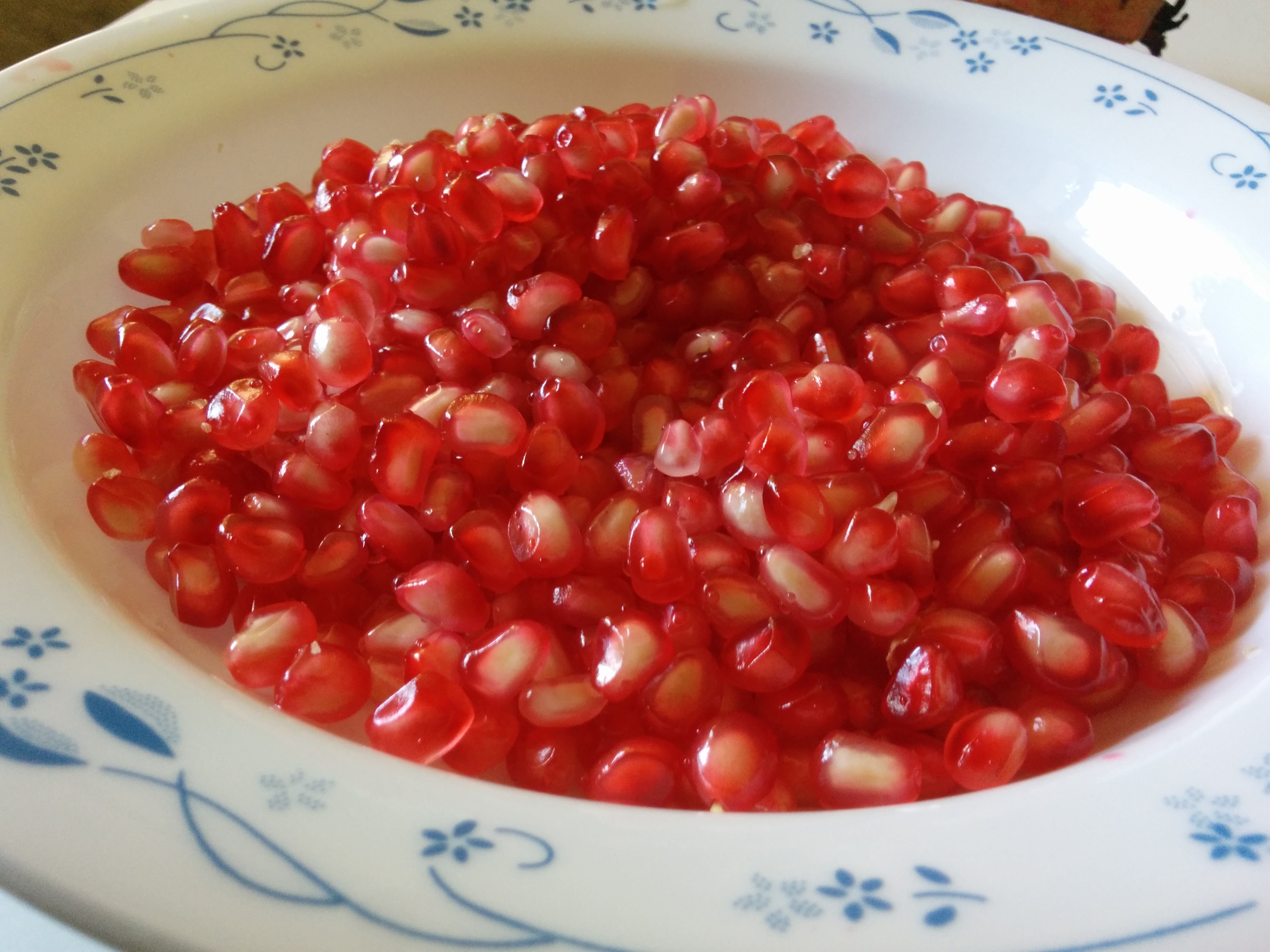
Culinary uses of Pomegranate Seeds:
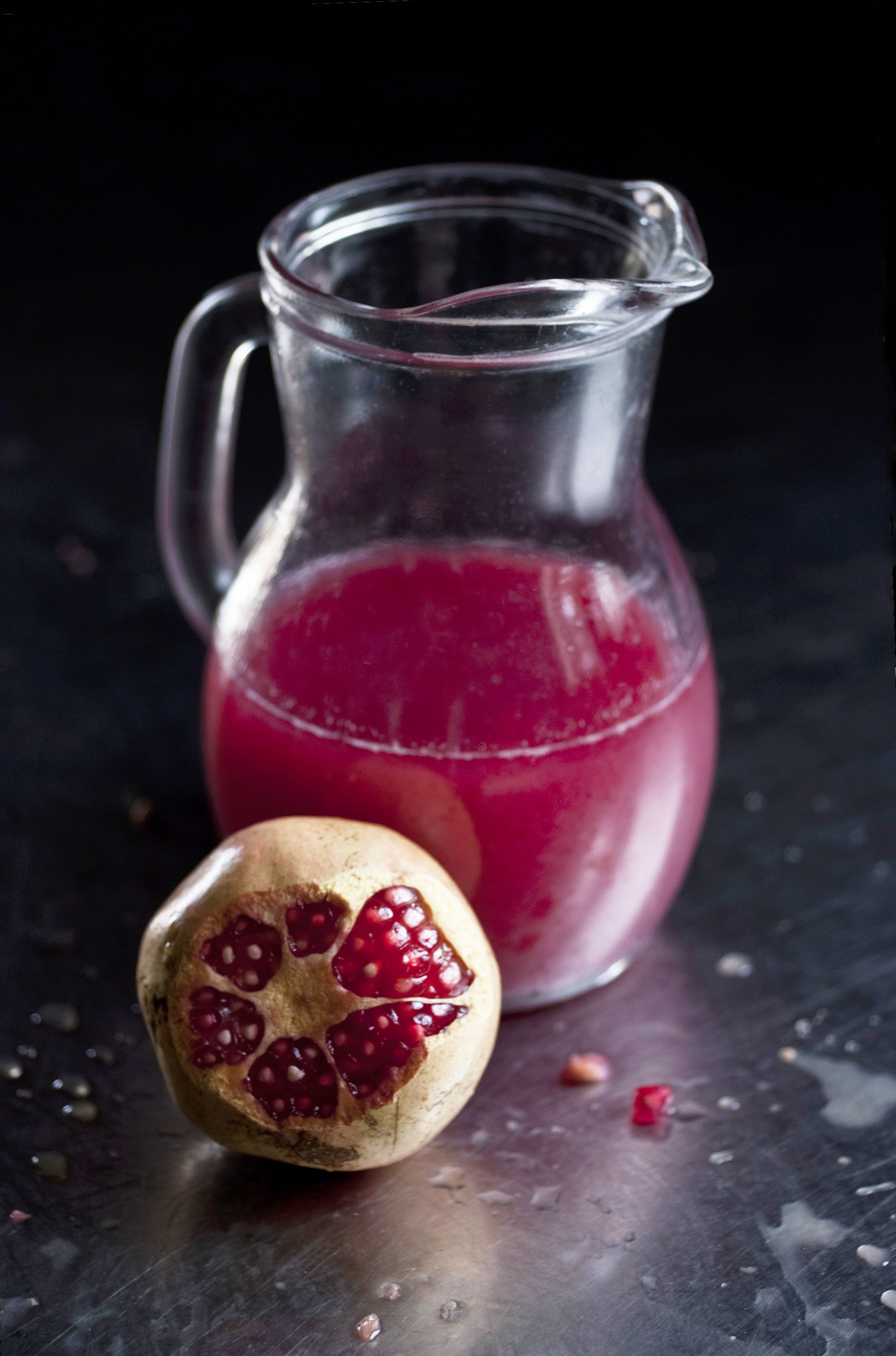
In mature fruit, the seeds can be pressed to get a tart flavoured juice high in polyphenols. Pomegranate juice has long been a common drink in West Asia and Europe, and is distributed worldwide. The taste of pomegranate
juice ranges from very acidic to very sweet.
Pomegranate juice is a good source of folate, potassium (K), and vitamin K, and it is extremely rich in antioxidants.
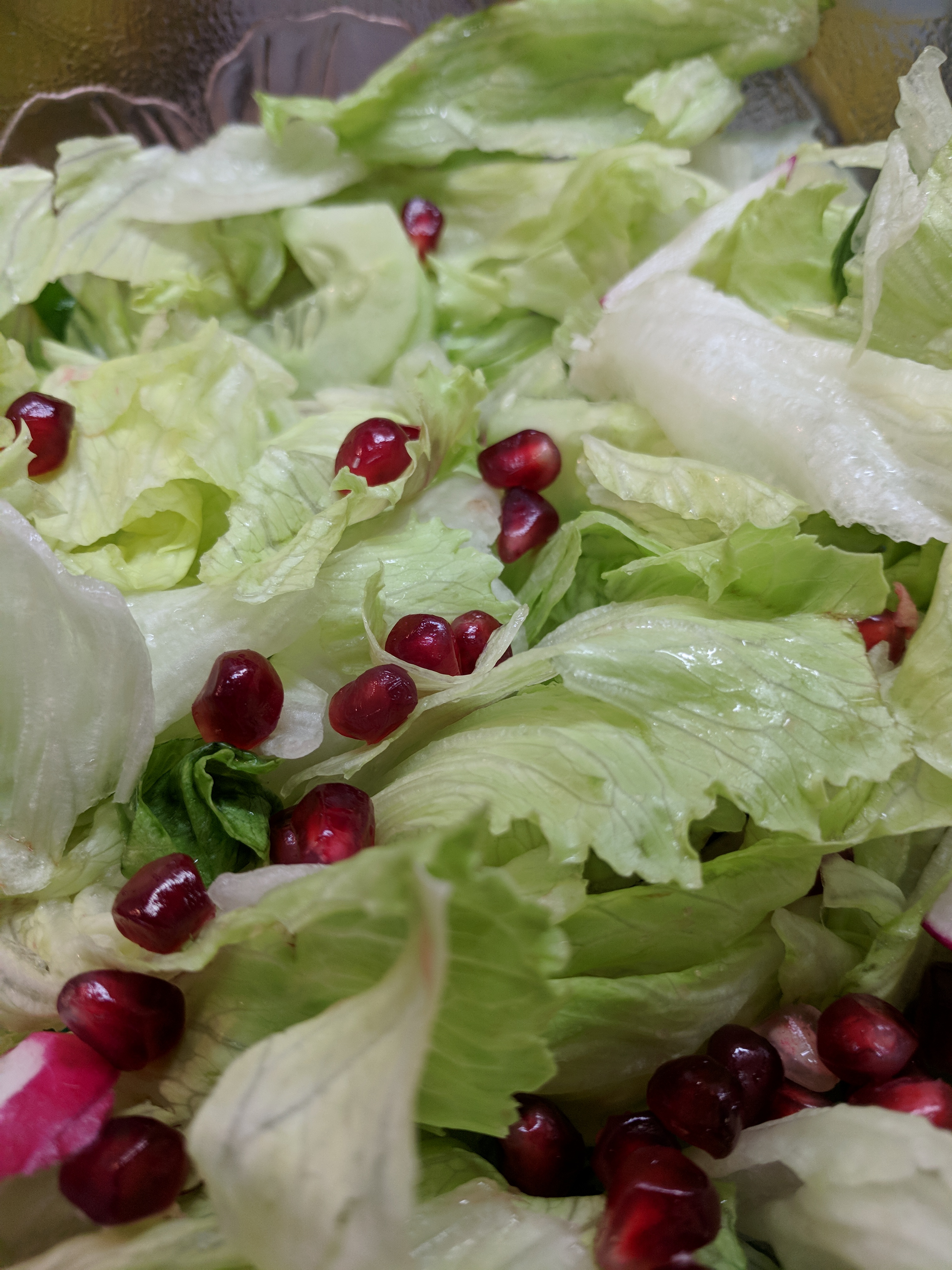
Pomegranate can be used in savory mains, fresh salads, and sweet desserts, using both the juicy arils and tangy molasses. These include dishes like sticky pomegranate chicken, Persian fesenjan (walnut and pomegranate stew), and grilled eggplant with pomegranate sauce. Salads frequently combine seeds with ingredients like feta, kale, avocado, or grains such as quinoa and farro for acidic contrast.
Cultivation:
Site, Soil and Light Conditions:
Pomegranate Punica prefers semi-arid to Mediterranean conditions with temperatures of 21C to 32C. The plant goes dormant below 10C.
It perform sbest on deep loamy soils, but will still grow quite well in sandy and clay soils.
Air circulation is important, especially in the spring during flowering. Flowers may not set or will abort if conditions are too humid so keep this in mind when selecting a site.
It grows very well in Sydney and in metropolitan Melbourne. because it is naturally adapted to regions with cool winters and hot summers.
The planting site should optimally offer around eight hours of full sun per day or at least 6 hours full sun in order to ensure good fruit colour and productivity.
It should have well drained soil with a pH of 5.5 – 7.0. Test and amend the soil. It is important that the soil be free draining. If the general soil is clay, planting on a raised bed at least 1.2m wide and 15 – 30cm in height will improve it. A water furrow can be added if additional drainage is needed.
In preparation for planting dig over the site to a depth of 30 cm and dig through well rotted manure and aged compost.
Planting and Training:
Plant trees in early spring avoiding late frost. Soil should be loosely worked and not wet. Dig a hole two to three times as wide as the root ball and the same depth, ensuring the top of the root ball sits level with or slightly above the surrounding soil.
Place the tree in the hole, ensuring the graft union (if visible) or root crown is at soil level. Backfill with soil, pressing gently to remove air pockets, and water in thoroughly.
Apply a 2-5cm layer of mulch around the tree, keeping it a few inches away from the trunk. Water deeply once a week during the first growing season to establish roots.
Initially, the Pomegranate plants can be trained by cutting back to 60-75 cm in height and after they branch out the lower branches are pruned to provide a clear main stem. As fruits are borne only at the tips of new growth, the branches can be shortened annually for the first 3 years to encourage the maximum number of new shoots on all sides, to achieve a strong, well-framed plant. After the 3rd year, only suckers and dead branches are removed.
Watering:
Though pomegranates are very drought tolerant, providing adequate soil moisture will improve plant vigour and fruit yield. Providing adequate water throughout drought periods will help minimize the amount of fruit splitting when the rain returns.
Thoroughly water the plants at planting and again 2 to 4 weeks after planting. Once the trees are established, water them about every 7 to 10 days.
As the plant matures reduce the amount of water delivered gradually in order to reduce splits and to enhance flavour and colour development.
The roots of the pomegranate tree do not tolerate long periods of standing water.
Drip irrigation is the preferred method as flowers are highly sensitive to humidity and moisture which may lead to fruit not setting.. Excessive soil moisture in the summer promotes an abundance of vegetative growth, but the fruit produced will tend to be softer, and lower quality.
Avoid excessive watering in autumn as it may contribute to fruit splitting. This splitting can lead to increase in spoling.
Fertilizing:
Like other fruit-bearing crops, pomegranate requires more Potash (K) than Nitrogen (N) especially
during fruit development stages at a ratio of 1:1.25.
Propagating Pomegranate
Propagating Pomegranate trees is best achieved through hardwood cuttings.
Take 15 – 30 cm cuttings from pencil-thick, one-year-old wood during the winter dormant period.
Using a sharp make a straight cut at the top and a 45-degree angled cut at the bottom the dip the lower end in rooting hormone.
Insert cuttings into propagating medium and keep moist in a warm, bright location
Roots will emerge in 4–8 weeks; transplant once significant root growth is visible.